
TL;DR
AI chatbots for lead qualification cut response times from hours to seconds, and data shows leads contacted within five minutes are 100x more likely to convert than those reached after 30 minutes. This guide compares 10 tools across text chat, voice AI, and omnichannel categories, with real pricing, honest tradeoffs, and actual user complaints. If you sell to phone-first populations or need vernacular language support (especially in BFSI), voice-first tools outperform text chatbots by a wide margin.
Why Lead Qualification Needs AI Right Now
Most sales teams lose deals before a conversation even starts. A prospect fills out a form, waits hours for a follow-up, and moves on. The numbers back this up: teams that respond within one minute see up to 391% higher conversions, while leads contacted after 30 minutes are nearly worthless by comparison.
An AI chatbot for lead qualification eliminates that gap entirely. Bots respond in seconds, ask qualifying questions around the clock, and route hot leads to human reps before interest fades. The cost difference is significant too. An AI chatbot interaction runs roughly $0.25 to $2.00, while a human support ticket costs $6 to $40, a 12x to 80x difference according to Elfsight and McKinsey data.
This isn’t a niche trend. Grand View Research valued the global chatbot market at $7.76 billion in 2024, projecting it to hit $27.29 billion by 2030. In financial services specifically, chatbot adoption is growing even faster, with the BFSI chatbot market expected to reach $19.1 billion by 2035 at a 27.75% CAGR.
Yet most guides on this topic only cover text-based website widgets. That misses a massive category: voice AI agents that qualify leads over phone calls, which matters enormously for industries like banking where customers prefer speaking to typing. This guide covers the full spectrum, including text chatbots, voice AI, and omnichannel tools, so you can pick the right fit regardless of channel.
For a deeper look at how AI is replacing traditional call center cost structures in India, that breakdown is worth reading alongside this comparison.
At-a-Glance Comparison Table
| Tool | Best For | Channel | Starting Price | Free Plan? | G2 Rating |
|---|---|---|---|---|---|
| Awaaz AI | BFSI voice + WhatsApp lead qualification (India/multilingual) | Voice, WhatsApp, SMS | Pay-per-use (credits/min) | No (demo available) | — |
| HubSpot Chatbot | SMBs wanting free CRM-integrated chat | Web chat | $0 (free plan) | Yes | 4.4/5 |
| Intercom (Fin) | SaaS support-led qualification | Web chat, email, WhatsApp | $29/seat/mo + $0.99/resolution | 14-day trial | 4.5/5 |
| Drift (Salesloft) | Enterprise B2B account-based marketing | Web chat | ~$2,500/mo | No | 4.4/5 |
| Tidio (Lyro) | E-commerce and small business | Web chat, Messenger, Shopify | $29/mo | 7-day trial | 4.7/5 |
| Landbot | No-code WhatsApp + web flows | Web chat, WhatsApp | $45/mo | Yes (100 chats) | 4.7/5 |
| Botpress | Developer teams with custom logic | Web chat, custom | $89/mo + AI spend | Yes (limited) | 4.7/5 |
| Respond.io | High-volume omnichannel chat | WhatsApp, Messenger, voice | Custom pricing | No | 4.8/5 |
| Qualified | Salesforce-native enterprise | Web chat | Custom (~$3,500+/mo) | No | 4.9/5 |
| Lindy | Multi-agent workflow automation | Chat, email, voice | $49.99/mo | Yes (40 tasks) | — |
How AI Chatbots Actually Qualify Leads
Before picking a tool, it helps to understand what “qualification” means in a chatbot context. Most sales teams use some version of BANT: Budget, Authority, Need, and Timeline. An AI chatbot for lead qualification maps these criteria into a conversation flow, whether that conversation happens over text or voice.
Budget: The bot asks about spending capacity or deal size. In BFSI, this might mean loan amount or monthly premium budget. The answer determines whether the lead fits your minimum thresholds.
Authority: The bot identifies whether the person is a decision-maker. For B2B, this means asking about role and team size. For consumer finance, it means verifying the applicant is the account holder.
Need: Pain-point discovery questions. A good chatbot doesn’t just ask “what do you need?” but uses branching logic to probe specific problems. Dashly’s client data shows that chatbot-driven qualification quizzes get 20% better results than static forms because they feel like conversations, not interrogations.
Timeline: Urgency scoring. “When are you looking to start?” or “When does your current contract expire?” feeds directly into lead scoring models.
The difference between text and voice qualification matters more than most guides acknowledge. Text chatbots work well for website visitors who are already browsing. Voice AI agents can proactively call leads, handle complex back-and-forth in real time, and work with populations that prefer talking over typing. A hybrid approach (voice for outbound qualification, WhatsApp for document follow-up, web chat for digital-first segments) is where the market is heading.
For a broader look at how these AI systems work in practice, the guide to conversational AI for contact centers covers the underlying technology in more detail.
The critical ingredient across all channels: human-in-the-loop escalation. 88% of banking chatbots include human escalation paths, according to CoinLaw research. For high-value deals or sensitive financial products, the bot qualifies and the human closes.
The 10 Best AI Chatbots for Lead Qualification
1. Awaaz AI
Best for: BFSI and multilingual voice-first lead qualification in India
Awaaz AI provides multilingual voice AI agents for customer support, sales, and service across phone calls, SMS, WhatsApp, and other messaging channels. It offers domain-specific agents for finance, health, commerce, and hospitality with CRM/CDP integrations and an in-house telephony stack.
Where most chatbots on this list are text-first website widgets, Awaaz AI is built for voice-first qualification. That distinction matters for banks, NBFCs, fintech companies, and microfinance institutions where borrowers in tier-2 and tier-3 cities prefer phone conversations and often code-switch between Hindi and English (or other regional languages) mid-sentence.
Key features:
- 24/7 AI agents across voice calls, SMS, and WhatsApp in a single platform
- Multilingual support across 8+ languages including vernacular and mixed-language conversations (e.g., Hinglish)
- Domain-specific BFSI agents for sourcing, KYC, credit eligibility screening, collections, and retention
- Low-latency conversations via an in-house telephony stack (no third-party CPaaS dependency)
- Over 95% ASR/NLU accuracy with human-in-the-loop safeguards
- CRM/CDP integrations with reporting that converts call data into structured, queryable insights
- Click-to-scale deployment for fast pilots and rollouts
Pricing: Pay-per-use model based on credits per minute of talk time. Four tiers available: Starter, Standard, Growth, and Scale. No free trial, but demos are available through the site.
Tradeoffs:
- Enterprise-sales-led motion, so limited public documentation and self-serve access
- Best fit for India/BFSI rather than global SaaS website chat use cases
- If you only need a simple web chat widget, this is more firepower than you need
Proof points: According to the company, Awaaz AI has served 3.8 million unique customers in the last year, with an 82% call engagement rate, 60% cost reduction, and 2x conversions. Client logos include Axis Bank, L&T Finance, Ujjivan, Fullerton India, Equitas, and others.
Why it stands out: This is the only tool on this list purpose-built for voice-first lead qualification in Indian vernacular languages with BFSI-specific workflows. Text chatbots struggle with low-literacy populations, code-switching behavior, and phone-first engagement patterns. Voice AI handles all three. For a deep dive into how voice technology applies specifically to financial services, the voice AI in banking guide covers ROI data and use cases.
2. HubSpot Chatbot

Best for: SMBs wanting free CRM-integrated lead capture
HubSpot’s chatbot builder lives inside its CRM, making it the path of least resistance for teams already using HubSpot for marketing and sales. The free tier gives you a rule-based bot that can capture lead information, book meetings, and route contacts to the right rep, all without adding another vendor.
Key features:
- Free bot builder with drag-and-drop logic
- Native meeting booking and lead routing within HubSpot CRM
- Rule-based conversation flows (if/then branching)
- Seamless contact record creation and property updates
- HubSpot ecosystem integrations (email, forms, workflows)
Pricing: Free plan available with HubSpot branding. Starter at approximately $20/seat/month. Professional tier at $500 to $800/month unlocks AI-powered conversational features.
Tradeoffs:
- Free plan slaps HubSpot branding on your widget and limits customization
- True AI capabilities (not just rule-based logic) require the Professional tier at $500+/month, a steep jump
- No voice capability whatsoever
- Limited for complex qualification logic that goes beyond simple branching
User sentiment: On G2 (4.4/5), users consistently praise the seamless CRM integration but complain about the jarring price increase from Starter to Professional. If you need anything beyond basic lead capture, be prepared for that jump.
3. Intercom (Fin AI Agent)
Best for: SaaS companies with support-led growth models
Intercom’s Fin AI agent resolves customer questions from your knowledge base and can qualify inbound leads through conversational flows. Its strength is combining support and sales qualification in a single platform, which works well for product-led SaaS businesses where support interactions naturally surface buying intent.
Key features:
- Fin AI agent answers from knowledge base content, reducing human workload
- Shared inbox for team collaboration on qualified leads
- Workflow automation for routing and tagging
- Multilingual text support
- $0.99 per AI resolution pricing model
Pricing: Essential at $29/seat/month. Advanced at $85/seat/month. Expert at $132/seat/month. Fin AI costs $0.99 per resolution on top of base plans.
Tradeoffs:
- Per-resolution pricing adds up fast at high volumes; a team handling 5,000 resolutions/month pays an extra $4,950
- Fin struggles with complex, nuanced questions and occasionally provides inaccurate responses, which is a common G2 complaint
- Primarily text-based, so voice qualification is not on the table
- Best for straightforward inquiries rather than complex BFSI qualification workflows
User sentiment: G2 rating of 4.5/5. Users love Fin for handling simple, repetitive queries but repeatedly flag inaccuracy on anything requiring nuanced understanding. One G2 reviewer noted that Fin “can struggle with complex, nuanced questions, occasionally providing inaccurate responses.”
4. Drift (Salesloft)
Best for: Enterprise B2B teams running account-based marketing
Now part of Salesloft, Drift pioneered the “conversational marketing” category. It identifies target accounts visiting your website, engages them with custom chatbots, and routes high-value prospects to sales reps in real time. If your average deal size is $50K+ and you’re running ABM playbooks, Drift was built for your workflow.
Key features:
- Custom chatbots triggered by account identity and firmographic data
- ABM account identification and personalized messaging
- Live chat with instant rep routing
- Meeting scheduling with calendar integration
- Conversational landing pages
- Deep Salesloft integration for pipeline management
Pricing: Premium starts at approximately $2,500/month billed annually. Advanced tier reportedly runs $4,000 to $6,000/month. Enterprise tier ranges from $6,000 to $10,000+/month. No free trial.
Tradeoffs:
- Extremely expensive, with annual commitment required and significant feature-gating between tiers
- G2 users report misaligned meeting bookings and routing issues that create friction
- Complex initial setup; one G2 reviewer described it as “frustrating to find the option to change” basic settings
- Salesloft bundle pressure means you may end up paying for more than you need
- No voice qualification capability
User sentiment: G2 rating of 4.4/5 from 1,255 reviews. Users love real-time website engagement but consistently complain about cost, routing bugs, and the learning curve. Practitioners on Reddit have questioned whether Drift’s pricing is justifiable when DIY solutions using GPT-4o mini can handle similar text-based qualification at a fraction of the cost.
5. Tidio (Lyro AI)
Best for: E-commerce stores and small businesses with product-heavy catalogs
Tidio combines live chat with Lyro, its AI chatbot that handles product questions, cart recovery, and basic lead capture. It integrates natively with Shopify and WooCommerce, making it the default pick for DTC brands that want to qualify purchase intent without complex setup.
Key features:
- Lyro AI responder trained on your product catalog and FAQ content
- Cart abandonment recovery flows
- Native Shopify and WooCommerce integrations
- Live chat fallback to human agents
- Visitor tracking and behavioral triggers
Pricing: Starting at $29/month. Lyro AI available as an add-on. 7-day trial available.
Tradeoffs:
- Limited utility outside e-commerce contexts
- No voice capability
- Not designed for complex B2B or BFSI qualification workflows
- AI capabilities are best for product questions, not deep BANT-style qualification
User sentiment: G2 rating of 4.7/5. Users praise the ease of setup and Shopify integration but note significant limitations when trying to use it for anything beyond straightforward e-commerce use cases.
6. Landbot
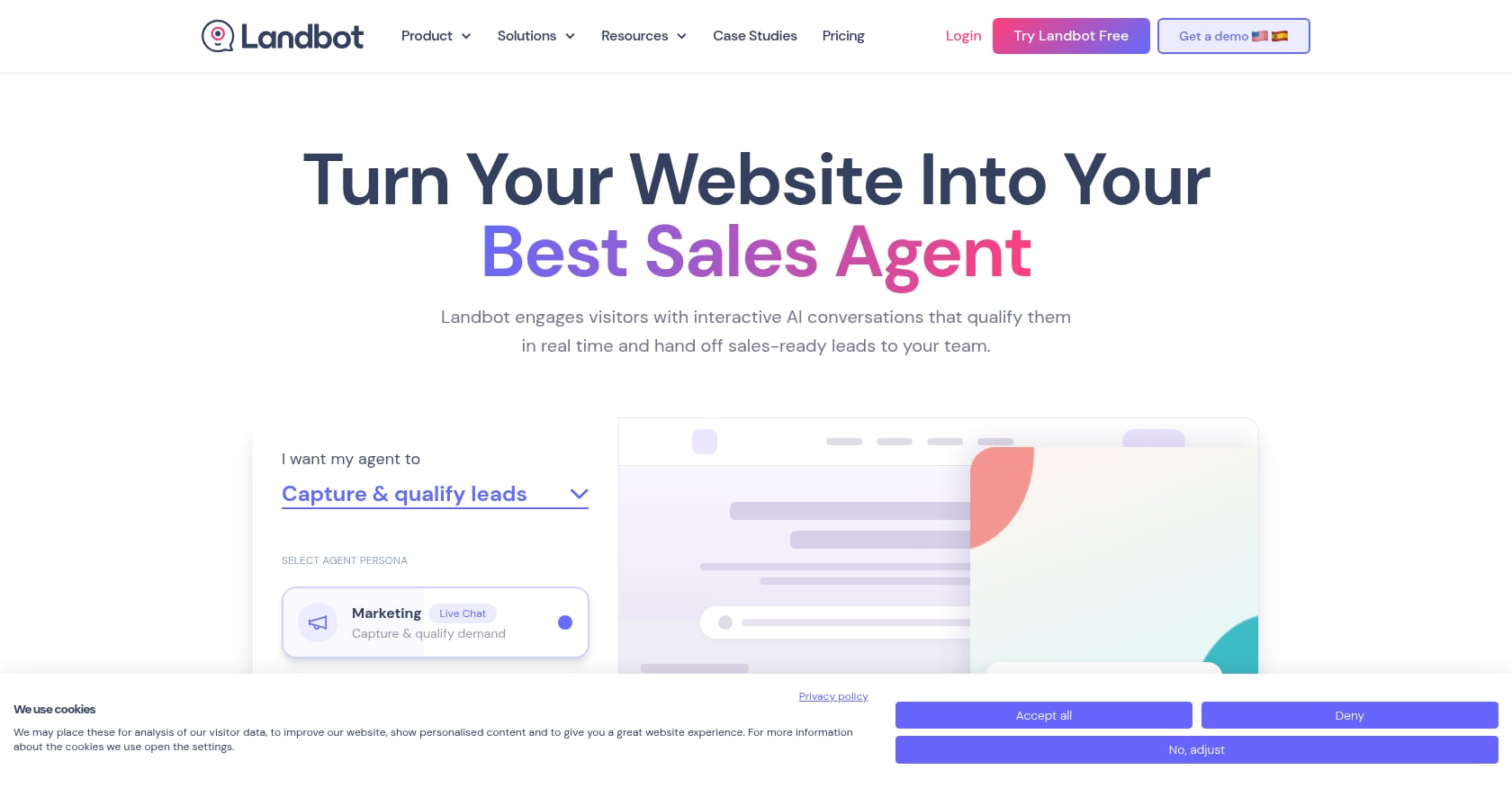
Best for: Marketing teams building no-code WhatsApp and web chat flows
Landbot’s visual, block-based builder lets non-technical teams create conversational flows for websites and WhatsApp without writing code. It’s popular with agencies and marketing teams that want branded, interactive qualification experiences with buttons, sliders, and media elements.
Key features:
- Drag-and-drop visual flow builder with UI components (buttons, carousels, sliders)
- WhatsApp Business API support for qualification flows
- Live chat handoff when leads meet criteria
- HubSpot and Salesforce integrations
- Conditional logic branching
Pricing: Free plan with 100 chats/month. Paid plans start at $45/month.
Tradeoffs:
- Limited AI flexibility for truly adaptive conversations; flows feel scripted when questions fall outside predefined paths
- Can become restrictive for complex qualification logic with many variables
- Primarily text-based, no voice support
- WhatsApp integration requires Business API setup
User sentiment: G2 rating of 4.7/5. Users praise the visual design experience but wish for deeper AI capabilities that could handle unexpected prospect responses more gracefully.
7. Botpress
Best for: Developer teams wanting full control over qualification logic
Botpress gives engineering teams a platform with built-in NLP, conversation memory, and code-level control. If your lead qualification requires custom scoring algorithms, API calls to external databases mid-conversation, or unusual branching logic, Botpress provides the flexibility that no-code tools can’t match.
Key features:
- Built-in NLP engine with intent recognition and entity extraction
- Persistent conversation memory across sessions
- Visual editor plus code editor for hybrid building
- Debugging and testing tools for conversation flows
- 30+ integrations including CRMs and databases
Pricing: Free plan with $5/month AI spend included. Paid plans from $89/month plus AI usage costs.
Tradeoffs:
- Requires engineering resources to build and maintain
- Steep learning curve for non-technical team members
- Overkill for simple qualification flows; unnecessary complexity if all you need is “name, email, budget”
- Documentation can be dense for first-time users
User sentiment: G2 rating of 4.7/5. Developers on forums and Reddit love the flexibility and the ability to inspect every layer of the bot’s logic. Non-technical users find it overwhelming.
8. Respond.io
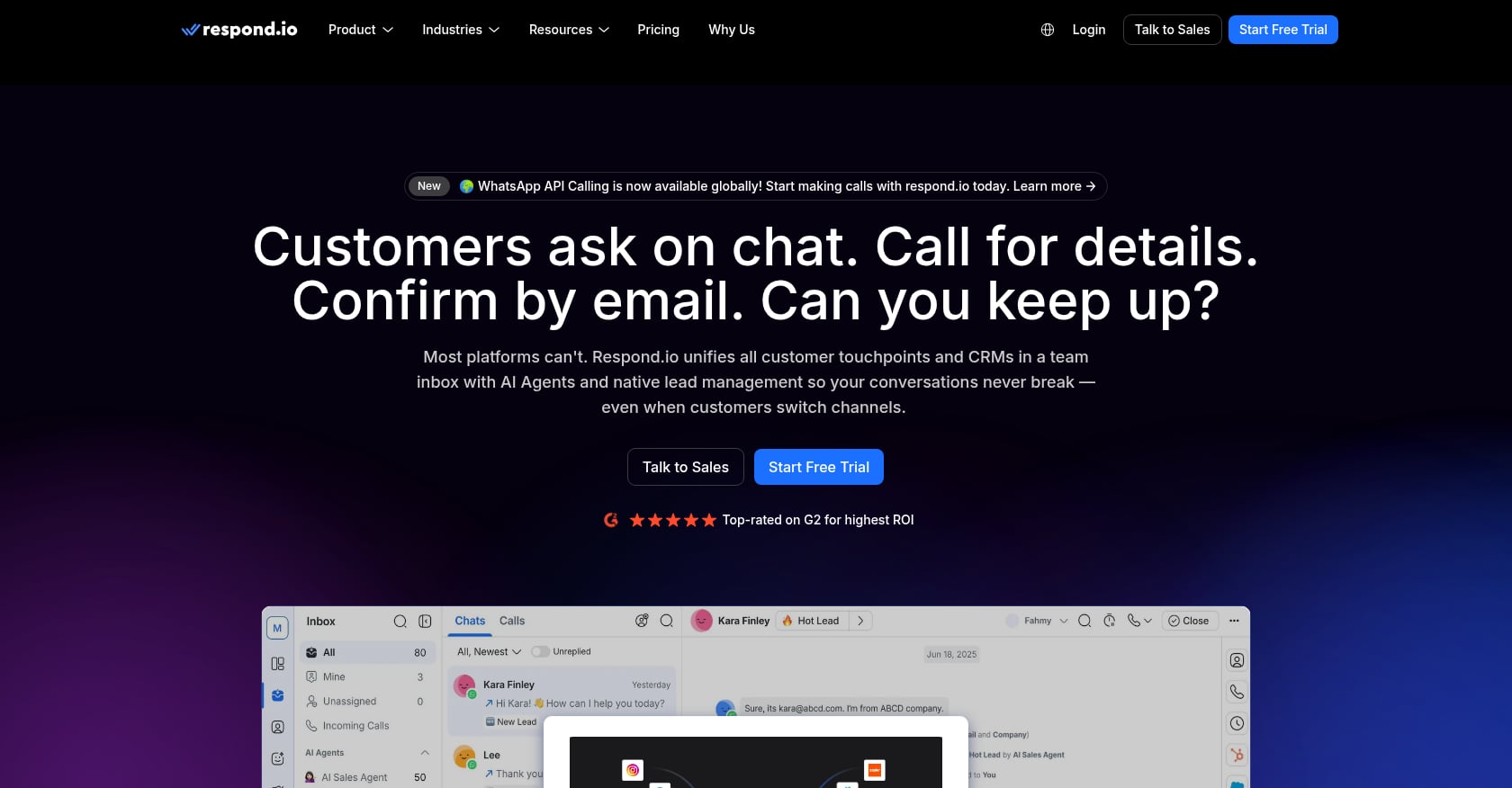
Best for: B2C businesses handling high inbound volume across multiple channels
Respond.io unifies conversations from WhatsApp, Messenger, Instagram, email, and even VoIP into a single inbox. Its workflow builder automates lead routing and qualification across channels, which makes it a strong pick for businesses with heavy inbound traffic spread across platforms.
Key features:
- Unified inbox aggregating WhatsApp, Messenger, Instagram, email, and VoIP
- Drag-and-drop workflow builder for automated qualification and routing
- AI agents for initial lead screening
- CRM integrations (HubSpot, Salesforce, Pipedrive)
- GDPR and ISO 27001 compliance
Pricing: Custom pricing (contact sales).
Tradeoffs:
- Advanced workflow configuration has a learning curve
- AI effectiveness depends heavily on the quality of training data you provide
- Custom pricing means you can’t evaluate cost before talking to sales
- Voice capabilities exist but are secondary to text channels
User sentiment: G2 rating of 4.8/5. Capterra 4.6/5. Users praise the unified inbox as a genuine time-saver but note that getting advanced workflows right takes iteration and patience.
9. Qualified
Best for: Salesforce-native enterprise teams
Qualified is built on the Salesforce platform, meaning every interaction syncs directly to Salesforce records in real time. For enterprise teams that live inside Salesforce and want their chatbot qualification data to flow seamlessly into existing pipeline management, nothing else matches this level of native integration.
Key features:
- Real-time visitor identification matched against Salesforce data
- Salesforce-native architecture (no middleware or sync delays)
- AI-powered routing based on account value and rep assignment
- Multi-brand support for enterprise portfolios
- Conversational engagement triggered by account signals
Pricing: Custom pricing, reportedly starting at $3,500+/month. Enterprise-only.
Tradeoffs:
- Completely dependent on Salesforce; useless without it
- Very expensive, even relative to other enterprise tools on this list
- Overkill for SMBs or teams not using Salesforce as their primary CRM
- No voice qualification capability
User sentiment: G2 rating of 4.9/5, though from a small sample of enterprise buyers. Those who use it are enthusiastic, but the high price and Salesforce dependency sharply limit the addressable audience.
10. Lindy
Best for: Teams wanting multi-agent workflow automation across channels
Lindy takes a different approach: instead of a single chatbot, you build multiple AI “agents” that handle different parts of your lead qualification and follow-up process. One agent qualifies via chat, another enriches CRM data, a third sends email sequences. It’s workflow automation with AI agents as building blocks.
Key features:
- Visual workflow builder for creating multi-agent systems
- Agents for chat, email, and voice lead capture
- CRM enrichment and 4,000+ integrations
- SOC 2 and HIPAA compliance
- Task-based free tier for testing
Pricing: Free plan with 40 tasks/month. Paid plans from $49.99/month.
Tradeoffs:
- Requires careful prompt tuning to get agents performing well
- Advanced multi-agent workflows can overwhelm first-time users
- Relatively new platform with limited G2 review history
- Voice capabilities are still maturing compared to dedicated voice platforms
User sentiment: Limited formal reviews due to newness. Early adopters on forums praise the flexibility of chaining agents together but note the setup investment required to get reliable results.
Voice AI vs. Text Chatbots for Lead Qualification: A Gap Nobody Talks About
Every tool from #2 through #10 on this list is primarily a text chatbot. That works perfectly when your leads are browsing your website or messaging you on WhatsApp. But it fails for a massive category of lead qualification: outbound.
Text chatbots wait for prospects to come to you. Voice AI agents call prospects proactively, have real-time conversations, handle objections, and book appointments or collect information, all without a human dialing a phone.
This distinction is particularly important for BFSI in India and other emerging markets. Phone penetration vastly exceeds smartphone app usage in tier-2 and tier-3 cities. Many borrowers are more comfortable speaking than typing. Code-switching (mixing Hindi and English mid-sentence, or switching between Tamil and English) is the norm, not the exception. Text chatbots built for English-first markets simply break in these contexts.
Practitioners on Reddit have been experimenting with DIY voice qualification bots using GPT-4o mini and ElevenLabs at roughly $0.05 per minute, questioning whether enterprise platforms justify their cost. The answer depends on scale and reliability. At a few hundred calls per day, DIY works. At millions of calls with regulatory requirements, you need purpose-built infrastructure.
The practical approach for most businesses is a hybrid: voice AI for outbound qualification calls, WhatsApp for document follow-up and nurturing, and web chat for prospects who prefer self-service. For organizations evaluating outbound calling specifically, this comparison of AI outbound calling bot platforms covers the voice-first category in depth.
For teams operating in multilingual markets, the guide on multilingual conversational AI explains how vernacular language support and code-switching actually work at a technical level.
How to Choose the Right AI Chatbot for Lead Qualification
With 10 options on the table, the decision comes down to five factors.
1. Where do your leads engage?
If leads come through your website, a text chatbot (HubSpot, Intercom, Drift) makes sense. If you’re reaching out to prospects via phone, voice AI (Awaaz AI) is the right tool. If leads come through WhatsApp, look at Landbot, Respond.io, or Awaaz AI. Many teams need more than one channel.
2. How complex is your qualification?
Simple form replacement (name, email, company size) works with Tidio or Landbot. BANT-style qualification with branching logic needs Intercom, Drift, or Botpress. BFSI-specific qualification (credit eligibility, KYC data collection, EMI follow-up) needs a domain-specific tool like Awaaz AI.
3. What CRM do you use?
HubSpot users should start with HubSpot’s built-in bot. Salesforce shops should look at Qualified or Drift. Teams needing CRM/CDP-agnostic integration have more flexibility with Awaaz AI, Respond.io, or Botpress.
4. What languages do your leads speak?
English-only audiences can use any tool on this list. Multilingual needs narrow the field considerably. Vernacular language support with code-switching (Hinglish, Tanglish, and similar mixes) requires specialized technology, and Awaaz AI is purpose-built for that.
5. What’s your budget?
Free: HubSpot. $29 to $89/month: Tidio, Landbot, Botpress, Lindy. $500+/month: Intercom (with AI features), Respond.io. Enterprise ($2,500+/month): Drift, Qualified, Awaaz AI.
For financial institutions specifically, the guide on improving customer experience in banking connects qualification workflows to broader CX strategy.
The Bottom Line
The AI chatbot for lead qualification market is splitting into three distinct categories: text chatbots for website engagement, voice AI for phone-based qualification, and omnichannel platforms that bridge both. Most businesses will eventually need a combination.
For SaaS companies and e-commerce brands with strong web traffic, text-first tools like HubSpot, Intercom, or Tidio deliver fast ROI with minimal setup. For enterprise B2B with large deal sizes, Drift and Qualified justify their premium pricing through ABM capabilities and deep CRM integration.
For BFSI organizations, fintech companies, and any business serving phone-first or multilingual populations, voice AI for lead qualification is not optional. It’s the primary channel. Awaaz AI fills a gap that no other tool on this list covers: voice-first, multilingual, domain-specific qualification built for Indian markets and scaled to millions of calls. If that matches your use case, book a demo with Awaaz AI to see how it maps to your specific qualification workflows.
Whichever direction you go, the data is unambiguous. Businesses using AI chatbots for lead qualification see 3x better conversion than those using forms, and every minute of delayed follow-up costs you qualified pipeline. The best time to automate qualification was last year. The second best time is now.
Frequently Asked Questions
What is an AI chatbot for lead qualification?
An AI chatbot for lead qualification is software that automatically engages prospects through text or voice conversations to determine whether they fit your ideal customer profile. It asks questions about budget, authority, need, and timeline (BANT criteria), scores responses, and routes qualified leads to human sales reps. This replaces or supplements the work traditionally done by SDRs and BDRs.
How do AI chatbots qualify leads compared to human SDRs?
AI chatbots respond instantly (sub-5-second response times versus hours for most human teams), work 24/7, and handle unlimited simultaneous conversations. They cost $0.25 to $2.00 per interaction compared to $6 to $40 for a human agent. The tradeoff is that humans handle ambiguity and emotional nuance better, which is why most effective setups use AI for initial qualification and humans for closing.
How much does a lead qualification chatbot cost?
Costs range dramatically. HubSpot offers a free bot with basic capabilities. Mid-tier tools like Tidio, Landbot, and Botpress run $29 to $89/month. Intercom starts at $29/seat/month but adds $0.99 per AI resolution. Enterprise platforms like Drift start at approximately $2,500/month, and Qualified reportedly starts above $3,500/month. Voice AI platforms like Awaaz AI use pay-per-use models based on minutes of talk time.
Can AI chatbots qualify leads over voice calls, not just text?
Yes, though most tools on the market are text-only. Voice AI platforms like Awaaz AI conduct qualification conversations over actual phone calls, handling outbound dialing, real-time conversation, and data capture. This is particularly important for industries like banking and financial services where phone calls remain the dominant customer engagement channel. For more on this category, explore automated outbound calling solutions.
Which AI chatbot is best for banking and BFSI lead qualification?
For BFSI, the requirements go beyond basic chatbot functionality. You need regulatory compliance awareness, domain-specific conversation flows (loan pre-qualification, credit eligibility, KYC data collection), multilingual support, and often voice capabilities. Awaaz AI is purpose-built for this vertical with domain-specific agents and vernacular language support. Qualified works for Salesforce-heavy financial services firms focused on web chat.
Do lead qualification chatbots integrate with HubSpot and Salesforce?
Most tools integrate with major CRMs. HubSpot’s chatbot is native to its CRM. Qualified is built on the Salesforce platform. Drift, Intercom, Landbot, Respond.io, and Botpress all offer HubSpot and Salesforce integrations through native connectors or APIs. Awaaz AI provides CRM/CDP integrations for syncing call data and qualification outcomes into existing systems.
What conversion improvements can I expect from using an AI chatbot for lead qualification?
Data from Dashly shows businesses using AI chatbots achieve 3x better conversion into sales compared to static website forms, and chatbot-driven qualification quizzes specifically outperform forms by 20%. Forrester research indicates enterprise chatbot deployments can deliver 210% ROI over three years. The biggest single factor is speed: leads contacted within five minutes are up to 100x more likely to be qualified than those contacted after 30 minutes.
Do I need a text chatbot, voice AI, or both?
It depends on where your leads engage. If most prospects find you through your website, start with a text chatbot. If you’re doing outbound prospecting or serving phone-first populations, voice AI is essential. Many organizations are moving toward omnichannel setups that combine voice calls for initial outbound qualification, WhatsApp for document collection and follow-up, and web chat for inbound digital visitors. The guide on AI voice solutions for Indian call centers covers the voice side of this equation.