
TL;DR
AI agents for customer service have gone mainstream, with Salesforce reporting 66% of service organizations now using them. But the best agent for a Shopify store is not the best agent for an NBFC collections team, and the best chat platform is not the right fit for Hindi-English phone support. This guide compares 11 AI customer service agents by use case, pricing model, and production readiness, with honest tradeoffs and practitioner feedback for each.
Why the Wrong AI Agent Is Expensive
The pressure is real. Gartner found that 91% of service leaders are under pressure to implement AI in 2026. Salesforce reported that AI agent adoption in service organizations jumped from 39% to 66% in one year.
Every vendor is pitching some version of “autonomous AI that resolves tickets.” But there is a less-cited Gartner prediction worth knowing: generative-AI cost per resolution for customer service may exceed offshore costs by 2030. Full automation, Gartner warns, “will be prohibitively expensive for most organizations.”
The takeaway is not that AI agents are a bad investment. It is that buying the wrong kind of agent, one mismatched to your channel, language, compliance environment, or cost model, creates exactly the expense the research warns about. The right question is not “Which AI agent is best?” It is “Which agent fits my support channel, language reality, workflow depth, and pricing model?”
If your customer service runs on phone calls in Indian languages, explore Awaaz AI to see voice-first agents built for that environment.
What Are AI Agents for Customer Service?
An AI agent for customer service is software that can understand a customer request, retrieve or reason over relevant knowledge, take actions in business systems, and escalate to a human when needed. Gartner Peer Insights describes this category as a shift from earlier automation to GenAI-powered systems that act with autonomy to fulfill support outcomes.
The distinction from traditional chatbots matters:
- Chatbot: Answers questions or routes tickets based on predefined flows.
- AI agent: Understands context, reasons through multi-step workflows, executes actions (refunds, account updates, KYC follow-ups, payment logging), and decides when to escalate.
- Voice AI agent: Does all of the above over phone calls, which adds requirements for speech recognition, text-to-speech, telephony infrastructure, latency control, barge-in handling, and call analytics.
For a deeper look at how these systems function, see this guide on how AI call centers work.
Best AI Agents for Customer Service: Quick Comparison
| Tool | Best for | Primary channels | Pricing model | Main strength | Key tradeoff |
|---|---|---|---|---|---|
| Awaaz AI | Indian BFSI voice, collections, KYC | Phone, SMS, WhatsApp | Per-minute talk time credits | India-native multilingual voice, finance workflows | Limited public pricing and reviews |
| Intercom Fin | SaaS and digital-first teams | Chat, email, messaging | $0.99/outcome + seat costs | Fast deployment, strong AI out of box | Costs can scale unpredictably |
| Zendesk AI Agents | Existing Zendesk enterprises | Messaging, email, voice | Plans + add-ons, outcome-based | Deep helpdesk ecosystem with QA | Can feel heavy and expensive |
| Salesforce Agentforce | Salesforce-committed enterprises | Service Cloud channels | $2/conversation, Flex Credits | CRM-native AI actions | Requires clean data and implementation discipline |
| Freshdesk Freddy AI | Budget-conscious SMBs | Freshdesk, Freshchat | $55-89/agent/month + sessions | Affordable helpdesk + AI bundle | Weak on multi-step workflows |
| Gorgias AI Agent | Shopify ecommerce | Helpdesk, chat | $0.90/resolved interaction | Shopify-native order actions | Struggles with complex support |
| Ada | Enterprise no-code automation | Web, email, SMS, WhatsApp | Conversation-based (custom) | Workflow execution without code | Pricing not transparent |
| Yellow.ai | Omnichannel enterprise | Chat, voice, email, SMS | Free tier, then $0.99/resolution | Broad channels and governance | Enterprise implementation complexity |
| PolyAI | Enterprise voice contact centers | Voice-first | Quote-based | Natural voice quality | Opaque pricing, less self-serve |
| Cognigy | Large contact-center orchestration | Voice, chat, 30+ channels | Custom enterprise | Complex workflow orchestration | Enterprise complexity and cost |
| Retell AI | Developer-led voice apps | Phone, API-driven voice | Usage-based per minute | Programmable voice infrastructure | Requires engineering resources |
11 Best AI Agents for Customer Service in 2026
1. Awaaz AI
Best for: Indian BFSI teams needing multilingual voice AI for collections, KYC, EMI reminders, and customer support over phone, WhatsApp, and SMS.
Pricing: Pay-per-use credits per minute of talk time across four tiers: Starter, Standard, Growth, and Scale. Specific pricing is available through demo consultation.
Key features:
- Voice-first AI agents across phone calls, SMS, WhatsApp, and messaging channels
- Support for 8+ languages including Hinglish and other vernacular mixes
- Domain-specific agents for sourcing, KYC, credit eligibility, collections, and retention
- In-house telephony stack for low-latency conversations
- CRM/CDP integrations and structured call analytics
- Human-in-the-loop escalation and enterprise-grade security
- Finance-first NLU with vocabulary tuned for EMI, NACH, mandate, settlement, and similar terms
Tradeoffs:
- Public pricing is not listed on the website; buyers need to request a demo
- Independent third-party review volume is limited
- Less self-serve documentation compared to developer-first voice platforms
User perspective: Public discussion about Awaaz AI is sparse but telling. On Reddit, a self-identified developer posted about offering AI voice agents to small businesses, which prompted practical questions about API availability and Indian language coverage. The developer confirmed support for 6+ Indian languages. These are informal community signals, not formal reviews.
For Indian BFSI teams, the buying criteria go beyond generic “AI support.” You need vernacular comprehension, compliant outbound calling, borrower-sensitive conversation design, and CRM writeback. That is where a domain-specific NLU approach outperforms a generic global chatbot.
2. Intercom Fin
Best for: SaaS and digital-first support teams that want fast AI deployment with outcome-based billing.
Pricing: $0.99 per outcome (a successfully resolved customer question). Seat and usage components apply when Fin runs inside Intercom. When used with an existing helpdesk like Salesforce or Zendesk, Intercom says there are no seat or platform fees, though minimum commitments apply. Optional Pro add-on at $99/month includes analysis of 1,000 conversations.
Key features:
- AI agent trained on help center content, docs, and conversation history
- Outcome-based billing tied to successful resolutions
- Multichannel support including chat, email, and messaging
- Workflow and procedure support
- Low setup barrier compared to heavily managed enterprise tools
Tradeoffs:
- Costs can surprise finance teams as volume grows
- Fin does not learn from human follow-up messages after escalation
- Vague help center articles produce vague AI answers
- Escalation behavior can feel unpredictable without careful rule configuration
User perspective: On Reddit, a customer-success professional said Fin is “super helpful” for a one-person CS team handling after-hours coverage and product questions clearly answered in docs. But they raised concerns about unpredictable cost and occasional “rogue” behavior around escalation. Another user who tested Fin alongside other tools said it is “very good out of the box” but warned that it is expensive and that knowledge quality drives everything.
3. Zendesk AI Agents
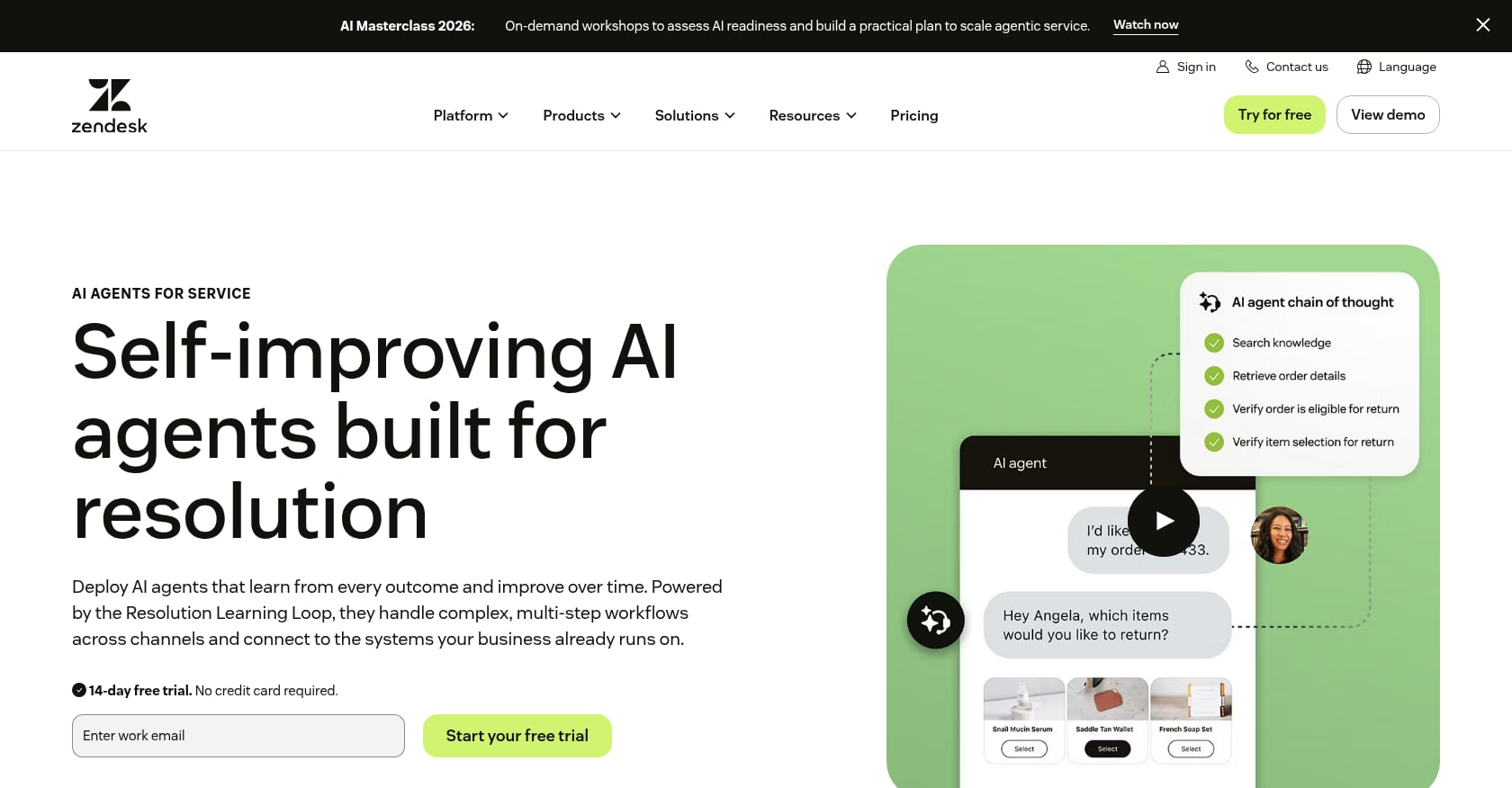
Best for: Existing Zendesk teams and enterprise support operations needing AI agents integrated into their established helpdesk.
Pricing: Zendesk plans with add-ons. Copilot at $50/agent/month (billed annually). AI agents use outcome-based pricing. Zendesk supports 80+ languages and announced in May 2026 that its voice AI agents support 60+ languages with mid-conversation switching.
Key features:
- AI agents across messaging, email, voice, and external platforms
- Knowledge grounding and workflow reasoning
- System actions and built-in QA with self-improvement loops
- Enterprise routing, reporting, and governance
Tradeoffs:
- Can feel expensive and heavy for small or mid-size teams
- Customer-facing AI features sometimes feel bolted onto the legacy helpdesk
- Advanced AI requires add-ons and careful configuration
- Voice AI performance should be tested for regional languages before committing
User perspective: A Reddit user who tested multiple platforms described Zendesk AI as useful for summarizing tickets and suggesting macros, but found the customer-facing agent experience clunky compared to AI-native tools. Another thread noted Zendesk works well for structured, high-volume requests like password resets and order status. That is fair positioning: strong for routine work, less convincing for complex edge cases without design effort.
4. Salesforce Agentforce
Best for: Enterprises deeply committed to the Salesforce ecosystem that want AI customer service agents operating directly against CRM data.
Pricing: Multiple options: $2/conversation, Flex Credits at $500 per 100k credits, Agentforce User License at $5/user/month, Flat Fee Access at $125/user/month, and Help Agent Resolutions at $2.
Key features:
- Agentforce Builder for creating customer-facing and employee-facing agents
- Agentforce Voice for phone support
- CRM actions: answering questions, updating records, troubleshooting
- Deep integration with Salesforce Service Cloud data
Tradeoffs:
- Not useful outside the Salesforce ecosystem
- Pricing model is complex and hard to forecast
- Results depend heavily on data cleanliness
- Demo performance does not always predict production results
User perspective: G2 reviewers say teams can configure a first customer service agent in hours, but warn that pricing concerns grow with usage. A Salesforce subreddit discussion adds a critical detail most listicles miss: if teams do not explicitly pass the case summary, customer sentiment, and what the AI already tried to the human rep, the agent just receives a raw transcript and wastes time re-reading context. This handoff design gap is worth asking about during evaluation.
For teams that need AI agents writing structured data back into CRM and banking systems, see this guide on voice AI with CRM.
5. Freshdesk Freddy AI
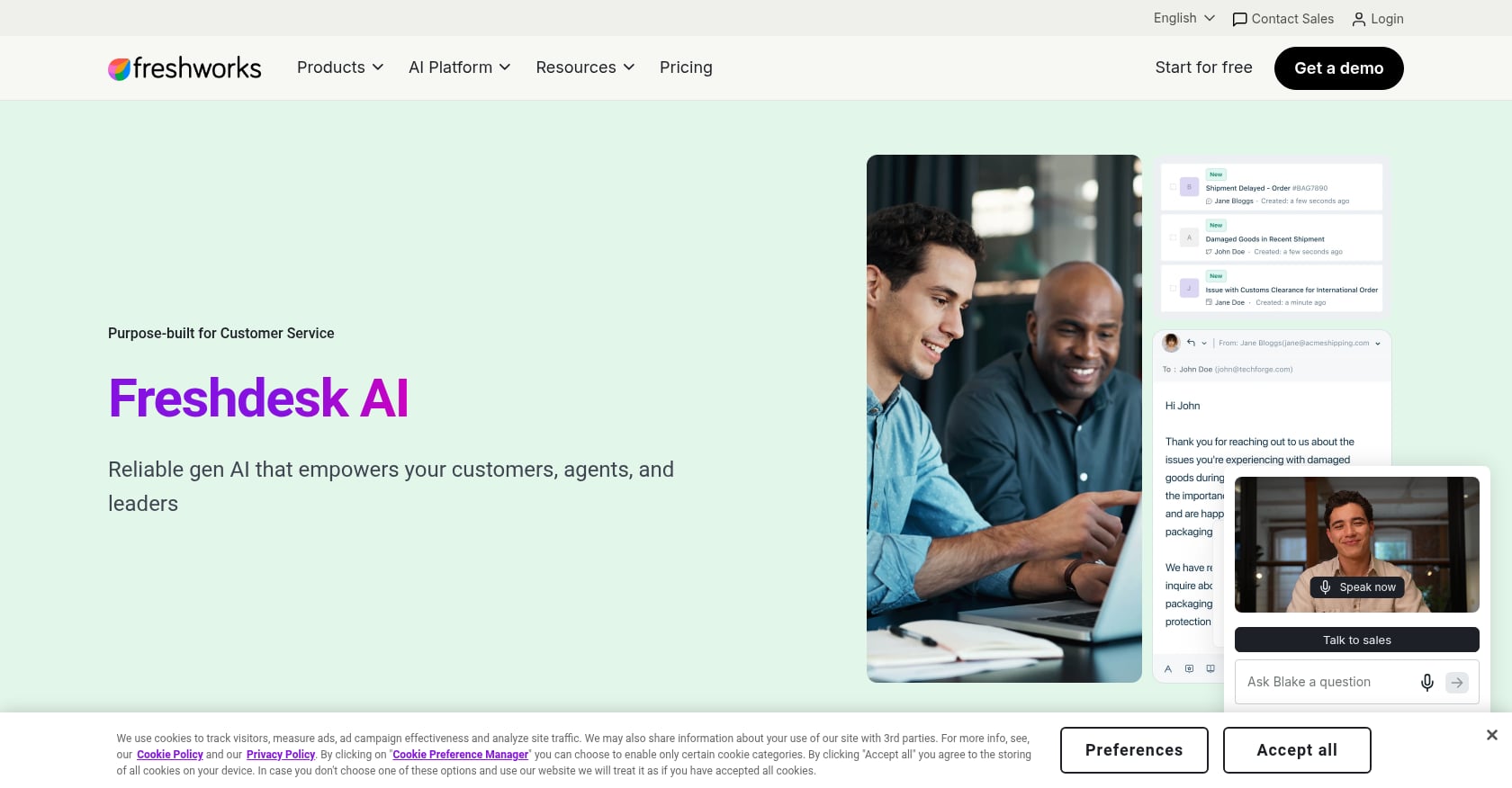
Best for: Budget-conscious SMBs already using Freshworks who want basic AI support without enterprise pricing.
Pricing: Growth at $55/agent/month (billed annually), Pro at $89/agent/month. First 500 Freddy AI Agent sessions included. Additional sessions at $49/100. Freddy AI Copilot add-on at $29/agent/month on Pro and Enterprise tiers.
Key features:
- Ticketing and shared inbox with knowledge base
- AI agent sessions included in paid plans
- AI copilot add-on for agent assistance
- Multilingual helpdesk on Pro tier
- Routing, analytics, and audit logs on higher tiers
Tradeoffs:
- AI layer works for simple deflection but struggles with multi-step workflows
- Session-based pricing is weakly tied to business outcomes
- Voice AI is not a core strength
- Getting full value often requires deeper commitment to the Freshworks ecosystem
User perspective: A Reddit user comparing Intercom Fin, Freshworks Freddy, and other options said Freddy made sense on paper because CRM and helpdesk live in one ecosystem, but in practice the AI was “fine for deflecting simple stuff” and “shaky on anything multi-step.” Another thread described Freshdesk as more affordable than Zendesk or Intercom but less polished overall.
6. Gorgias AI Agent
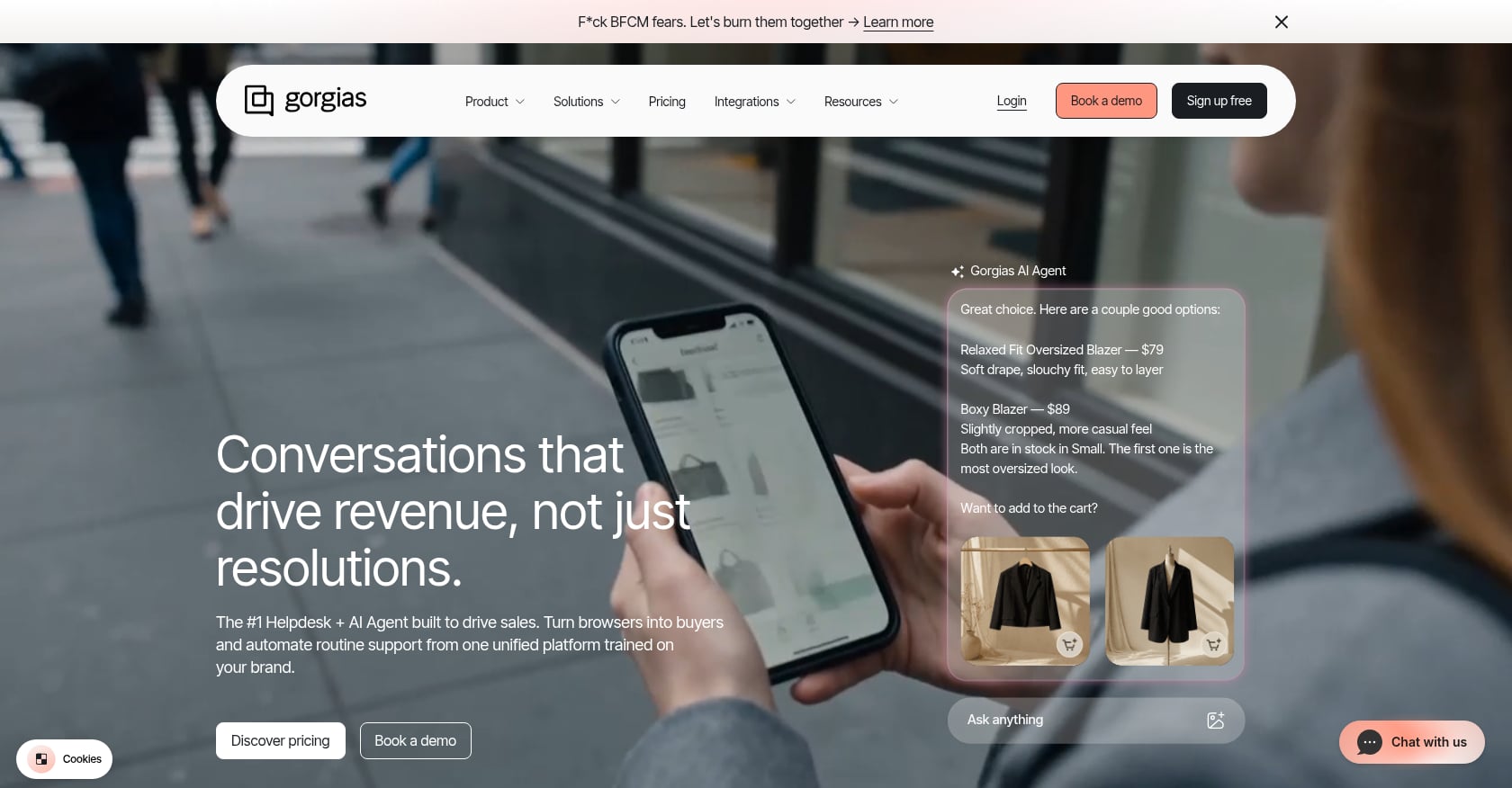
Best for: Shopify merchants needing an AI agent that understands ecommerce workflows like order status, returns, and subscription changes.
Pricing: AI Agent is an add-on. Most plans charge $0.90 per resolved interaction. Starter begins at $1 per resolved conversation. Buyers only pay when AI handles a conversation from start to finish without human involvement. Overages vary by plan and billing cycle.
Key features:
- Trains on Shopify data, store website, help center articles, and custom guidance
- Actions like canceling orders, processing returns, and modifying subscriptions
- Tone-of-voice controls
- Multilanguage detection and reply
- Image-based ticket support for damaged items
Tradeoffs:
- Struggles with complex technical support and warranty claims
- AI resolution fees add another layer to helpdesk costs
- Setup and training effort drives quality
- Not suited for non-ecommerce support environments
User perspective: A Reddit ecommerce user said they use Gorgias but “haven’t had a great experience” with the AI for technical troubleshooting. Basic questions like order status work, but more complex tickets produce errors. Another merchant thread focused on understanding whether Gorgias charges only when AI fully resolves a ticket, showing that pricing mechanics remain a live concern.
7. Ada
Best for: Enterprise teams that want no-code AI support automation with workflow execution across multiple backend systems.
Pricing: Conversation-based pricing. Customers pay for every conversation the AI agent has. Exact public dollar pricing is not listed. Custom quotes for enterprise deployments.
Key features:
- AI agent that can authenticate customers, check account status, execute workflows, update systems, and confirm outcomes in a single conversation
- No-code deployment
- Multi-system workflow support
- Multi-channel coverage including web, email, SMS, and WhatsApp
Tradeoffs:
- Public pricing is not transparent
- Conversation-based billing means unresolved conversations may still be charged
- Language, voice, and channel support should be validated for your specific use case
- G2 reviewers note integration issues and feature limitations alongside ease of use
User perspective: G2 review data shows common pros including ease of setup and feature quality, while common cons include usability issues and integration limitations. Enterprise buyers should request detailed demos of their specific workflows rather than relying on general product walkthroughs.
8. Yellow.ai
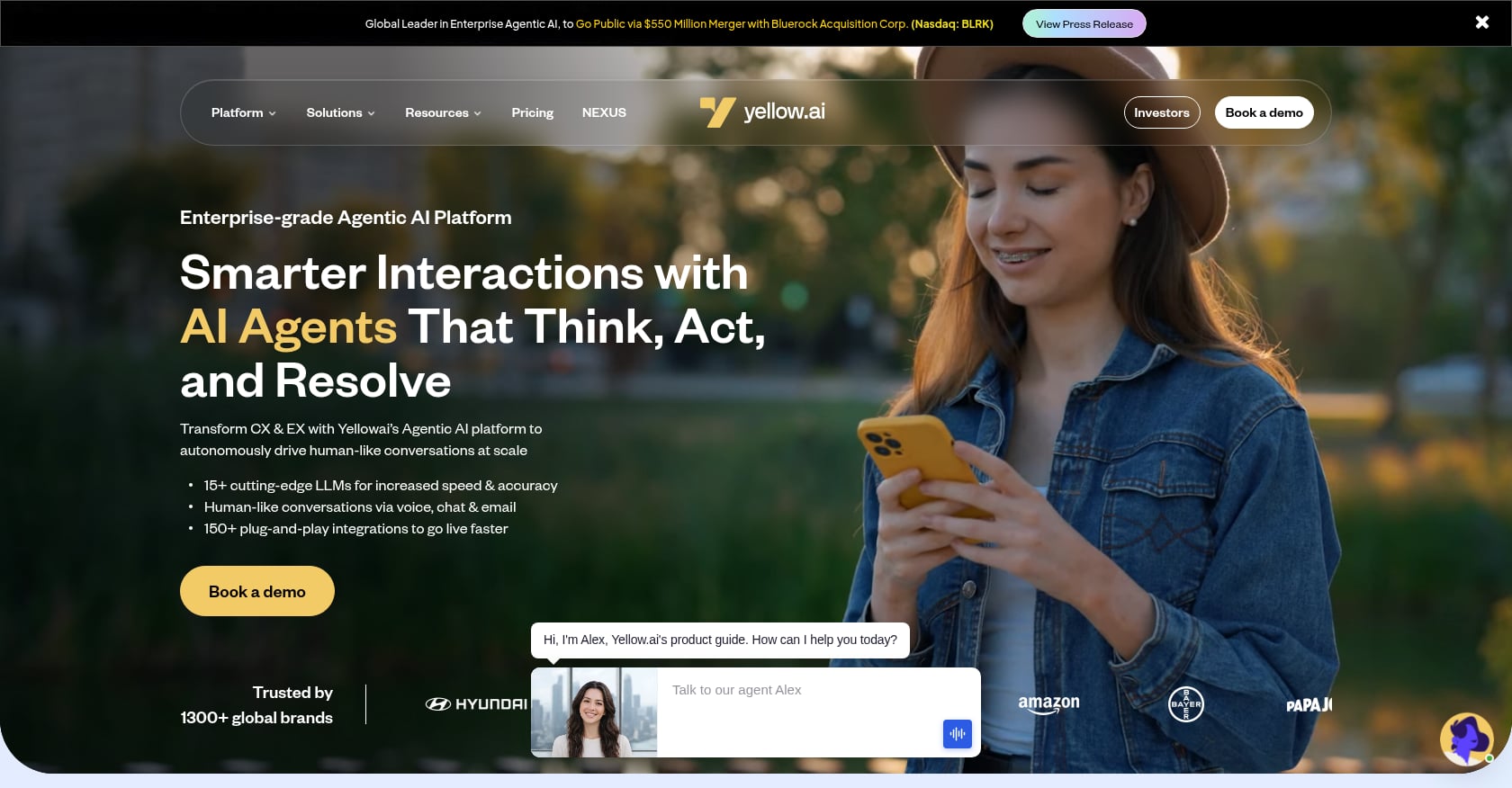
Best for: Large enterprises needing omnichannel AI customer support automation across voice, chat, email, and SMS with governance and compliance controls.
Pricing: Free plan includes 1 AI agent and 500 conversations/month, then $0.99 per resolution. Enterprise tier includes unlimited AI agents, all channels, 150+ integrations, and SOC2/GDPR/ISO compliance. Enterprise pricing requires contacting the company.
Key features:
- Chat, voice, email, and SMS in one platform
- VoiceX natural voice AI
- Intelligent email agents
- 150+ out-of-box integrations
- Role-based access and compliance controls
- AI copilot for testing and optimization
Tradeoffs:
- Enterprise implementation can be lengthy
- Total cost depends heavily on channels, use cases, and volume
- Language support should be evaluated by channel, not just by total count
- For India BFSI voice workflows, compare collections and KYC depth against specialized tools
User perspective: Yellow.ai’s pricing page features vendor-hosted customer quotes. Waste Connections reports automating routine queries and saving millions with an after-hours voice AI deployment. Gartner Peer Insights lists Yellow.ai in both conversational AI and AI agents for customer service categories, supporting its enterprise relevance. Treat vendor-curated testimonials as directional, not independent validation.
9. PolyAI
Best for: Enterprise voice-first contact centers that prioritize natural-sounding conversations and high call containment.
Pricing: Quote-based. PolyAI describes its pricing as transparent, but specific public prices are not available. Expect a sales-led buying process.
Key features:
- Voice-first AI agents designed for enterprise contact centers
- Natural conversation quality
- High call containment rates
- Web and app chat support alongside voice
Tradeoffs:
- Pricing is not self-serve or publicly listed
- Implementation may be slower than API-first alternatives
- Less suitable for small-budget pilots
- Data residency and deployment model need review for regulated industries
User perspective: A Capterra reviewer said PolyAI exceeded expectations and handled over 80% of simple transaction calls on day one without a human agent. On Reddit, a hospitality team running multilingual support said PolyAI had the best voice naturalness among tested options but raised concerns about cloud-only deployment and data sovereignty for German properties.
10. Cognigy
Best for: Large contact centers needing orchestration across voice, chat, and 30+ channels with enterprise-grade integrations.
Pricing: Custom enterprise pricing. Not publicly listed.
Key features:
- AI agents across voice and chat
- Pre-connected with 30+ channels including certified contact-center integrations
- 100+ language support
- Complex workflow orchestration
- Named a Leader in the 2026 Forrester Wave for Conversational AI Platforms (per vendor claim)
Tradeoffs:
- Enterprise complexity requires dedicated implementation resources
- Custom pricing makes comparison difficult
- Not ideal for fast, lightweight pilots
- Best suited for organizations with mature technology operations
User perspective: Practitioners on Reddit discussing enterprise AI agent platforms consistently emphasize that buyers should focus less on “best chatbot” and more on a platform that can orchestrate the whole customer journey: AI agents, agent assist, routing, conversation intelligence, and QA. That perspective favors Cognigy’s positioning but also underscores the implementation investment required.
11. Retell AI
Best for: Engineering teams building custom voice AI applications who want API-level control over call logic and workflows.
Pricing: Usage-based. Retell’s own comparison content describes pricing around $0.07-0.08/minute for core AI voice, approximately $0.015/minute for telephony, and around $2/month for phone numbers. Verify current pricing before committing.
Key features:
- Real-time outbound and inbound phone calls
- Programmable call logic through APIs and configuration tools
- Backend and CRM integrations via webhooks and APIs
- Batch outbound calling with concurrency controls
Tradeoffs:
- Requires engineering resources for setup and maintenance
- Not a full omnichannel customer service suite
- Voice economics must include AI, telephony, model, and phone-number costs
- Less appropriate for non-technical support teams
User perspective: A Reddit user who built a customer support follow-up system after testing Vapi, Synthflow, Bland, and Retell said Retell was the first one that felt “production-ready.” But the same post noted the usual voice-agent cracks: latency, robotic tone, dropped conversations, and derailment when customers interrupt. Production readiness takes more than a clean demo.
How to Choose the Right AI Customer Service Agent
Picking the right platform comes down to six questions.
1. What is your dominant support channel?
Phone-heavy operations need Awaaz AI, PolyAI, Yellow.ai, or Retell. Chat and email teams should look at Intercom Fin, Zendesk, Ada, or Freshdesk. Shopify stores belong on Gorgias. Salesforce shops should start with Agentforce.
2. Does the agent need to take action, or only answer?
There is a big difference between answering “What is my balance?” and actually processing a refund, logging a promise-to-pay, triggering a KYC follow-up, or updating a loan management system. If your workflows require backend actions, evaluate integration depth, not just conversational quality.
3. What pricing unit matches your economics?
Per-outcome pricing rewards resolution but definitions vary. Per-conversation charges whether resolved or not. Per-minute works for voice but must include telephony and model costs. Seat-based add-ons punish large teams. The cheapest-looking option is not always cheapest at scale.
4. Can it handle your customers’ language in production?
Do not accept “supports Hindi” as proof. Test noisy calls, rural accents, Hinglish, English financial terms embedded in Hindi sentences, and domain vocabulary like EMI, NACH, foreclosure, and settlement. For more on this challenge, read about code-switching voice AI and why it matters for Indian markets.
5. How does the handoff work?
A good handoff passes the escalation reason, a summary of what the AI tried, customer sentiment, the full transcript, and next-best action to the human agent. Most handoffs in practice pass almost nothing. Practitioners on LinkedIn repeatedly say handoff is where AI support breaks down. One practitioner notes that handoff decisions depend on urgency, emotion, and customer trust, not just whether the AI “knows” the answer.
6. What compliance rules apply?
For Indian BFSI, this is not optional. RBI guidance restricts recovery calls to between 8:00 a.m. and 7:00 p.m. and prohibits intimidation or harassment. TRAI’s DND framework governs unsolicited commercial communications. India’s DPDP Act requires consent notices in clear language with options in English or any Eighth Schedule language. For teams deploying AI agents in debt collection workflows, understanding these rules is table stakes.
AI Customer Service Agent Pricing Models Explained
Pricing confusion is one of the biggest pain points buyers report. Here is how the major models work and what to watch for.
| Pricing model | How it works | What to watch |
|---|---|---|
| Per outcome / resolution | Pay when the AI resolves a defined outcome | Definitions vary. Ask what counts as “resolved.” |
| Per conversation | Pay for every conversation regardless of outcome | Predictable volume math, but you pay for failures too. |
| Per session | Pay per session regardless of resolution | Cheap-looking but weakly tied to value. |
| Per minute | Common in voice AI | Must include telephony, TTS, STT, LLM, and phone costs. |
| Per seat + AI add-on | Traditional helpdesk plus AI features | Expensive for large teams before usage even starts. |
| Custom enterprise | Quote-based | Good for large deployments but opaque and hard to compare. |
Practitioners on Reddit discussing Intercom Fin and Gorgias repeatedly mention cost unpredictability as a top concern. One customer-success professional said finance teams get nervous when AI costs scale with volume in ways that are hard to cap. The lesson: model your expected ticket or call volume at 3x before signing anything.
Why Voice AI Agents Need Different Evaluation in India
Most global AI customer service agent comparisons focus on chat and email. That leaves a gap for markets where phone calls dominate, customers speak multiple languages in the same sentence, and regulatory constraints shape every conversation.
India’s voice AI market was estimated at USD 153 million in 2024, projected to reach USD 957 million by 2030, according to market research cited by Exotel’s banking benchmarks. The growth is driven by BFSI, where phone calls remain the primary customer touchpoint.
Indian voice AI faces specific challenges that global tools often fail:
- Code-switching: Customers mix Hindi and English mid-sentence, use Romanized spelling variations, and embed English financial terms like “EMI” and “foreclosure” inside Hindi phrases.
- Accent diversity: A borrower in rural Tamil Nadu sounds nothing like a customer in Delhi. Generic ASR models struggle with both.
- Noisy calls: Background noise from traffic, markets, and households is the norm, not the exception.
- Latency sensitivity: Voice AI agents require sub-500ms response times to feel natural. One practitioner on LinkedIn puts it sharply: under 500ms feels human, around 800ms feels off, past 1200ms the conversation breaks. A Reddit thread from a banking contact-center evaluation suggests that customer frustration is often about the delay rather than the AI itself. Users talk over the bot after two or three seconds of silence.
For BFSI teams evaluating AI customer service agents in India, a specialized voice-first platform built for these conditions will outperform a global chat tool with voice bolted on. Compare Indian call center solutions to understand the options.
Your Knowledge Base Matters More Than Your Model
A pattern shows up consistently in practitioner feedback: AI agents fail not because the underlying model is bad, but because the knowledge they draw from is messy.
A Reddit user who tested Stonly, Fin, and Zendesk argued that feeding AI agents unstructured PDFs or Notion docs leads to hallucination. Structured data, fallback logic, and human handoff matter more than choosing a bigger model.
A LinkedIn practitioner categorized AI support-agent failure into four buckets: missing knowledge, retrieval errors, synthesis errors, and conflicting knowledge sources. This framework is more useful than just saying “the AI hallucinated.” It gives teams a diagnostic starting point.
Before choosing any AI agent for customer support, audit your knowledge base. Are articles clear and specific? Are there conflicts between documents? Are there known gaps? Documentation quality will determine AI performance more than the vendor you pick.
Pilot Checklist Before You Deploy
A 2026 paper on AI agents at Nubank’s 100M+ user scale found that evaluation-driven development produced a 37-percentage-point improvement in AI transactional NPS and a 29-percentage-point gain in self-service rate. The lesson: rigorous testing beats demo magic.
Jason Lemkin advised on X that teams starting with AI agents should deploy one for outbound, one for inbound qualification, and one for customer support, then connect them through the CRM. Do not try to orchestrate 20 agents in month one.
Here is a practical pilot scorecard:
- Pick 2-3 high-volume intents. Do not try to automate everything at once.
- Build a golden test set from real transcripts, not synthetic examples.
- Test noisy calls and interruptions. Clean demos hide production problems. One practitioner on LinkedIn who has shipped thousands of AI voice calls says the “smart part” is maybe 30% of the product; the rest is plumbing like latency, barge-in, voice quality, and guardrails.
- Test language switching with real borrower or customer vocabulary.
- Validate the handoff payload. Does the human agent receive a summary, sentiment, and context, or just a raw transcript?
- Run parallel before replacing. Keep humans on the same workflows initially to benchmark quality.
- Review every failed conversation weekly. Look for knowledge gaps, retrieval errors, and escalation failures.
- Track cost per resolved case and cost per successful business outcome (promise-to-pay, completed KYC, confirmed appointment).
For BFSI teams, request the security and compliance checklist before running any pilot with customer data.
Small finance banks and NBFCs evaluating Awaaz AI specifically can follow this BFSI procurement guide for a structured buying process.
Frequently Asked Questions
What is an AI agent for customer service?
An AI agent for customer service is software that understands customer requests, retrieves relevant knowledge, takes actions in business systems (like processing refunds or updating accounts), and escalates to human agents when needed. Unlike basic chatbots that follow scripted flows, AI agents can reason through multi-step workflows.
How is an AI agent different from a chatbot?
A chatbot answers questions or routes tickets using predefined rules. An AI agent understands context, reasons across multiple knowledge sources, executes backend actions, and makes decisions about when to escalate. The difference is autonomy and action, not just conversation quality.
How much do AI customer service agents cost?
Pricing varies widely. Intercom Fin charges $0.99 per outcome. Salesforce Agentforce charges $2 per conversation. Freshdesk starts at $55/agent/month with bundled AI sessions. Gorgias charges $0.90 per resolved interaction. Voice AI platforms often charge per minute. Enterprise tools like PolyAI and Cognigy use custom quotes. Always model your expected volume at 3x before committing.
Which AI agent is best for voice customer support?
It depends on geography and use case. For Indian BFSI voice support with vernacular languages, Awaaz AI is built specifically for that environment. For enterprise English-language contact centers, PolyAI offers strong voice naturalness. For developer-built applications, Retell AI provides API-level control. Yellow.ai and Cognigy offer voice alongside broader omnichannel capabilities.
Which AI customer service agent is best for India?
Awaaz AI is the strongest fit for Indian customer service teams, particularly in BFSI. It supports 8+ Indian languages including Hinglish code-switching, runs on an in-house telephony stack for low-latency conversations, and includes domain-specific agents for collections, KYC, EMI reminders, and credit eligibility. Global tools like Intercom and Zendesk work well for chat, but they are not designed for the language complexity and regulatory requirements of Indian voice support.
Can AI agents replace human customer service representatives?
Not entirely, and probably not soon. AI agents handle routine, structured, high-volume workflows well: order status, FAQ deflection, payment reminders, appointment confirmations. Complex, emotional, or exception-heavy cases still need human judgment. Gartner predicts that full automation will be prohibitively expensive for most organizations. The best deployments move humans to higher-value work rather than eliminating them.
What is the biggest reason AI customer service agents fail?
Knowledge quality. If your help center articles are vague, outdated, or contradictory, the AI will produce vague, outdated, or contradictory answers. Practitioners consistently report that messy documentation causes more failures than model limitations. Other common failure points include poor handoff design, high latency on voice calls, and weak integration with backend systems.
Are AI agents safe for banking customer service?
They can be, with the right controls. Banking deployments need compliance guardrails (RBI guidelines for collections, TRAI rules for outbound calls, DPDP Act for consent), human-in-the-loop escalation for sensitive decisions, audit trails for every conversation, and hallucination monitoring. The AI agent itself is not inherently unsafe. The deployment design determines safety.