
TL;DR
Indian banks, NBFCs, and fintechs need AI contact centre platforms purpose-built for regulated financial conversations, not generic chatbots with a phone line attached. This comparison evaluates seven platforms across banking workflow depth, Indian language accuracy, compliance posture, pricing transparency, and real user sentiment. Awaaz AI is the strongest choice for India-first BFSI voice workflows spanning EMI reminders, KYC follow-ups, collections, and customer support. Below you will find a side-by-side comparison table, a practical evaluation scorecard, and a pilot checklist.
Why Banking CX in India Demands Specialized AI Contact Centres
Banking customer experience in India has a trust problem, not just a technology gap. An EY India study of 2,030 banking customers found that only 25% rated their experience as excellent, even though digital and mobile banking adoption remains strong. Chatbots remain underutilized and less trusted. Meanwhile, 73% of women surveyed said they were comfortable with AI-powered assistants resolving banking queries, while half of older customer segments still preferred speaking to a real person.
That gap reveals what AI contact centres for banking CX actually need to do. The goal is not call deflection. It is resolution: in the customer’s natural language, with appropriate empathy, and with a clear path to a human when the conversation turns sensitive.
India makes this harder than most markets. Customers switch between Hindi and English mid-sentence. Borrowers in tier-2 and tier-3 cities may prefer Tamil, Marathi, Telugu, or Bengali. TRAI regulates outbound calling through the 140xx (promotional) and 1600xx (service/transactional) number series. RBI expects auditability and explainability from AI deployments. DPDP mandates consent capture and data minimization. A global AI contact centre platform might check some of these boxes, but for banking CX in India, the winning stack must handle voice-first workflows, vernacular code-switching across languages, regulatory constraints, and core banking integrations simultaneously.
Most generic CX tools were not designed for this combination. That is why this article compares seven AI contact centre platforms specifically for banking CX, scored on the dimensions Indian financial institutions care about most.
Book a demo to see how Awaaz AI handles these challenges with a finance-first voice AI platform.
At-a-Glance Comparison
| Platform | Best for | India BFSI fit | Pricing model | User sentiment | Key tradeoff |
|---|---|---|---|---|---|
| Awaaz AI | India-first BFSI voice workflows | Very high | Pay-per-use, per minute of talk time | Limited public reviews; strong BFSI client base | Enterprise sales motion; limited public pricing |
| Skit.ai | Collections and revenue recovery | High for collections | Custom quote; no free trial | Gartner: 5.0 (1 review) | Narrow fit outside collections; sparse reviews |
| Gnani.ai | Large-scale Indic voice AI | High for enterprise voice | Custom enterprise | Gartner: 4.3 (7 reviews) | Vendor-claimed metrics need validation |
| Yellow.ai | Omnichannel digital CX | Medium-high | Freemium + premium | G2: 4.4 (106 reviews) | Broad platform; voice/language depth varies |
| Convin.ai | QA, coaching, conversation intelligence | Medium-high | Custom quote | G2: 4.7 (548 reviews) | Stronger in analytics than autonomous voice |
| Rezo.ai | Unified enterprise CX automation | Medium | Custom enterprise | G2: 4.8 (10 reviews) | Small review base; pricing opaque |
| Exotel | India telephony infrastructure + AI | High for telephony | Product-specific; mostly custom | Gartner: 37 product reviews | Telephony backbone first; AI layer may need supplementing |
How We Evaluated AI Contact Centre Platforms for Banking CX
Every platform was assessed across ten dimensions specific to Indian banking:
- Banking workflow depth. Does it support KYC, EMI reminders, loan onboarding, collections, fraud alerts, and customer support out of the box?
- Voice quality and latency. What is the end-to-end response time on real Indian PSTN calls?
- Indian language and code-switching support. Can it handle Hindi, Hinglish, and regional languages in production?
- Compliance posture. How does it address DPDP consent, RBI auditability, TRAI calling rules, and DND suppression?
- Human handoff and escalation. What happens when confidence drops or the customer is frustrated?
- CRM, LMS, and core banking integrations. Can it read and write to downstream systems safely?
- Analytics and QA. Does it convert calls into structured, queryable data?
- Pricing transparency. Can you model total cost of ownership before signing?
- Review and practitioner sentiment. What do G2, Gartner, Reddit, and LinkedIn practitioners actually report?
- Deployment model. Self-serve, managed, enterprise, or API-first?
Banking-specific NLU for financial conversations matters more than generic intent detection. A platform that handles food orders well may still fail on loan tenure clarification or EMI restructuring requests.
What a Production Banking AI Contact Centre Stack Actually Includes
Vendor demos often simplify this. A production system involves at least ten layers working together: telephony and SIP/PSTN routing, automatic speech recognition (ASR), language detection, NLU or LLM processing, policy and compliance guardrails, tool calls to CRM/LMS/core systems, text-to-speech (TTS), call recording and transcription, analytics and QA, and human handoff. If any single layer underperforms, call quality suffers.
1. Awaaz AI
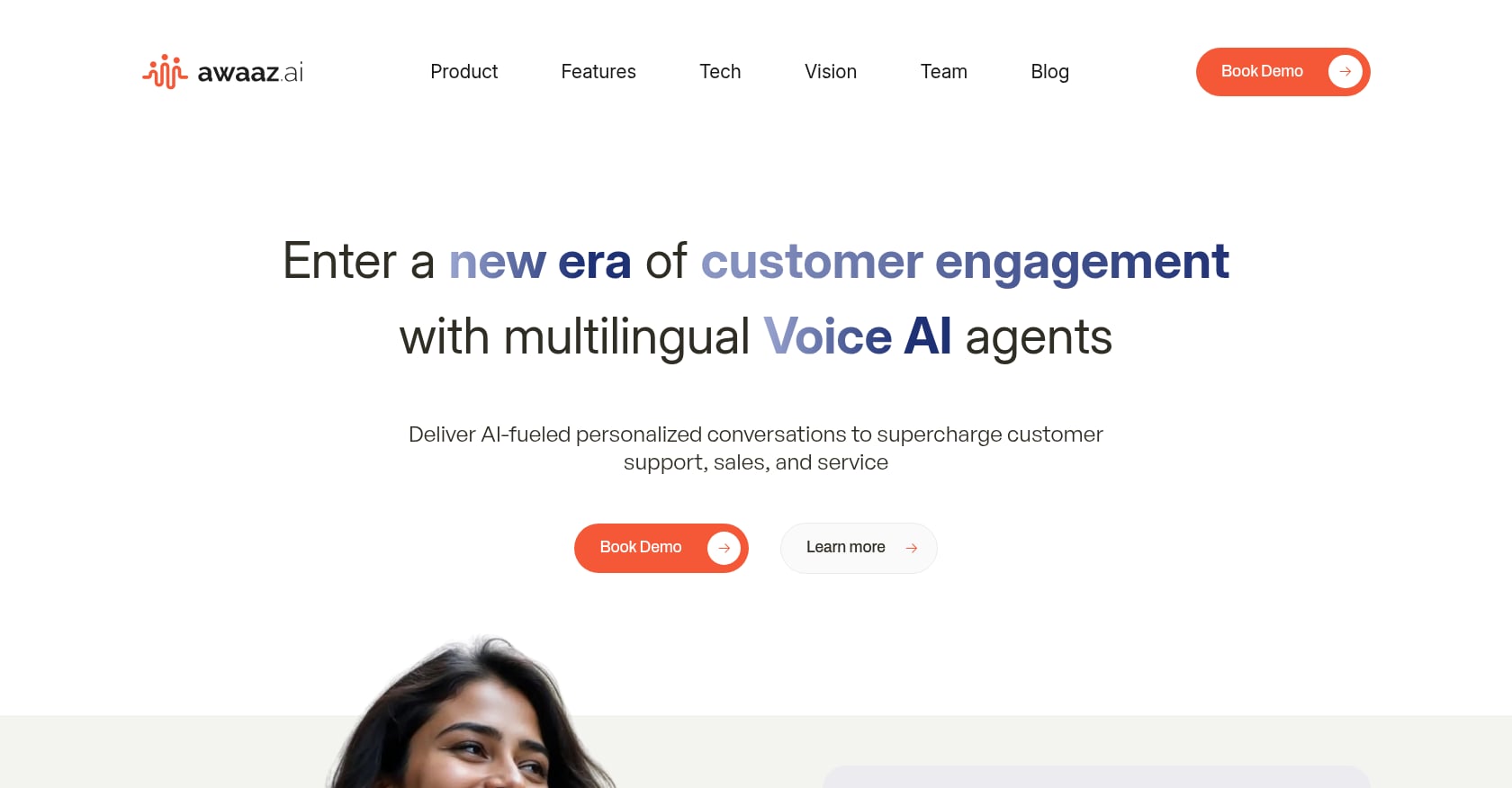
Best for: India-first banking CX across voice, WhatsApp, and SMS, covering support, sales, KYC, collections, and retention workflows.
Awaaz AI is built specifically for Indian financial services. Its multilingual voice AI agents handle customer support, sales, and service across phone calls, SMS, WhatsApp, and messaging channels. The platform supports 8+ languages with vernacular and mixed-language support (including Hinglish) and ships with finance-first templates designed around regulated BFSI workflows.
Key features:
- Multilingual voice AI agents across phone, SMS, WhatsApp, and messaging
- Finance-first workflow templates: sourcing, KYC, credit eligibility, collections, retention
- 8+ Indian languages with code-switching support
- In-house telephony stack for low-latency conversations
- Opinionated NLU design with fine-tuned language model agents
- Human-in-the-loop escalation
- CRM/CDP integrations and APIs
- Reporting and analytics converting calls into structured data
- Enterprise-grade security positioning
- Product tiers: Starter, Standard, Growth, Scale
Pricing:
Pay-per-use credits per minute of talk time. Public price is not listed on the website. Demo available; free trial not found. Contact Awaaz AI for current rates and tier details.
Tradeoffs:
- Public pricing is not transparent; enterprise-led sales motion
- Fewer public self-serve docs compared to developer-first platforms
- Independent third-party review volume is limited; enterprise buyers should request references
User perspective:
Awaaz AI’s client roster includes names like Axis Bank, L&T Finance, Ujjivan, Fullerton India, Equitas, and Dvara KGFS (according to Awaaz AI). The platform reports 3.8M unique customers served in the past year and an 82% call engagement rate. Independent verification of all engagements requires direct reference checks during procurement.
Choose Awaaz AI if your bank or NBFC needs voice automation designed around Indian borrower language, BFSI workflows, and human handoff. Avoid if you need a self-serve developer API for building custom voice agents from scratch.
If you are a small finance bank evaluating procurement, the SFB procurement guide walks through approval and vendor evaluation steps.
2. Skit.ai
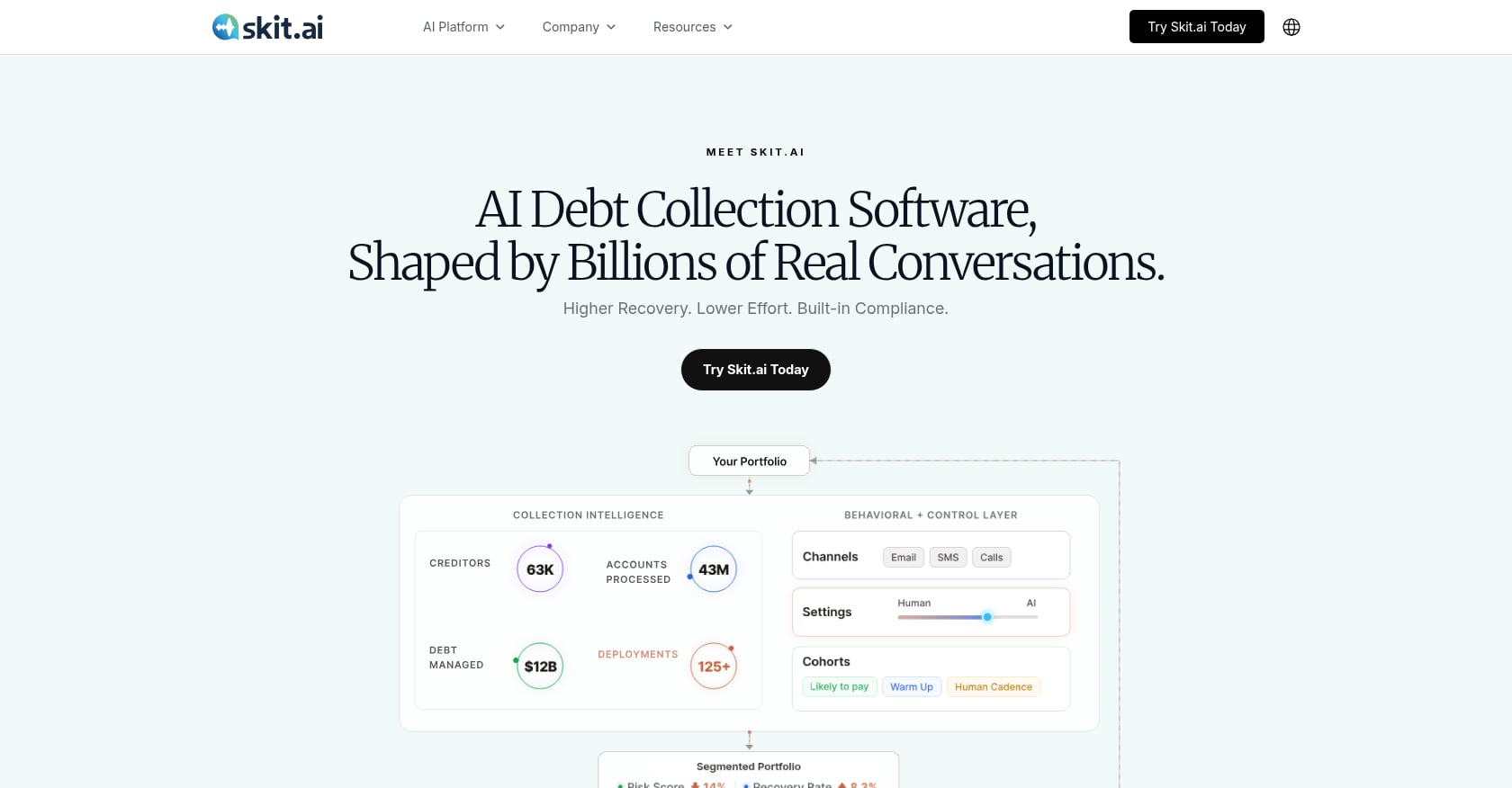
Best for: Collections-first voice AI in lending, debt recovery, and ARM-style workflows.
Skit.ai is a conversational voice AI provider focused primarily on the accounts receivable management (ARM) industry and revenue recovery, according to Gartner. Its public materials emphasize omnichannel outreach across voice, SMS, chat, and email for collection-related workflows.
Key features:
- Voice AI designed for debt collections and recovery
- Omnichannel outreach: voice, SMS, chat, email
- PTP (promise-to-pay) capture workflows
- Delinquency stage segmentation
- Performance-based pricing positioning (vendor-claimed)
Pricing:
Custom quote. TrustRadius reports no free version or free trial. G2 notes that pricing can be high for small businesses. Confirm current pricing with the vendor.
Tradeoffs:
- Best fit appears concentrated in collections and recovery
- Public review volume is very thin (Gartner shows 5.0 from just 1 rating)
- Pricing transparency is low
- Banks should validate non-collections service workflows separately
User perspective:
The single visible Gartner review praises Skit.ai’s qualified professionals and customer support. Reviewer insights mention human interactive voice and multilingual options, with response time noted as an improvement area. The sparse review base means buyers should rely more on pilot results than on aggregate ratings.
Choose Skit.ai if your primary problem is high-volume outbound collections. Avoid if you need a full-service AI contact centre covering inbound support, onboarding, and service alongside collections.
For a deeper look at compliance considerations in this space, see this AI debt collection guide.
3. Gnani.ai
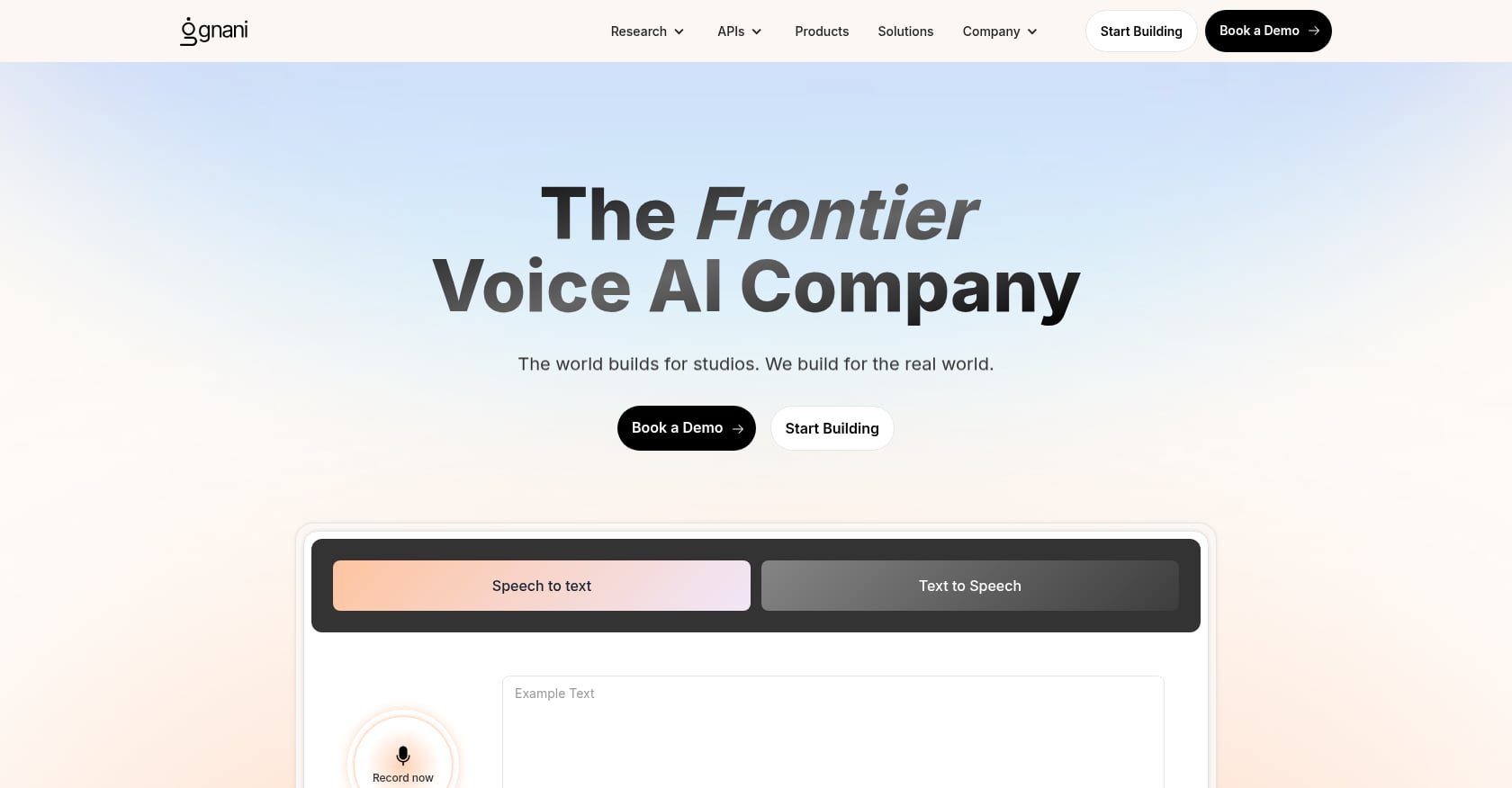
Best for: Large-scale Indic voice AI for enterprise contact centres, collections, and speech analytics.
Gnani.ai serves large Indian enterprises across banking, NBFCs, telecom, and BPOs. Its product set covers voice-led automation, speech analytics, agent assist, and Indic language workflows.
Key features:
- AI-driven voice and speech recognition solutions
- Enterprise-scale contact centre automation
- Collections-focused voice AI
- Speech analytics and agent assist
- Indic language coverage
Pricing:
Public pricing not available. Treat as custom enterprise pricing. When evaluating, ask for cost per attempted call, cost per connected call, cost per completed call, and cost per recovered account.
Tradeoffs:
- Public review footprint is thin (Gartner: 4.3 from 7 reviews; G2 reports insufficient reviews for buying insight)
- Vendor-claimed case study metrics require direct validation with references
- Dialect and workflow tuning may add implementation time
- Legacy core banking and LMS integration can be a significant variable
User perspective:
A practitioner on LinkedIn argued that Indian NBFC collections is one of the hardest voice AI environments because it involves high outbound volume, borrowers speaking multiple languages, mid-sentence switching, instant judgment of robotic-sounding calls, and overlapping TRAI, RBI, and DPDP constraints. Platforms serving this market need to prove performance under these specific conditions, not just in demos.
Choose Gnani.ai if you are a large enterprise running high-volume Indic voice programs and can validate claims through references and pilot data. Avoid if you need transparent pricing or a large base of independent reviews before procurement.
4. Yellow.ai
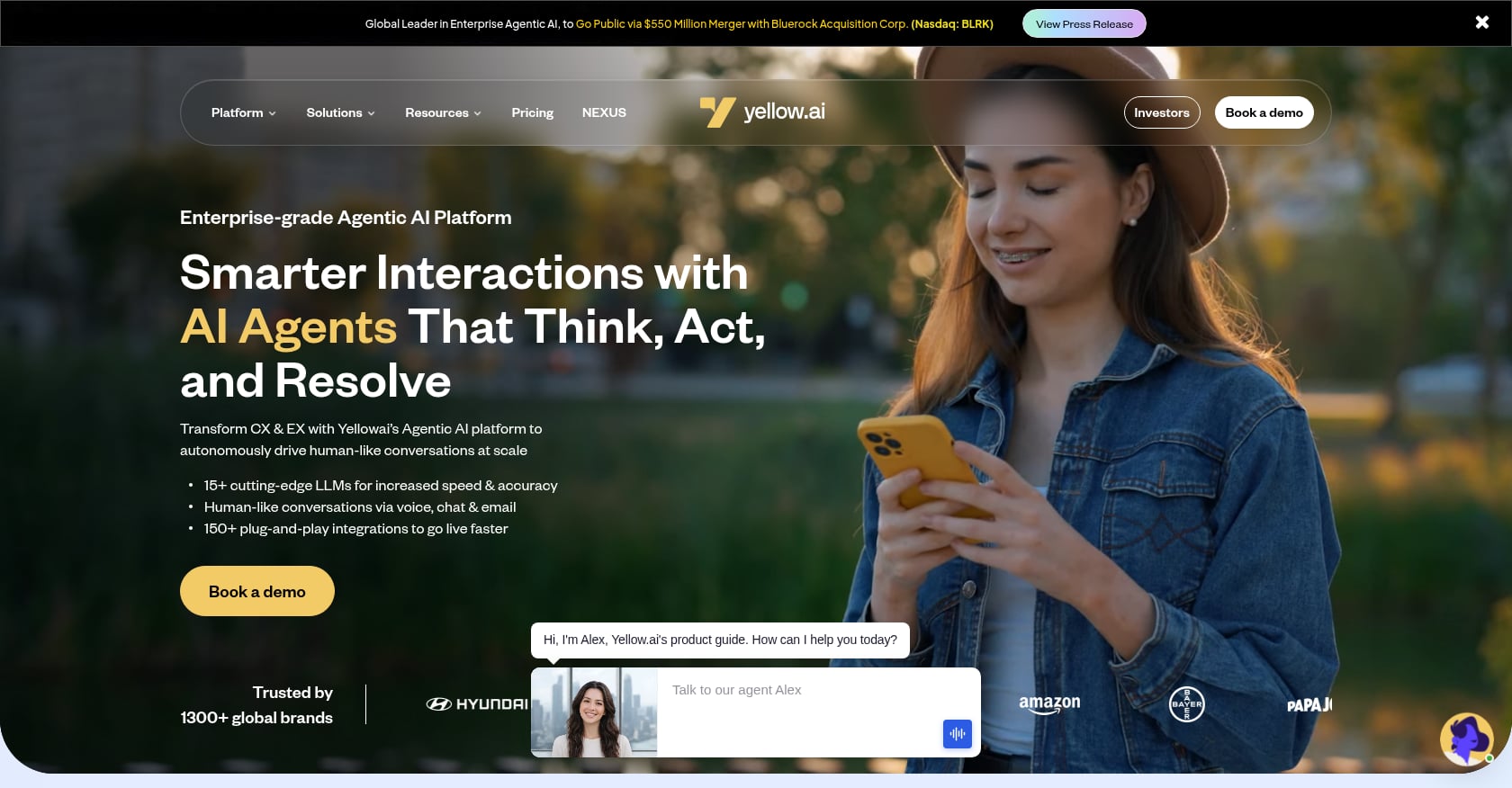
Best for: Omnichannel banking CX automation when voice is one part of a broader digital support strategy.
Yellow.ai is a generative AI-powered customer service automation platform serving over 1,100 enterprises across 85+ countries. It covers chat, messaging, web, app, WhatsApp, and voice in a single platform.
Key features:
- Omnichannel automation across chat, messaging, WhatsApp, web, app, and voice
- Claims support for 135+ languages
- Freemium plan with development and live environments
- Premium/enterprise plans with sandbox, staging, and production
- CRM and ticketing integrations
Pricing:
Freemium plan available. Premium and enterprise plans require contacting Yellow.ai for a custom quote. WhatsApp pricing involves Meta-related pass-through costs that change based on Meta’s updates. Confirm current pricing directly.
Tradeoffs:
- Broad horizontal platform, so voice and Indian language depth may vary by feature and channel
- “135+ languages” does not mean equal voice quality across Indian languages; verify Hindi, Hinglish, and regional language accuracy separately
- Enterprise implementation can require significant setup and workflow design
- Less voice-first for Indian collections compared to specialized providers
User perspective:
G2 lists Yellow.ai at 4.4/5 from 106 reviews. Gartner Peer Insights users highlight its ability to handle repetitive inquiry automation. For banking CX teams, the value is strongest when voice is one channel among many, not the primary automation target.
Choose Yellow.ai if your bank needs a broad omnichannel CX platform covering digital self-service, chat, and messaging alongside voice. Avoid if your primary need is vernacular voice-first outbound for Indian BFSI workflows.
5. Convin.ai
Best for: Contact centre QA, conversation intelligence, agent coaching, and AI phone call augmentation.
Convin.ai is a conversation intelligence platform using generative AI for sales, support, and collection call centers. It offers modules for real-time coaching, post-call analysis, conversation insights, and AI phone calls.
Key features:
- 100% call auditing and QA automation
- Real-time agent assist and coaching
- Post-call conversation analytics
- AI Phone Calls for inbound/outbound virtual agents
- CX insights and reporting dashboards
Pricing:
Custom quote via the Convin.ai pricing page. No public rate card. Ask whether AI Phone Calls are priced separately from QA, agent assist, and conversation intelligence modules. Also ask about recording storage, transcription minutes, and overage fees.
Tradeoffs:
- Strongest in analytics and QA, not necessarily in autonomous vernacular BFSI voice calls
- Some users report lag and cost concerns on G2
- Evaluate the AI Phone Calls product separately from the mature conversation intelligence suite
User perspective:
Convin.ai carries a 4.7/5 rating from 548 G2 reviews, with users praising its user-friendly interface, auditing productivity, and customer support. G2 reports an average implementation time of 1 month and average ROI timeline of 8 months. That review volume is significant compared to most India-focused competitors.
Choose Convin.ai if your primary pain is QA visibility, agent coaching, or conversation analytics across your contact centre. Avoid if you need a standalone autonomous voice AI agent for regulated BFSI workflows like collections or KYC.
6. Rezo.ai
Best for: Enterprise CX teams wanting unified AI automation with hands-on vendor support during implementation.
Rezo.ai positions itself as a unified CX agentic AI platform offering autonomous AI voice bots, intelligent QA, and omnichannel experiences for enterprise contact centres.
Key features:
- Autonomous AI voice bots
- Intelligent QA
- Omnichannel CX automation
- Enterprise contact centre focus
- Hands-on implementation support
Pricing:
G2 reports that pricing details are not currently available and directs buyers to the vendor. Treat as custom enterprise pricing. Ask about pilot fees, setup charges, per-call or per-resolution pricing, and channel costs.
Tradeoffs:
- Positive but very small review base (G2: 4.8/5 from just 10 reviews)
- Pricing is fully opaque
- G2 reviewers note expense compared to alternatives and occasional bugs
- Banking-specific controls like consent, data residency, regulatory scripts, and DND management need direct validation
User perspective:
G2 reviewers praise Rezo.ai’s implementation ease, support quality, and analytics. The small review volume means buyers should request BFSI-specific references and pilot results rather than relying on aggregate ratings.
Choose Rezo.ai if you want a unified CX automation platform with strong vendor support. Avoid if you need pricing transparency or extensive independent validation before signing.
7. Exotel
Best for: India communications infrastructure, cloud telephony, and contact centre operations with AI add-on modules.
Exotel provides AI-powered customer communication solutions including voice and messaging APIs, SMS, WhatsApp, RCS, IVR, call routing, call recording, and an agent dashboard. Gartner notes that Exotel holds a UL-VNO license for VoIP telephony services in India.
Key features:
- India cloud telephony and CPaaS with VoIP license
- Voice, SMS, WhatsApp, RCS, and WebRTC APIs
- IVR, call routing, call forwarding, and call recording
- Contact centre agent dashboard
- AI Voice Agents and AI Chat Agents (add-on modules)
- CRM integrations and call analytics
Pricing:
Exotel has a public pricing page, but most enterprise AI products route to “Talk to an Expert.” Separate AI pricing from telephony usage, number rental, WhatsApp/SMS charges, contact centre seats, and API costs. Confirm current pricing with the vendor.
Tradeoffs:
- Strong communications backbone, but not necessarily the most specialized BFSI voice AI layer by itself
- Gartner reviewers note limited international scope and reporting limitations
- For banking CX, clarify whether Exotel serves as the AI agent platform, the telephony layer, the contact centre platform, or all three in your architecture
- May need a separate AI workflow layer on top for sophisticated banking conversations
User perspective:
Exotel carries 37 product reviews on Gartner. Favorable reviews praise platform stability, reliability, and responsive support. Critical reviews say Exotel works well for India-limited telephony but is less viable for international calling and lacks a ticketing system.
Exotel’s own published benchmark framework for banking suggests evaluation targets like greater than 92% intent accuracy, greater than 95% slot filling, less than 5% code-mix degradation, and under 500ms end-to-end voice latency. These benchmarks are useful regardless of which platform you evaluate.
Choose Exotel if you need reliable India communications infrastructure and want AI as an add-on layer. Avoid if you need a fully managed, finance-specific voice AI platform without assembling integrations yourself.
How to Choose the Right AI Contact Centre for Banking CX
Use this BANK-CX scorecard when evaluating any platform:
| Criterion | What to ask |
|---|---|
| Banking workflow fit | Which BFSI workflows are prebuilt: KYC, onboarding, EMI, collections, loan status, fraud alerts? |
| Accuracy in real language | What are WER, intent accuracy, and slot accuracy for Hindi, English, Hinglish, and regional languages on phone audio? |
| Network and latency | What is p50/p95 end-to-end latency on Indian PSTN calls under load? |
| Know-your-regulator controls | How are DPDP consent, RBI auditability, TRAI/DND suppression, and AI disclosure handled? |
| Core-system integration | Can it read/write to CRM, LMS, CDP, dialer, ticketing, and core banking systems securely? |
| eXperience fallback | What happens when confidence is low, the customer is angry, or the workflow becomes sensitive? |
Ask for p95 Latency on Indian PSTN Calls, Not a Web Demo
Practitioners on Reddit repeatedly point out that voice AI latency is not only an LLM problem. In a developersIndia thread, a builder working on Indian voice AI calls reported 1.5 to 2 second latency. Other practitioners advised separating the phone path from the AI path, testing local Indian telephony providers against US-routed infrastructure, logging first media packet and first audio byte separately, and keeping the routing layer swappable.
End-to-end latency on a production banking voice AI call comes from at least seven sources: PSTN ingress and media routing, voice activity detection and endpointing, STT streaming, LLM first token generation, tool/API calls to CRM or core banking, TTS audio generation, and audio streaming back to the caller. If the vendor only shows latency from a browser-based demo, those numbers will not reflect real phone-call performance in India.
Raw Language Count Is a Trap
A vendor claiming 100+ languages may still fail on the specific mix your customers use. For Indian banking CX, what matters is task completion in Hindi, Hinglish, and the two or three regional languages your borrowers actually speak, on noisy phone connections with poor networks and background noise.
Ask for production samples, not studio recordings. Test on your own anonymized call data. Measure task completion rate, not word error rate alone. A LinkedIn practitioner also observed that different voice AI pricing models suit different call patterns: short EMI reminder campaigns, 7-minute onboarding calls, and inbound service queries each have distinct cost profiles. Evaluate cost per workflow, not just per vendor.
Which Banking Workflows to Automate First
Not every banking workflow should be automated immediately. Here is a practical sequence:
Start here (lower risk, high volume):
EMI and payment due-date reminders. Application status updates. Document follow-up calls. Branch/ATM locator queries. Product FAQs. Lead qualification and appointment scheduling. Re-KYC reminders. Post-call WhatsApp summaries.
Move next (medium risk):
KYC data collection. Loan onboarding support. Service request triage. Retention and reactivation campaigns. Collections segmentation by delinquency stage. PTP capture with controlled scripts. Complaint intake with escalation.
Treat carefully (high risk):
Fraud alerts requiring authentication. Financial advice. Credit decisions. Dispute resolution. Sensitive collections negotiation. Any workflow involving fund movement or irrevocable customer action.
For more on which contact centre use cases are safe to automate first, including common pitfalls.
Compliance Is a Scoring Dimension, Not a Paragraph
For AI contact centres in banking, compliance deserves its own evaluation weight. RBI’s December 2024 bulletin acknowledged that AI/ML can handle enormous data volumes and improve decisioning but explicitly flagged risks including algorithmic bias and data privacy. The subsequent FREE-AI Committee framework proposed 26 recommendations across six pillars covering trust, fairness, accountability, explainability, and resilience.
On the calling side, PIB clarified in July 2026 that 1600xx numbers are designated for service and transactional calls by regulated BFSI entities to existing customers, while 140xx numbers are for promotional calls. DND preferences apply to promotional calls, and customers can block specific categories including banking and financial products.
What this means for AI contact centre procurement in banking:
- Ask how the vendor classifies calls as promotional, service, or transactional
- Confirm DND/NCPR suppression is automated before dialing
- Verify that the AI discloses itself at the beginning of every call
- Check that scripts can be locked for regulated workflows
- Confirm where audio, transcripts, and metadata are stored
- Ask about DPDP data minimization and retention policies
For enterprise security documentation, request the compliance checklist to evaluate Awaaz AI’s posture.
Common Mistakes When Buying AI Contact Centre Software for Banking
1. Buying a demo instead of a production system. Practitioners on Reddit note that the gap between demo-ready and production-ready voice AI is “huge,” particularly for BFSI in India where collections, regional languages, and compliance create real stress. Ask vendors for live deployment references and error logs, not just a polished walkthrough.
2. Evaluating English voice quality but deploying Hinglish calls. Test in the languages your customers actually use, on actual phone lines, with actual background noise.
3. Ignoring telephony routing latency. The LLM may be fast, but if calls route through US infrastructure before reaching an Indian phone, the customer hears dead air. This is one of the most common production problems practitioners report.
4. Treating compliance as a post-launch checkbox. DPDP consent, TRAI call classification, DND suppression, and AI disclosure should be designed into the workflow from day one, not patched in after launch.
5. Not separating promotional, service, and transactional calls. This affects your number series, DND filtering, routing logic, and regulatory exposure.
6. Automating sensitive workflows before proving low-risk ones. Collections negotiation and fraud alerts are harder than EMI reminders. Prove the basics first.
7. Choosing by language count instead of task completion. 100 languages on a slide means nothing if the bot cannot complete a KYC verification in Hinglish on a noisy phone call.
8. Not budgeting for integration, QA, monitoring, and human fallback. The per-minute AI cost is one line item. Integration engineering, evaluation dashboards, human agent backup, and compliance monitoring are the rest of the budget. A developer-first platform like Retell AI (G2: 4.8/5 from 2,064 reviews at $0.07/min pay-as-you-go) offers transparent usage pricing, but compliance, telephony, and data residency costs sit entirely with the buyer.
30-Day Pilot Plan for Banking AI Contact Centres
Before committing to a full deployment, run a controlled pilot. Here is a practical pilot framework adapted for banking:
- Pick one high-volume, low-risk workflow (EMI reminders or document follow-ups)
- Select 2 to 3 languages based on real call volume distribution
- Test using anonymized recordings from actual customer calls
- Define success metrics before launch: containment rate, task completion, CSAT, cost per outcome
- Run in shadow mode or QA mode before going live
- Start with a controlled portfolio segment
- Monitor every call during the first week
- Route low-confidence and sensitive calls to humans
- Measure cost per resolution, not just cost per minute
- Prepare a compliance pack (consent flows, AI disclosure, audit logs, DND suppression) before scaling
| Pilot dimension | Pass/fail criterion |
|---|---|
| Language | Handles top 2-3 customer languages and code-switching |
| Latency | p95 is acceptable on real Indian phone calls |
| Compliance | AI disclosure, consent, DND suppression, call classification, audit logs |
| Integration | Reads/writes required CRM/LMS fields safely |
| Escalation | Human handoff works with transcript and context |
| CX | Customers complete the task without frustration |
| ROI | Cost per outcome beats current baseline |
| Risk | Failure modes identified and monitored |
Final Recommendation
If your banking CX problem is primarily India-first voice outreach (EMI reminders, KYC follow-ups, loan onboarding, collections, customer support), start with Awaaz AI. It is purpose-built for Indian financial services, supports vernacular code-switching, runs on an in-house telephony stack for low latency, and ships with finance-first workflow templates.
If your problem is broader omnichannel digital support, evaluate Yellow.ai. If your priority is contact centre QA and agent coaching, evaluate Convin.ai. If you need India communications infrastructure with AI add-ons, evaluate Exotel. For collections-only voice AI, Skit.ai and Gnani.ai deserve evaluation.
Whichever platform you shortlist, score it against the BANK-CX framework above. Ask for proof on Indian PSTN calls, not web demos. Validate compliance workflows before signing. Run a controlled pilot before scaling.
Get started with Awaaz AI for India-first banking CX automation.
Frequently Asked Questions
What is an AI contact centre for banking CX?
An AI contact centre for banking CX uses voice AI agents, conversational AI, and automation to handle customer interactions across phone calls, WhatsApp, SMS, and messaging. In banking, these platforms manage workflows like EMI reminders, KYC verification, loan status inquiries, collections outreach, and customer support, often in multiple Indian languages including Hindi and Hinglish.
Which banking workflows should be automated with AI first?
Start with high-volume, lower-risk workflows: EMI payment reminders, application status updates, document follow-ups, and re-KYC reminders. These have predictable conversation patterns, lower regulatory sensitivity, and clear success metrics. Move to collections, KYC data collection, and onboarding support after validating the basics.
Can AI voice agents handle Hinglish and code-switching in banking calls?
Some can, but quality varies widely. Platforms built for Indian markets (like Awaaz AI and Gnani.ai) explicitly design for code-switching between Hindi and English. Others claim broad language support but show accuracy degradation when customers switch languages mid-sentence. Always test with your own call recordings in production conditions.
What compliance rules apply to AI calling in Indian banking?
The key frameworks are TRAI’s 140xx/1600xx calling series rules (governing promotional vs. service calls), DND/NCPR suppression requirements, DPDP consent and data minimization obligations, and RBI’s evolving responsible AI expectations under the FREE-AI framework. Your vendor should handle call classification, consent capture, AI disclosure, and audit logging automatically.
How much does AI contact centre software for banking typically cost?
Pricing models vary: per minute of talk time, per conversation, per resolution, or custom enterprise agreements. Public pricing is rare among India-focused BFSI vendors. Budget for AI usage, telephony charges, number rental, WhatsApp/SMS fees, integration work, QA and monitoring, and human escalation costs. Evaluate cost per outcome (cost per PTP captured, cost per KYC completed), not just cost per minute.
How should banks evaluate voice AI latency?
Ask for p50 and p95 end-to-end latency measured on Indian PSTN calls under production load. Latency comes from telephony routing, speech-to-text processing, LLM response time, API calls to backend systems, text-to-speech generation, and audio streaming. Web-based demo latency numbers will not reflect real phone-call performance.
Should a bank choose a voice-first platform or an omnichannel CX platform?
It depends on where your biggest CX gap sits. If most customer interactions happen over phone calls (common in collections, rural banking, and tier-2/3 servicing), a voice-first platform is the better fit. If your primary channels are app, web, chat, and WhatsApp with voice as one element, an omnichannel platform like Yellow.ai may make more sense. Many banks eventually need both.