
TL;DR
AI for customer service now spans voice agents, chatbots, copilots, ticket automation, and full contact-center platforms. The right choice depends on your primary customer channel, language needs, regulatory risk, and budget model. For India-first BFSI teams with phone-heavy and multilingual workflows, Awaaz AI is the strongest fit. For SaaS chat support, Intercom Fin leads. For existing Zendesk or Salesforce shops, their native AI tools make sense. This guide compares 9 platforms across pricing, real user sentiment, honest tradeoffs, and use-case fit.
Why AI Customer Service Is No Longer Optional
AI customer service used to mean a chatbot that answered FAQs. That era is over.
In 2026, the category includes AI voice agents handling phone calls in regional languages, copilots whispering suggestions to human agents mid-conversation, autonomous chat agents resolving tickets without human involvement, and contact-center platforms that combine routing, QA, and analytics with generative AI. Zendesk’s CX Trends 2026 report found that 74% of consumers expect customer service to be available 24/7, and 88% expect faster responses than a year ago source. Salesforce projects that 50% of service cases will be resolved by AI by 2027, up from 30% in 2025 source.
The question is no longer whether to use AI for customer service. It is which type, on which channel, at what cost, and with what safeguards.
That decision looks different depending on where your customers actually ask for help. A SaaS company fielding chat questions on its website needs a different tool than a small finance bank handling collections calls in Hindi, Tamil, and Hinglish. An ecommerce brand on Shopify needs different grounding than an insurance company running compliance-sensitive outbound campaigns.
This guide compares 9 AI customer service tools across those real differences, including pricing models that often surprise buyers after they sign.
At-a-Glance Comparison Table
Pricing was researched in May 2026. Verify current figures before purchasing.
| Tool | Best For | Primary Channel | Pricing Model | Starting Price | G2 Rating | Main Limitation |
|---|---|---|---|---|---|---|
| Awaaz AI | India-first BFSI voice support | Phone, WhatsApp, SMS | Pay-per-use credits/minute | Demo-led pricing | Limited public reviews | Public pricing and third-party reviews are thin |
| Zendesk AI | Existing Zendesk support teams | Tickets, chat, voice | Seat + AI add-ons | $155/agent/mo (Suite + Copilot Pro) | 4.3/5 | Costs stack with add-ons; AI can feel bolted on |
| Intercom Fin | SaaS/chat-first self-service | Chat, email | $0.99/outcome + seats | $29/seat/mo + $0.99/outcome | 4.5/5 (3,811 reviews) | Outcome pricing scales fast at volume |
| Freshdesk Freddy | SMB/midmarket help desk | Tickets, email, chat | Seat + AI session packs | $19/agent/mo + Freddy add-ons | 4.4/5 (3,721 reviews) | AI ceiling hits sooner than expected |
| Salesforce Agentforce | Salesforce-native enterprises | CRM/service workflows | Seat, flex credits, or $2/conversation | $25/user/mo (Starter Suite) | Strong G2 presence | Expensive, complex, requires clean data |
| Ada | Enterprise AI self-service | Chat, email, voice, messaging | Custom enterprise quote | Contact sales | 4.6/5 (170 reviews) | Pricing not transparent; reporting gaps |
| Gorgias AI Agent | Shopify/ecommerce brands | Help desk, chat, email | Ticket tiers + AI add-on | $10/mo + $250/mo AI Agent | Positive G2 sentiment | Product-answer hallucination risk |
| Tidio Lyro | Small business/ecommerce startups | Live chat, help desk | Base plans + Lyro add-on | Free plan; Lyro from $32.50/mo | 4.6/5 (1,901 reviews) | Add-ons and API limits surprise teams |
| Talkdesk AI | Enterprise contact centers | Voice + digital CCaaS | Per-user contact-center plans | $85/user/mo (Digital Essentials) | 4.4/5 (~2,500 reviews) | Not lightweight; AI pricing requires sales |
Quick Picks by Use Case
Best overall for India-first voice customer service: Awaaz AI
Best for BFSI voice workflows (KYC, collections, reminders): Awaaz AI
Best for Zendesk-heavy teams: Zendesk AI
Best for SaaS chat self-service: Intercom Fin
Best for SMB/midmarket help desk: Freshdesk Freddy
Best for Salesforce-native enterprises: Salesforce Agentforce
Best for enterprise AI self-service: Ada
Best for Shopify/ecommerce: Gorgias AI Agent
Best low-friction AI chat for small teams: Tidio Lyro
Best for enterprise contact centers: Talkdesk AI
What Is AI for Customer Service?
AI for customer service is not a single product category. It is a collection of technologies that automate, assist, or improve how companies handle customer interactions. Understanding the subcategories matters because choosing the wrong type wastes budget and frustrates customers.
AI chatbot: Answers text-based questions on a website, app, or messaging channel using predefined flows or generative AI. Good for FAQs and simple self-service.
AI customer service agent: Goes beyond answering questions to actually resolve issues, looking up orders, processing returns, updating accounts, or completing multi-step workflows without human involvement.
AI voice agent: Handles phone conversations. Can make outbound calls (reminders, collections, appointment confirmations) and receive inbound calls (support, routing, information requests). For a deeper look at how this works in contact centers, see this complete guide to conversational AI for contact centers.
Agent copilot: Assists human agents during or after conversations by suggesting responses, summarizing threads, pulling relevant knowledge, or auto-filling ticket fields.
Help desk AI: Triages incoming tickets, suggests priority and routing, summarizes conversation history, and automates repetitive ticket management tasks.
Contact-center AI: Combines voice and digital channel management, workforce scheduling, quality assurance scoring, real-time analytics, and AI-powered routing into one platform.
Conversation analytics: Turns unstructured calls, chats, and emails into queryable data, surfacing sentiment trends, compliance gaps, and coaching opportunities.
The most important distinction: does the AI only suggest answers to humans, or does it directly resolve customer issues? That line determines your risk profile, your staffing model, and your pricing structure.
The 9 Best AI Customer Service Platforms
1. Awaaz AI
Best for: India-first BFSI voice customer service, multilingual phone and WhatsApp workflows
Awaaz AI is designed for teams where the customer’s front door is a phone call or WhatsApp message, not a website chat widget. It supports multilingual voice AI agents across phone, SMS, and WhatsApp, with domain-specific agents built for finance, health, commerce, and hospitality.
For banks, NBFCs, microfinance institutions, and fintechs, Awaaz AI offers finance-first workflow templates covering sourcing, KYC, credit eligibility, collections, retention, and onboarding. The platform supports 8+ languages, including vernacular and code-switching patterns like Hinglish. It runs on an in-house telephony stack built for low-latency conversations, which matters because even small delays in voice AI make customers hang up.
Key features:
- Multilingual voice AI agents for support, sales, and service
- Phone, WhatsApp, and SMS in one platform
- Finance-specific workflows: KYC calls, EMI reminders, collections, credit eligibility, reactivation
- In-house telephony stack for low-latency, human-like turn-taking
- Human-in-the-loop escalation
- Analytics dashboard converting calls into structured, queryable data
- CRM/CDP integrations and APIs
- Supports 8+ Indian languages with code-switching
Pricing:
Pay-per-use credits charged per minute of talk time. Plan tiers include Starter, Standard, Growth, and Scale. Pricing is demo-led. Free trial not listed.
What Awaaz AI reports:
3.8M unique customers reached in the last year, 82% call engagement rate, 60% cost reduction, and 2x conversions. These are client-reported metrics; independent verification would require reference calls or case studies during procurement.
Tradeoffs:
- No transparent public pricing. Buyers need to book a demo for specifics.
- Public third-party review footprint is thinner than global help desk vendors. Enterprise buyers should ask for customer references and pilot metrics.
- Strongest for India/voice/BFSI. Not the obvious default for a SaaS team that only needs website chat deflection.
Why choose it:
If your customers call, speak in Indian vernacular languages, switch between Hindi and English mid-sentence, or need BFSI workflows like voice AI for banking with measurable ROI, Awaaz AI is purpose-built for that reality. For teams evaluating Indian call center AI voice solutions, it belongs on the shortlist.
Book a demo with Awaaz AI to test real customer conversations in the languages and workflows your borrowers actually use.
2. Zendesk AI

Best for: Midmarket and enterprise teams already standardized on Zendesk
Zendesk AI is strongest when layered on top of an existing Zendesk environment with mature ticketing, a well-maintained help center, clean macros, and structured routing. Its AI packaging is changing in May 2026, removing the “Essential” vs “Advanced” AI agent distinction and expanding agentic capabilities like reasoning, multi-step procedures, and external API integrations across Suite and Support plans source.
Key features:
- Multichannel support: tickets, messaging, live chat, help center, voice
- AI copilot with live call transcripts, suggested macros, and ticket summarization
- AI agents with expanding autonomous resolution capabilities
- Quality assurance and workforce management add-ons
- Suite-level platform for end-to-end support operations
Pricing:
- Suite + Copilot Professional: $155/agent/month (annual billing)
- Suite + Copilot Enterprise: $209/agent/month (annual billing)
- Copilot add-on alone: $50/agent/month
- QA add-on: $35/agent/month
- WFM add-on: $25/agent/month
- Advanced AI agents: “Talk to Sales” source
Tradeoffs:
- Costs stack quickly. Seat fees plus Copilot, QA, WFM, and AI agent pricing can push effective costs well above the headline number.
- Works best when the knowledge base, macros, tags, routing, and workflows are already clean. Garbage in, garbage out.
- Less compelling if the buyer’s primary channel is outbound/inbound voice in Indian vernacular languages.
Real user perspective:
Practitioners on Reddit report mixed experiences. One Zendesk Copilot discussion notes that live call transcripts help reduce wrap-up time, but suggested macros still need humans for edge cases and emotionally charged conversations source. Another thread describes the AI Copilot as feeling “bolted on” for some workflows source.
3. Intercom Fin
Best for: SaaS and product-led companies that want fast AI self-service in chat and email
Intercom Fin is one of the more polished AI customer service agents for chat-first support. It resolves customer questions autonomously using help center content and can take actions through external system integrations. It works as part of the Intercom platform or as a standalone agent layered on top of other help desks like Salesforce source.
Key features:
- AI agent that resolves issues autonomously, not just deflects
- Shared inbox, ticketing, workflows, and help center
- Customizable tone, voice, and behavior rules
- External-system actions for multi-step resolutions
- Standalone option: use Fin without migrating your entire help desk
Pricing:
- Essential: $29/seat/month + $0.99 per Fin outcome
- Advanced: $85/seat/month + $0.99 per Fin outcome
- Expert: $132/seat/month + $0.99 per Fin outcome
- Standalone Fin AI Agent: $0.99/outcome, no seats required, minimum ~50 outcomes/month
- Additional charges for WhatsApp, SMS, email campaigns, and phone source
Tradeoffs:
- Outcome pricing is clean but can become expensive at high volume. A team resolving 10,000 issues per month through Fin pays $9,900 in outcome fees alone, before seat costs.
- Product-specific or edge-case answers still need continuous knowledge-base hygiene.
- Voice support via Fin requires a sales conversation; this is not a phone-first platform.
Real user perspective:
Intercom Fin holds a 4.5/5 rating from 3,811 verified G2 reviews. Practitioners on Reddit who tested multiple AI agents for about a year described Fin as strong for repetitive volume but harder to tune than marketing implies, especially for product-specific support source.
4. Freshdesk Freddy AI

Best for: SMB and midmarket help desk teams wanting AI on a relatively approachable budget
Freshdesk is a broad help desk platform with ticketing, omnichannel support, and AI capabilities powered by Freddy. For teams that want traditional help desk functionality with AI layered on top (rather than an AI-first architecture), Freshdesk is a reasonable middle ground.
Key features:
- Multichannel support: tickets, email, chat, phone
- Freddy AI Agent for automated resolutions
- Freddy Copilot for agent assistance
- Customer insights and advanced ticketing
- Parent brand (Freshworks) is India-origin, which can help procurement in some organizations
Pricing:
- Growth: $19/agent/month (annual billing)
- Pro: $55/agent/month (annual billing)
- Enterprise: $89/agent/month (annual billing)
- Freddy AI Agent Sessions: $100 per 1,000 sessions
- Freddy AI Copilot: $29/agent/month (annual) or $35/agent/month (monthly) source
Tradeoffs:
- AI add-ons and session packs change the real cost meaningfully. A team on the Pro plan adding Copilot and AI sessions could be paying $84+/agent/month before volume-based session costs.
- Advanced AI may be less sophisticated than AI-native platforms like Intercom or Ada.
- Not purpose-built for high-volume Indian voice workflows or BFSI-specific compliance needs.
Real user perspective:
G2 reviewers (4.4/5 from 3,721 reviews) praise Freshdesk as easy to scale as ticket volume grows. But Reddit sentiment is more pointed: users report clunky ticket management, unreliable search, and price creep. One practitioner summary called Freddy “fine for getting started” but noted it “hit its ceiling faster than expected” source.
5. Salesforce Agentforce
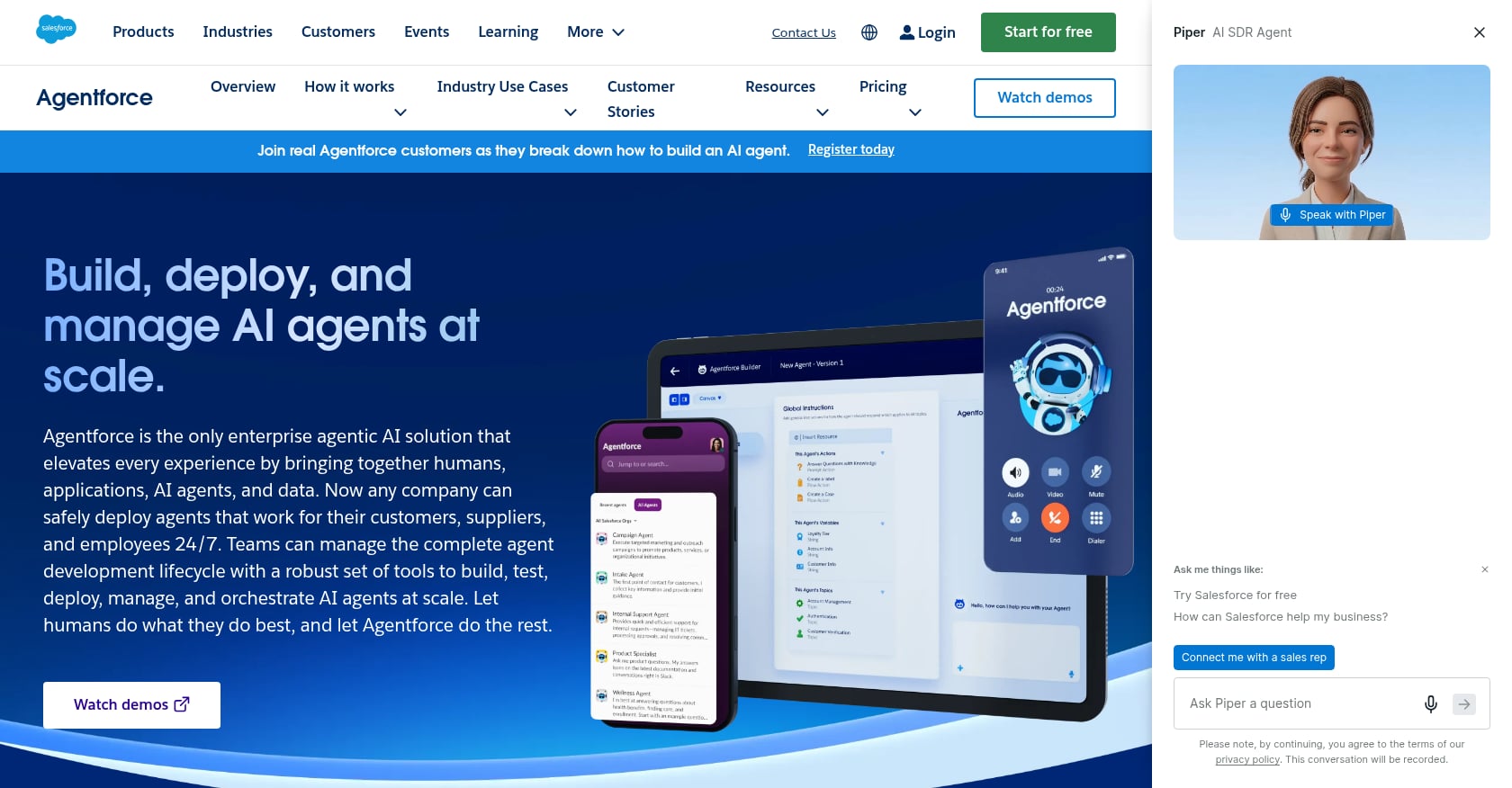
Best for: Large enterprises where Salesforce already owns the service data, case workflows, and permissions model
Salesforce Agentforce brings agentic AI directly into Service Cloud, using CRM data, knowledge articles, case history, and workflow rules to power autonomous and assisted resolutions. When the data is clean and the processes are mature, it can be powerful. When they are not, it is expensive frustration.
Key features:
- CRM-native AI agents that act on service cases, customer records, and knowledge
- Agent Builder and Prompt Builder for custom AI workflows
- Consumption-based pricing (Flex Credits or per-conversation) alongside seat licensing
- Deep integration with Salesforce ecosystem (Sales Cloud, Marketing Cloud, Data Cloud)
- Salesforce Foundations tier includes free Agent Builder access and 200k Flex Credits
Pricing:
- Starter Suite: $25/user/month
- Pro Suite: $100/user/month
- Enterprise: $175/user/month
- Unlimited: $350/user/month
- Agentforce 1 Service: $550/user/month
- Flex Credits: $500 per 100k credits
- Conversations: $2 per conversation source
Tradeoffs:
- Total cost of ownership is high. Base Service Cloud licenses plus Agentforce pricing plus Data Cloud plus implementation can run into significant six-figure annual commitments.
- Requires clean Salesforce data and disciplined process design. Agentforce will not fix a messy org.
- Overkill for teams that need a focused phone or WhatsApp voice agent in Indian languages.
Real user perspective:
Reddit sentiment is polarized. Some users report success when the use case stays inside Salesforce data and workflows. Others criticize the gap between demos and production outcomes, Data Cloud complexity, and off-script reliability source.
6. Ada

Best for: Enterprise support organizations that want an AI-native automation platform across channels
Ada positions itself as an AI-first customer service platform, not a help desk with AI bolted on. It supports chat, email, voice, and messaging, and has powered billions of customer interactions according to G2.
Key features:
- Omnichannel AI agents across chat, email, voice, and messaging
- AI-native architecture (not a legacy help desk with AI added later)
- Enterprise-grade deployment and support
- Ease of use and responsive vendor support highlighted in reviews
Pricing:
Ada uses demo-led, custom enterprise pricing. No public package prices are listed source. G2 pricing insights indicate perceived cost is high.
Tradeoffs:
- Pricing is not transparent. Buyers cannot self-qualify or compare without a sales conversation.
- Reporting and analytics could be more detailed, especially around categorization and volume analysis, according to G2 reviewers.
- For India-first BFSI voice operations, compare carefully against platforms purpose-built for Indian language telephony.
Real user perspective:
Ada holds a 4.6/5 from 170 G2 reviews. Users praise ease of use, fast implementation, and the ability to reduce repetitive inquiries without adding headcount. The most common critique centers on reporting depth.
7. Gorgias AI Agent

Best for: Shopify-centric ecommerce brands that need order, returns, and shipping support
Gorgias is built around ecommerce. It pulls in Shopify order data, customer history, and product information to power both human agents and its AI Agent. For DTC brands, this ecommerce grounding is the key differentiator.
Key features:
- Deep Shopify and ecommerce integrations (order status, returns, subscriptions, shipping)
- AI Agent for autonomous resolution of common ecommerce questions
- Help desk with email, chat, and social support
- Ticket-based billing tied to actual support volume
Pricing:
- Starter: $10/month
- Basic: $60/month
- Pro: $360/month
- Advanced: $900/month
- Enterprise: custom quote
- AI Agent: starts at $250/month as an add-on
- Dual billing: help desk ticket fee + outcome-based automation fee when AI resolves without handoff source
Tradeoffs:
- Product-answer accuracy depends entirely on how well the AI is grounded in live catalog, inventory, and order data. Without it, hallucinations happen.
- Cost can rise with ticket and AI automation volume in ways the flat plan price does not reveal.
- Not built for BFSI, KYC, collections, or India-first phone support.
Real user perspective:
Ecommerce practitioners on Reddit flag a consistent pattern: Gorgias AI handles order status and basic FAQs well, but product questions involving fit, variants, defects, or policy exceptions cause confidently wrong answers. Several recommend requiring human handoff for anything the AI is not confident about source.
8. Tidio Lyro
Best for: Small businesses and ecommerce teams that want to start with AI chat support quickly
Tidio offers a low-friction entry point: a free plan, a 7-day trial without a credit card, and a chatbot-to-human handover flow that G2 reviewers specifically call out as smooth. Lyro, its AI agent, handles common questions and can be added incrementally.
Key features:
- Live chat, help desk, and AI agent in one platform
- Lyro AI Agent for automated chat resolutions
- Social media and email conversation management
- Automation flows and chatbot builder
- 50 free Lyro conversations on every account to start
Pricing:
- Free: $0/month
- Starter: $24.17/month
- Growth: from $49.17/month
- Plus: from $749/month
- Premium: contact for pricing
- Lyro AI Agent: from $32.50/month (50 Lyro AI conversations)
- 7-day free trial, no credit card required source
Tradeoffs:
- Add-ons can make the real monthly bill much higher than the base plan suggests. API pricing in particular has drawn complaints.
- Conversation limits per tier mean fast-growing teams may outgrow Tidio quickly.
- Not designed for enterprise BFSI voice workflows or multilingual phone support.
Real user perspective:
Tidio holds a 4.6/5 from 1,901 G2 reviews. Users appreciate the ease of switching between chatbot automation and human takeover. Reddit concerns focus on modular add-on pricing and API limitations that can frustrate technical teams source.
9. Talkdesk AI

Best for: Enterprise contact centers modernizing the full stack, not just adding a chatbot
Talkdesk is a cloud contact center platform (CCaaS) with AI layered across the operation: routing, voice, digital channels, agent copilot, QA, workforce management, and an AI virtual assistant called Autopilot. It is the right fit when the problem is not “we need a bot” but “we need to redesign how our 200-seat contact center operates.”
Key features:
- Cloud contact center for voice and digital channels
- Talkdesk Copilot: next-best-action recommendations, AI translations, automatic summaries
- Talkdesk Autopilot: agentic AI virtual assistant for voice and digital
- Workforce management and quality assurance
- Call management and centralized support operations
Pricing:
- Digital Essentials: $85/user/month
- Voice Essentials: $105/user/month
- AI products (Copilot, Autopilot): require sales contact source
Tradeoffs:
- Higher base cost and operational complexity than point solutions.
- AI pricing and packaging require a sales process, making comparison difficult.
- Not the fastest path for a BFSI team that specifically wants multilingual outbound/inbound voice campaigns in India.
Real user perspective:
Talkdesk holds a 4.4/5 from about 2,500 G2 reviews. Users highlight ease of use and improved response efficiency. The platform is praised for centralizing support operations, though the full cost picture often requires deep vendor engagement.
How to Choose the Right AI Customer Service Tool
Start With the Channel, Not the Model
The biggest mistake buyers make is comparing AI capabilities in a vacuum. The right starting question is: where do customers actually ask for help?
- Phone-first customers need a voice AI agent.
- WhatsApp/SMS-heavy customers need omnichannel voice and messaging workflows.
- Website and app users need a chatbot or AI agent.
- Email and ticket queues need help desk AI, case triage, or copilot.
- Call centers need CCaaS with voice AI, QA, and routing.
- Ecommerce shoppers need order, returns, and subscription AI grounded in catalog data.
- Enterprise CRM users need CRM-native AI agents.
For India and BFSI, phone plus WhatsApp often matter more than website chat. This is the gap that voice-first platforms fill, and why evaluating multilingual conversational AI separately from generic help desk AI matters.
Match AI Autonomy to Risk
Not every customer interaction should be handled the same way. Use this framework:
| Risk Level | Example | Recommended AI Role |
|---|---|---|
| Low | Order status, appointment reminder, FAQ | AI resolves directly |
| Medium | KYC follow-up, document collection, plan changes | AI collects info, escalates exceptions |
| High | Loan eligibility, collections negotiation, complaints | Scripted/guardrailed AI + mandatory human escalation |
| Regulated | Banking, insurance, healthcare, payments | Audit logs, consent verification, data retention, compliance review |
Demand Human Handoff That Preserves Context
A bad handoff makes AI feel like a delay tactic. Zendesk’s CX Trends 2026 data shows that 74% of consumers find it frustrating to repeat their story to different agents source. The AI should transfer the full conversation transcript, a summary, detected intent, customer identity, the last action taken, the unresolved issue, and the reason for escalation.
Any platform that cannot do this turns AI from a service improvement into a service barrier.
Test With Real Customer Conversations
Vendor demos are too clean. A proper evaluation should include at least 70 test conversations: normal requests, angry customers, edge cases, incomplete information, language switching, CRM-dependent actions, and handoff scenarios.
For teams evaluating voice AI in India, add noisy phone lines, rural accents, Hinglish code-switching, partial KYC details, EMI reminder objections, and customers asking for a human agent. If the AI cannot handle these, it will fail in production regardless of how smooth the demo sounded.
A Reddit discussion about voice AI makes a useful point: customers dislike feeling trapped in a fake conversation when they want a quick answer. AI works better when it removes friction and hands off transparently, rather than trying to sound maximally human source.
AI Customer Service Pricing Explained
Pricing is becoming harder than product comparison. Multiple buyer-side Reddit discussions highlight confusion around outcome pricing, token costs, add-ons, and whether AI should be priced like software, labor, or outcomes source. One buyer commented that per-resolution pricing made more sense to finance teams than vague subscription pricing, because they only paid when the AI actually worked.
Here are the pricing models you will encounter:
| Pricing Model | Common In | What to Watch |
|---|---|---|
| Per seat/agent/month | Zendesk, Freshdesk, Salesforce, Talkdesk | You keep paying for seats even when AI handles more volume |
| Per resolution/outcome | Intercom Fin, some AI agents | Costs scale with success; how “resolution” is defined matters |
| Per conversation | Salesforce Agentforce, some chat AI | High-volume support gets expensive fast |
| Per minute | Voice AI platforms like Awaaz AI | Long calls and poor containment increase cost |
| Per ticket + automation fee | Gorgias | Ticket volume and AI add-ons create billing surprises |
| Custom annual contract | Ada, enterprise platforms | Hard to compare without volume modeling |
The honest way to compare: build a monthly total cost model.
Total monthly AI support cost = base seats + AI add-ons + usage fees (outcomes, minutes, conversations) + telephony + SMS/WhatsApp charges + implementation + QA/review time + integration maintenance + compliance review + human fallback capacity.
For India-specific voice AI economics, this guide on call center cost per minute in India breaks down how to model per-minute voice AI against human agent costs.
Implementation Checklist: Deploying AI Customer Service Safely
McKinsey reports that more than 80% of customer care organizations are investing in generative AI, but scaling remains hard because of deployment, safety, governance, and business-case challenges source. The organizations capturing real value are not just adding AI to one workflow. They are remapping customer journeys, removing unnecessary process steps, and redesigning escalation paths source.
A practitioner on Reddit who tested AI agents for customer support over about a year said the tools that failed were the ones treated as static infrastructure, not the ones with worse features. The difference was weekly review cycles source.
Here is a practical deployment checklist:
- Pick your top 3 use cases. Do not automate everything at once.
- Estimate volume, average handling time, escalation rate, and recontact rate for those use cases.
- Prepare a real conversation test set. Include at least 50 to 100 past conversations: normal, angry, edge cases, incomplete info, language switching.
- Define what the AI must never do. Promise refunds outside policy, change account terms, give medical/legal/financial advice, disclose personal data, negotiate outside authorized parameters.
- Set confidence thresholds and mandatory human escalation rules.
- Connect to CRM, help desk, telephony, and WhatsApp. Salesforce reports that companies unifying customer service channel data are 1.4x more likely to achieve a “very successful” AI implementation source.
- Test multilingual and edge cases before launch.
- Launch to a narrow customer segment first. Not the entire base.
- Review weekly for the first 4 to 8 weeks. Check containment rate, CSAT by AI vs human, recontact rate, complaint rate, escalation quality, and hallucination/error rate.
- Expand only after metrics stabilize.
For regulated industries, add consent verification, DND-safe outreach (TRAI requires that commercial communications respect the National Customer Preference Register source), call recording and transcript handling under India’s Digital Personal Data Protection Act source, and audit logs for every AI decision. Teams in banking and financial services can use this enterprise security and compliance checklist as a starting framework.
Common AI Customer Service Failure Modes
Few buying guides talk plainly about failure. These are the patterns that cause real damage:
- Stale knowledge base. The AI answers based on outdated policies, pricing, or product information.
- No access to live account or order data. The AI sounds smart but cannot actually check status or take action.
- Poor handoff. The customer waits through AI, then has to repeat everything to a human.
- Hallucinated answers. The AI confidently gives wrong policy, product, or pricing information. Ecommerce teams on Reddit report this as a recurring issue with product-specific questions.
- Deflection disguised as resolution. Cases marked “resolved” by the AI, but customers call back within 24 hours.
- AI blocking access to humans. Angry customers forced through loops without an escalation path.
- Pricing that scales faster than expected. Per-outcome or per-conversation fees that looked cheap in the pilot but run up quickly at full volume.
- Voice latency. Even 500ms of extra delay makes phone conversations feel robotic and drives hang-ups.
- Multilingual ASR failures. Speech recognition that works in American English but fails with Indian accents and code-switching.
- No monitoring after launch. The AI degrades over time as products, policies, and customer behavior change.
BFSI Procurement Questions
For banks, NBFCs, MFIs, small finance banks, and insurance companies evaluating AI for customer service, these questions should be part of every vendor conversation:
- Can the AI handle KYC, collections, reminders, and eligibility calls end to end?
- Can it speak in the customer’s language and switch mid-call?
- What happens if the customer disputes information or asks to speak with a human?
- Can we audit every call with full transcripts and decision logs?
- Where are recordings and transcripts stored, and for how long?
- How are consent and DND preferences handled before outbound calls?
- Can the AI integrate with our LMS, LOS, CRM, or CDP?
- Can we control scripts, disclaimers, escalation rules, and retry logic?
- What human-in-the-loop review workflows exist?
- Can we pilot with a small borrower segment before scaling?
For small finance banks specifically, this procurement guide for Awaaz AI walks through the evaluation and buying process in detail.
FAQ
What is AI for customer service?
AI for customer service refers to a range of technologies, including chatbots, voice AI agents, copilots, ticket automation, and contact-center AI, that automate or assist customer interactions across phone, chat, email, WhatsApp, and other channels. The category spans everything from simple FAQ bots to autonomous agents that resolve issues without human involvement.
Can AI replace human customer service agents?
Not entirely. AI handles repetitive, well-bounded tasks well: order status, appointment reminders, basic troubleshooting, FAQ answers. But complex issues, emotionally charged conversations, policy exceptions, and regulated decisions still need humans. The best deployments use AI to handle volume while freeing human agents for higher-value work.
How much does AI customer service cost?
It depends on the pricing model. Seat-based platforms like Zendesk and Freshdesk range from $19 to $350+/agent/month before AI add-ons. Outcome-based tools like Intercom Fin charge $0.99 per resolution. Voice AI platforms often charge per minute of talk time. The real cost includes add-ons, usage fees, telephony, implementation, and human fallback capacity.
What is the difference between an AI chatbot and an AI voice agent?
A chatbot handles text-based interactions on websites, apps, or messaging platforms. A voice AI agent handles phone conversations, both inbound and outbound. Voice agents deal with additional complexity: accents, background noise, interruptions, and real-time turn-taking. For phone-heavy markets like India, voice agents address the channel where most customers actually reach out.
Is AI customer service safe for banks and financial institutions?
It can be, with the right safeguards. Regulated industries need audit logs, consent verification, DND compliance, call recording policies, data retention controls, human escalation paths, and ongoing monitoring. The risk is not AI itself, but deploying AI without these controls. BFSI teams should evaluate vendors specifically on compliance readiness, not just conversational quality.
Can AI handle Indian languages and code-switching like Hinglish?
Some platforms can. Most global help desk AI tools are optimized for English and a handful of European languages. For Indian vernacular languages with regional accents and mid-sentence language switching, specialized platforms built with Indian speech data perform significantly better. Academic benchmarks like the Voice of India dataset cover 15 major Indian languages and 139 regional clusters source, showing the scale of the challenge.
How do I measure ROI after launching AI customer service?
Track these metrics weekly for the first two months: containment rate (percentage resolved without human), recontact rate within 24 to 72 hours, CSAT for AI-handled vs human-handled interactions, complaint rate, escalation rate and quality, average handling time, cost per resolved issue, and hallucination or error rate. Resolution rate alone can be misleading if CSAT drops or customers simply give up.
Should I start with AI for phone support, WhatsApp, chat, or ticketing?
Start with the channel where you have the highest volume and the most repetitive interactions. For many India-based BFSI companies, that is phone and WhatsApp. For SaaS companies, it is usually website chat and email. Match the tool to the channel. Trying to force a chat-first tool onto a phone-heavy customer base (or vice versa) creates friction instead of reducing it. For teams exploring automated outbound calling workflows, phone-first AI should be evaluated independently from help desk tools.