
TL;DR
The best voice AI for banks in India is not the platform with the smoothest demo. It is the one that survives real Indian phone calls: Hinglish code-switching, noisy mobile audio, RBI-sensitive collection scripts, and CRM integrations that actually update records. Awaaz AI ranks first for Indian BFSI teams that need multilingual, phone-first voice workflows across collections, KYC, EMI reminders, and customer support. This guide compares 9 platforms on language accuracy, BFSI workflow depth, compliance readiness, pricing, and real user sentiment.
Why This Comparison Exists
If you are a CX head, collections leader, or digital banking leader at an Indian bank or NBFC, choosing Voice AI is not a technology decision. It is an operations and compliance decision wrapped inside a technology purchase.
India had 870 million Indic-language internet users in 2024, with 140 million people using voice commands. Most of your borrowers and customers speak Hindi, Hinglish, Tamil, Telugu, Marathi, Bengali, or Kannada on the phone. They switch languages mid-sentence. They call from noisy environments on low-bandwidth mobile connections.
Global voice AI platforms can sound excellent in controlled demos. But research on Hinglish code-switching shows that ASR word error rates jump 30 to 50% on code-switched speech compared to monolingual input. That gap between demo quality and production quality is where banks lose money, break compliance, and frustrate customers.
This guide ranks 9 voice AI platforms by production fit for Indian banking, not by marketing polish.
Book a demo with Awaaz AI to see how it handles your actual call recordings.
Quick Comparison Table
| Rank | Platform | Best for Indian banks when… | Public pricing | User/review signal | Main tradeoff |
|---|---|---|---|---|---|
| 1 | Awaaz AI | You need BFSI-first multilingual voice agents for KYC, collections, EMI reminders, support, voice + WhatsApp/SMS | Pay-per-use credits per minute; Starter/Standard/Growth/Scale tiers; demo available | BFSI logos include Axis Bank, L&T Finance, Ujjivan, Equitas, Fullerton India; limited public third-party reviews | Public pricing amounts and third-party reviews are limited |
| 2 | Gnani.ai | You need enterprise Indian-language voice AI plus voice biometrics | Custom, not clearly public | Gartner 4.3/5 across 7 reviews | Small public review sample; enterprise sales cycle |
| 3 | Skit.ai | You need debt collections and recovery automation | Not listed; no free version/trial | G2: 3 reviews, 2.5/5; Gartner: 1 review, 5.0 | Thin, mixed review base |
| 4 | Yellow.ai | You need broad omnichannel CX across voice, chat, WhatsApp, email | Free tier exists; enterprise custom | G2: 4.4/5 from 106 reviews; Gartner: 4.4/5 from 101 | Implementation complexity, learning curve |
| 5 | Rezo.ai | You need CX automation and NBFC-style engagement | Not public | G2: 4.8/5 from 10 reviews | Small sample; some bugs and pricing complaints |
| 6 | Ozonetel | You want contact center + telephony + AI voice in one stack | $30/$45/$55 per user/month tiers; custom tier available | G2: 4.6/5 from 625 reviews | Strong CCaaS, not BFSI-first voice AI |
| 7 | Haptik | You want India enterprise conversational AI, especially chat/WhatsApp-led | Custom; no free version/trial | G2: 4.5/5 from 167 reviews | Voice may be secondary to chat/commerce |
| 8 | Convin.ai | You need call QA, conversation intelligence, and compliance monitoring | Not clearly public | G2 seller profile shows 549 reviews | Better as QA layer than autonomous voice agent |
| 9 | Sarvam AI | You have engineering resources and want Indic STT/TTS/LLM infrastructure | Public API pricing (STT ₹30/hour); not full voice-agent pricing | Reddit/dev sentiment: strong Hinglish potential, latency concerns | Developer infrastructure, not turnkey BFSI platform |
What Makes Voice AI “Bank-Ready” in India?
Most vendor comparison articles treat “bank-ready” as a checkbox for compliance certifications. That misses the point. For Indian banks, production readiness means surviving conditions that no demo replicates.
Indian Languages and Code-Switching
A customer in Pune might start a sentence in Marathi, switch to Hindi, throw in an English loan term, and end with a number in Marathi. This is normal. Over 250 million people in India engage in code-switched communication regularly.
Practitioners on Reddit report that marketing pages claim 90%+ Hinglish accuracy, but real production calls with background noise and “three languages happening at once” degrade results fast. One speech-tech discussion noted that a wrong language switch during ASR can cascade into wrong tokens until the system resets, corrupting entire conversation segments. For banking, a misheard EMI amount, a garbled date, or a missed consent phrase is not just an error. It is a compliance event.
For a deeper look at this challenge, see our guide to code-switching in Voice AI.
BFSI Workflow Depth
Voice AI for banks cannot just answer questions. It needs to follow regulated scripts, capture promise-to-pay commitments, verify right-party contact before disclosing account details, send payment links mid-call through WhatsApp or SMS, and hand off to a human when a borrower is in distress.
Practitioners on a voice automation forum emphasize that the gap between demo-ready and production-ready voice AI is huge. Clients want real-time CRM updates and downstream actions, not FAQ-trained bots that sound nice but cannot write back to a loan management system.
Platforms built around domain-specific NLU for finance handle these requirements natively. Generic conversational AI platforms often need extensive customization to match.
RBI, DPDP, and Collections Controls
Under RBI’s IT outsourcing directions, banks and NBFCs remain fully responsible for outsourced technology. Deploying a vendor’s voice AI does not transfer regulatory accountability.
The Digital Personal Data Protection Act, 2023 adds obligations around notice, consent, data fiduciary duties, grievance redress, and penalties. Every voice AI call that captures personal data must comply.
For collections specifically, RBI prohibits recovery calls before 8:00 a.m. or after 7:00 p.m. and bars harassment, threatening language, anonymous calls, persistent calling, and contacting relatives. Reddit threads in Indian legal forums show borrowers complaining about 100+ calls per day, threats, and escalation to the RBI Ombudsman. AI does not solve this. AI scales it, unless the platform enforces timing windows, retry caps, and escalation controls by design.
Telephony, Latency, and Integrations
Indian phone calls happen on noisy mobile networks with low bandwidth. Call drops are common. DND and spam labeling affect connect rates. The best voice AI for banks in India must handle these conditions while maintaining natural turn-taking, not awkward 2-second pauses that make callers hang up.
Integration matters just as much. Can the platform update your CRM, loan origination system, or collection management system in real time? Can supervisors query outcomes by DPD bucket, product, region, or language?
Pricing That Makes Sense
Pricing on most voice AI platforms is opaque. Some charge per minute, some per resolution, some per seat, and some bundle telephony while others do not. Indian BFSI buyers are price-sensitive, and multiple Reddit threads describe India pricing pressure as “brutal” for voice AI vendors.
The right question is not “what is the per-minute rate?” It is “what is the cost per completed task?” per EMI commitment captured, per KYC form completed, per lead qualified.
For a detailed breakdown, read about multilingual voice bot costs for Indian banks.
Best Voice AI Platforms for Banks in India
1. Awaaz AI
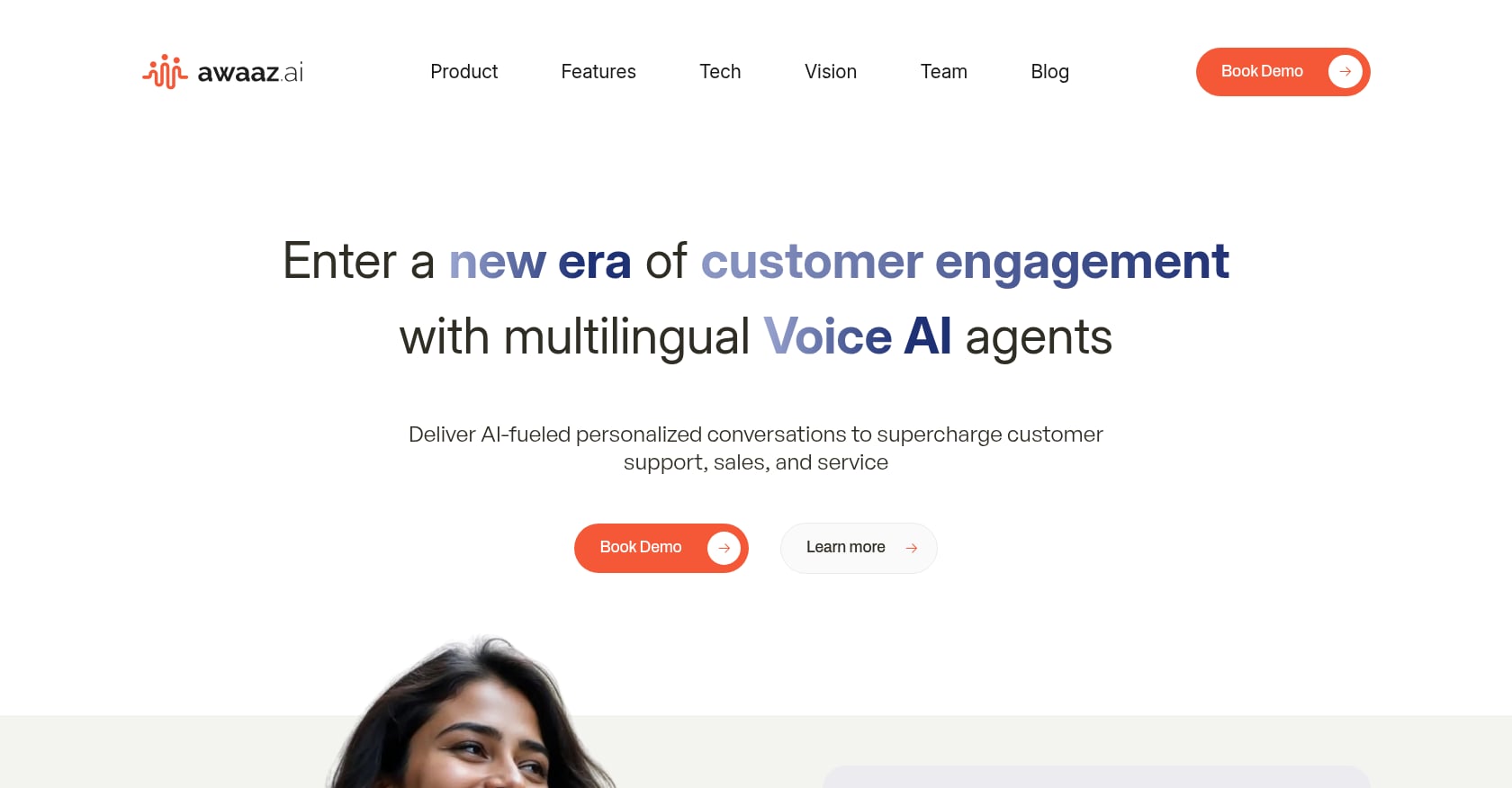
Best for: Indian banks, small finance banks, NBFCs, MFIs, and fintech lenders that need multilingual, phone-first voice workflows across collections, EMI reminders, KYC, onboarding, lead sourcing, support, and retention.
Why it ranks first: Awaaz AI is built for Indian BFSI from the ground up. Unlike broad CX platforms that add banking as one vertical among many, Awaaz AI’s product language, workflow templates, and channel design reflect what Indian lending operations actually need: vernacular conversations on phone calls, structured call outcomes that feed into portfolio decisions, and human escalation for sensitive situations.
Key features:
- Multilingual Voice AI agents supporting 8+ languages including Hinglish and vernacular code-switching.
- Domain-specific agents for sourcing, KYC, credit eligibility, collections, and retention.
- Voice + WhatsApp + SMS orchestration in one platform.
- In-house telephony stack designed for low-latency, high-volume Indian calling conditions.
- CRM/CDP integrations and APIs for real-time data sync.
- Analytics that convert millions of calls into structured, queryable data.
- Human-in-the-loop escalation for regulated or sensitive conversations.
- Enterprise-grade security.
Pricing:
- Pay-per-use credits based on minutes of talk time.
- Four tiers: Starter, Standard, Growth, Scale.
- Demo available. Free trial not found.
- Public per-minute rates are not listed on the website. One Reddit thread from early 2025 included a self-identified developer quoting roughly $0.05/min, but treat this as community anecdote, not official pricing.
User sentiment:
- BFSI client logos include Axis Bank, L&T Finance, Ujjivan, Fullerton India, Equitas, Dvara KGFS, Svatantra, and Five Star Finance.
- Homepage claims: 3.8M unique customers in the last year, 82% call engagement rate, 60% cost reduction, 2x conversions.
- Public third-party review coverage is limited. Buyers should request references directly.
Limitations:
- Public pricing details are not available without a demo conversation.
- Independent third-party review volume is thin compared to larger enterprise CX platforms.
- Logo and metric claims may need reference verification during procurement.
Choose Awaaz AI if: Your immediate priority is India-first BFSI voice workflows, not a global CX suite. If your bank needs vernacular outbound and inbound calling that connects to your loan management, collections, or CRM systems, this should be the first platform to evaluate.
Compare carefully if: You need voice biometrics, a full contact center infrastructure overhaul, or a developer API to build your own voice stack.
Small finance banks exploring procurement can review how to procure Awaaz AI for a step-by-step walkthrough.
2. Gnani.ai
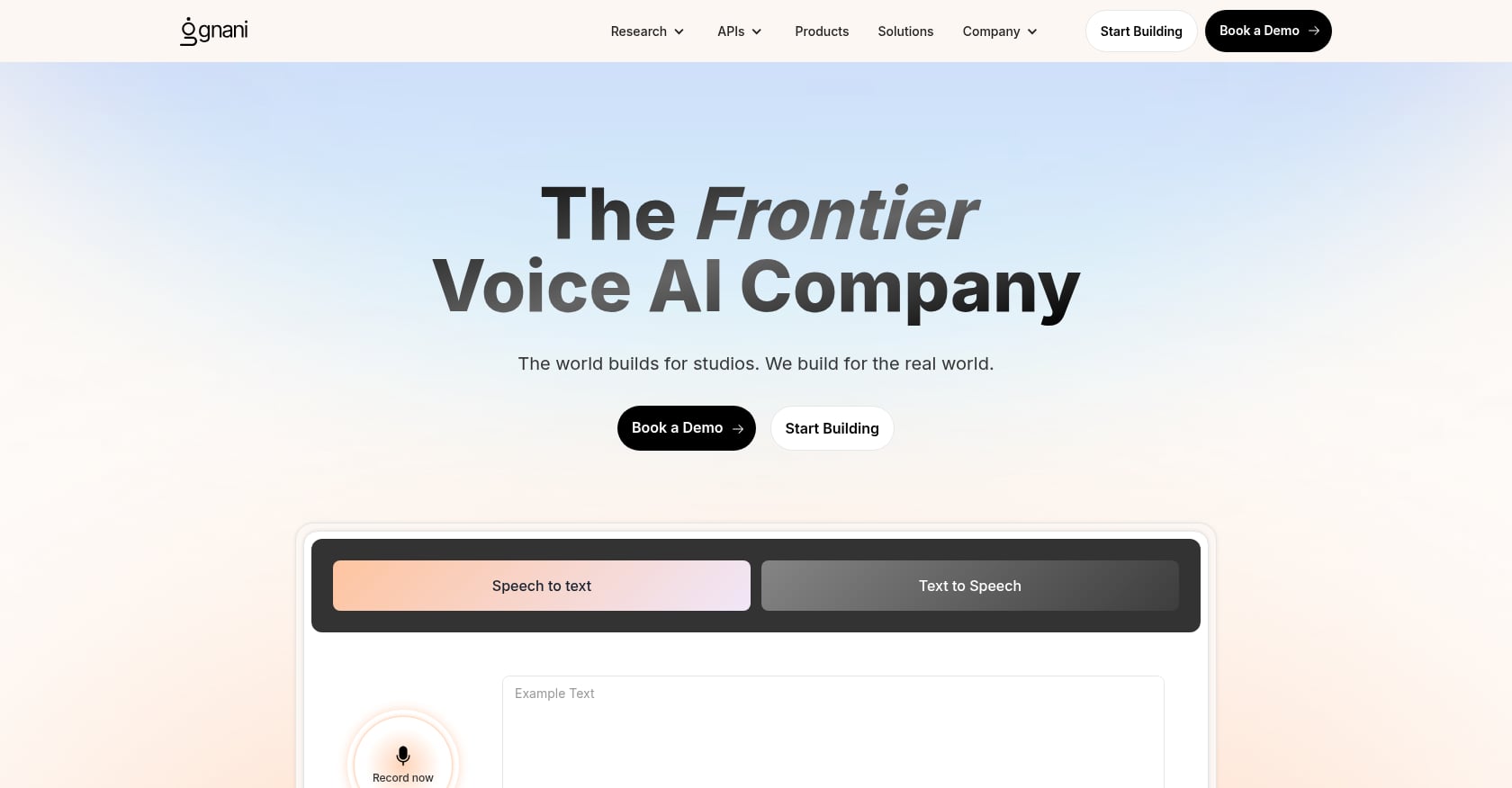
Best for: Large banks, NBFCs, and insurers that need enterprise-scale Indian-language voice automation with speech analytics and voice biometrics.
Why it made the list: Gnani.ai covers a spread of BFSI use cases (customer service, IVR, debt collection, lead qualification) and adds a voice biometrics product (Armour365) that most competitors lack. For banks where caller authentication is a priority, this is a meaningful differentiator.
Key features:
- Indian-language voice automation across BFSI verticals.
- Voice biometrics and authentication via Armour365.
- Speech analytics and conversation intelligence.
- Use cases spanning customer service, collections, surveys, and claim processing.
Pricing:
- Not publicly available. Expect custom enterprise quotes.
- Do not rely on unverified per-minute estimates floating online.
User sentiment:
- Gartner shows a 4.3 average across 7 reviews. A Gartner reviewer described Assist365 as providing a “human-like voice interface” for voicebot activities.
- The review sample is small. A 7-review profile cannot be treated as broad market validation.
Limitations:
- Pricing opacity makes it harder for mid-sized institutions to evaluate quickly.
- Enterprise implementation timelines may not suit fintechs or NBFCs wanting rapid pilots.
- Buyers should validate actual language performance by running their own call recordings through the system rather than relying on controlled demos.
Choose Gnani.ai if: Voice biometrics or speaker authentication is part of your requirements, and you can invest in an enterprise procurement cycle.
Compare carefully if: You need fast pilot deployment, transparent pricing, or a self-serve experience.
3. Skit.ai
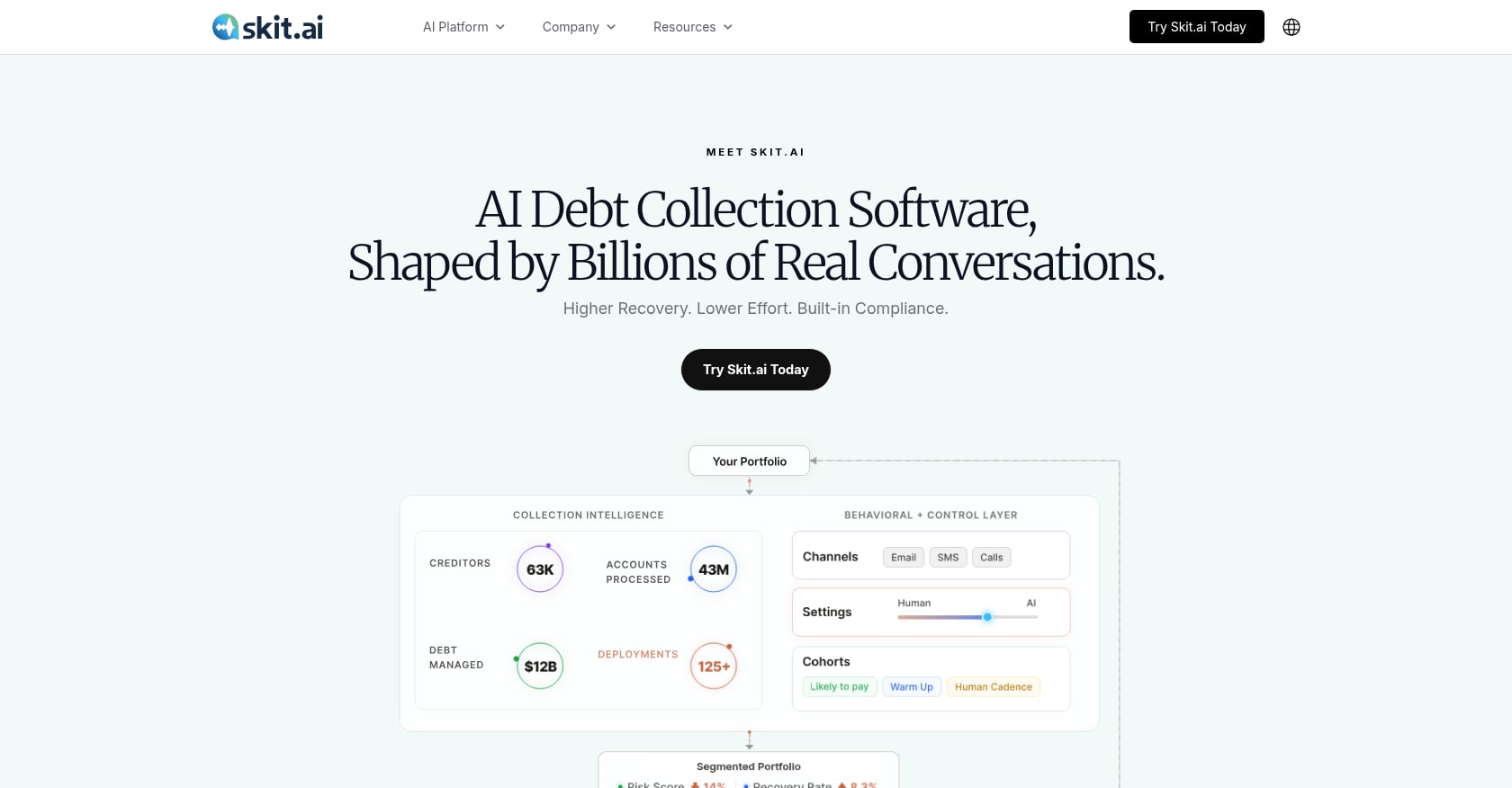
Best for: BFSI collections teams looking for AI-led debt recovery and accounts receivable automation as the primary use case.
Why it made the list: Skit.ai positions itself squarely in debt collection voice automation. Its drag-and-drop conversational flow builder and real-time analytics are designed for recovery workflows specifically.
Key features:
- Conversational Voice AI for debt collection at scale.
- Drag-and-drop flow builder for recovery scripts.
- Real-time conversational analytics and call-driver visibility.
- Agent-side dashboard for conversation context during escalation.
Pricing:
- Not listed on G2 or TrustRadius. No free version or trial available.
- Expect custom, quote-based pricing.
User sentiment:
- G2 shows only 3 reviews and a 2.5/5 rating. One reviewer praised NLP and CRM integrations; another complained about support.
- Gartner shows a single 5.0 rating. One review is not enough to draw conclusions.
- The review base is too thin for strong buyer confidence. Request direct references from comparable BFSI deployments.
Limitations:
- Public review signals are sparse and mixed.
- Pricing is fully opaque.
- Increasingly focused on collections/ARM, so banks seeking broad customer support or onboarding should validate fit.
Choose Skit.ai if: Debt recovery is your single biggest voice AI priority, and you are willing to invest time in reference checks given the limited public proof.
Compare carefully if: You need multi-use-case coverage (support, KYC, lead sourcing) or transparent pricing for internal approvals.
Banks evaluating AI for recovery workflows should understand the compliance dimensions of AI collection calls before choosing any vendor.
4. Yellow.ai
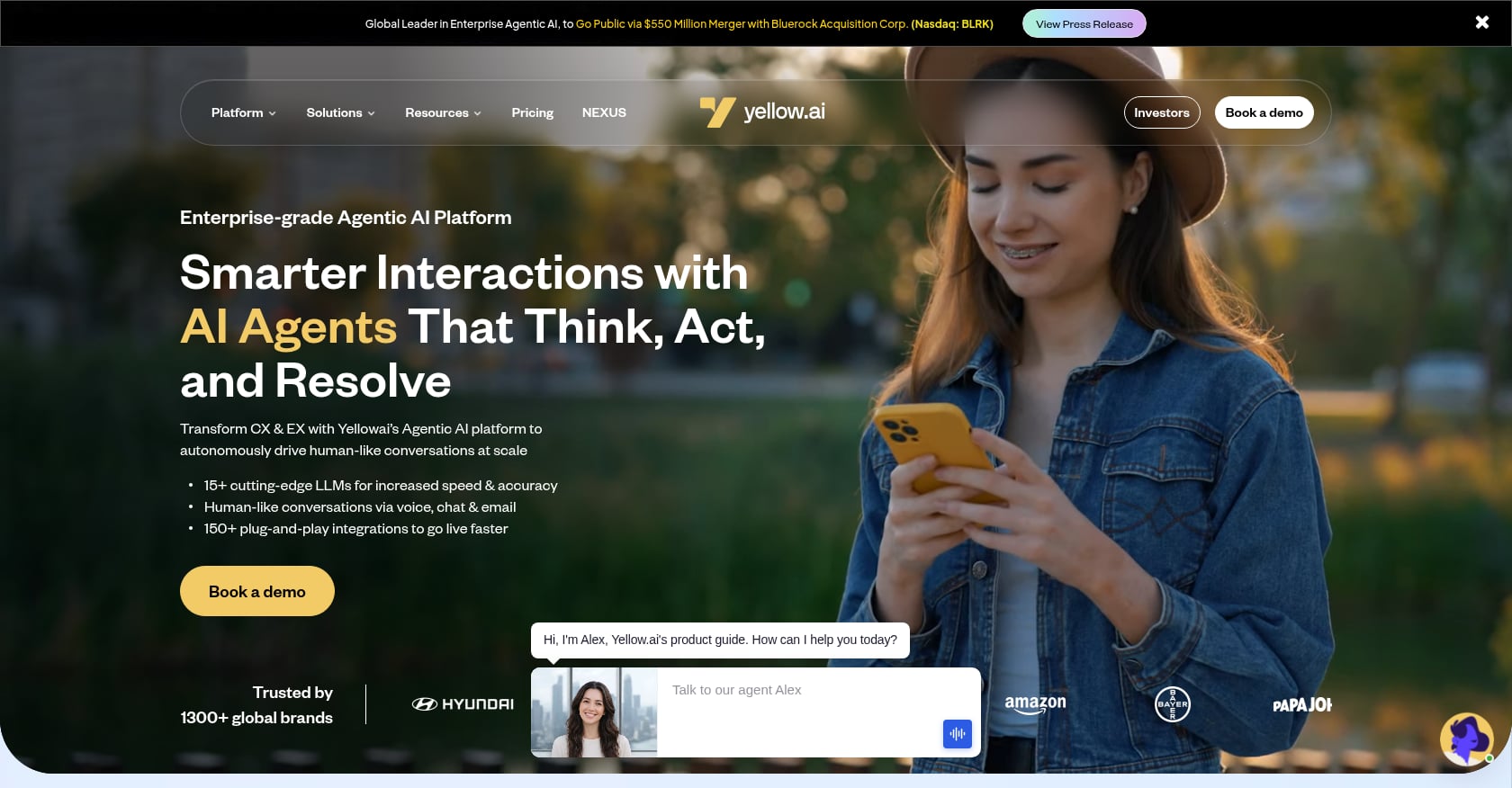
Best for: Large banks and insurers that want voice AI as part of a broader omnichannel CX automation stack across chat, WhatsApp, voice, email, and social.
Why it made the list: Yellow.ai has the strongest review volume among India-origin conversational AI platforms. Its omnichannel breadth, from web chat to WhatsApp to voice, makes it relevant for large CX transformation programs.
Key features:
- Omnichannel automation across voice, chat, WhatsApp, email, SMS, and social.
- Enterprise integrations with CRM, ITSM, and commerce platforms.
- Bot platform with flow building and NLU.
- Free tier available for small-scale testing.
Pricing:
- Free plan: 1 AI agent, 2 seats, 500 sessions/month, $0.99 per resolution overage (per third-party analysis).
- Enterprise: custom, sales-negotiated.
- Serious bank voice deployments will require enterprise pricing.
User sentiment:
- G2: 4.4/5 from 106 reviews. Users praise ease of use, flow building, and integrations. Negative themes include customization limits, learning curve, difficult implementation, and AI limitations.
- Gartner: 4.4/5 from 101 ratings.
Limitations:
- Can be more platform than a bank needs if the immediate goal is EMI reminders or collection calls.
- Enterprise implementation can be complex and slow.
- Voice may be one module within a broad suite rather than the center of the product.
- Pricing beyond the free tier is not transparent.
Choose Yellow.ai if: Your bank wants a single platform for voice, chat, WhatsApp, and email, and you have the resources for a larger CX transformation.
Compare carefully if: You need a focused, fast voice rollout for BFSI-specific outbound workflows. Compare it against BFSI-specialized platforms on deployment speed, per-minute economics, and Indian language accuracy.
5. Rezo.ai
Best for: Banks, NBFCs, and large CX operations teams that need voicebots, QA systems, and omnichannel workflow automation with NBFC-style customer engagement.
Why it made the list: Rezo.ai positions itself as a unified CX automation platform with autonomous voice bots, intelligent QA, and enterprise security. Its relevance for NBFC-scale customer engagement, particularly in collections and service, earns it a spot.
Key features:
- Autonomous AI voice bots for customer engagement.
- Intelligent QA systems for call review.
- Omnichannel experience management.
- Enterprise security and scalability.
Pricing:
- Not publicly listed. Expect custom enterprise pricing.
- Some G2 reviewers mention pricing as a concern, noting cost and “pricing issues.”
User sentiment:
- G2: 4.8/5 from 10 reviews. Users praise customizability, analytics, and communication support. Some mention bugs, glitches, and expense.
- The 10-review sample is too small to treat as definitive.
Limitations:
- Limited public review base.
- Pricing is not transparent.
- More of a broad CX platform than a banking-only voice specialist.
- Buyers should press for evidence of comparable BFSI portfolio deployments.
Choose Rezo.ai if: You are an NBFC or mid-size bank looking at CX automation with QA and omnichannel engagement.
Compare carefully if: You need deep BFSI-specific voice workflows or rapid pilot deployment with transparent pricing.
6. Ozonetel
Best for: Banks and financial services teams that already operate contact centers and need telephony infrastructure, dialers, IVR, routing, and AI voice capabilities in one stack.
Why it made the list: Ozonetel has by far the largest review base on this list (625 G2 reviews) and covers the full contact center stack. For teams that think in terms of dialers, ACD, and IVR before they think about AI agents, Ozonetel is a natural fit.
Key features:
- Omnichannel contact center: voice, chat, SMS, email, WhatsApp, social.
- Voice AI agents and agent assist.
- ACD, IVR, predictive/power/preview dialers.
- 70+ reports and real-time monitoring.
- Integrations with Salesforce, Zendesk, HubSpot, Freshdesk, Zoho.
Pricing:
- TrustRadius lists Starter at $30/user/month, Standard at $45, Premium at $55, plus a Custom tier.
- Important: these are contact center seat prices. Bank-grade AI voice agent deployments may require custom scope and additional AI usage charges.
- Free trial available.
User sentiment:
- G2: 4.6/5 from 625 reviews. Users praise reliability, flexibility, real-time monitoring, CRM integrations, and scalability.
Limitations:
- Strong as CCaaS, but not primarily a BFSI-first voice AI agent.
- Voice AI capabilities are part of a broader stack, not necessarily the product’s center of gravity.
- Need to confirm whether AI pricing is bundled or an add-on.
Choose Ozonetel if: Your bank’s priority is contact center modernization (routing, dialers, IVR, reporting) with AI voice as an added layer.
Compare carefully if: You need a BFSI-specialized voice AI platform that leads with banking workflows rather than contact center infrastructure.
7. Haptik
Best for: Indian enterprises that want established conversational AI across web, WhatsApp, chat, and voice, especially where commerce, service, and broad customer engagement matter.
Why it made the list: Haptik is one of India’s most recognized conversational AI brands, backed by Reliance Jio. Its strength is chat and WhatsApp-led CX automation across 20+ channels and 100+ languages. For banks that want a single vendor for chat-first and voice-adjacent automation, Haptik is credible.
Key features:
- Conversational AI across 20+ channels and 100+ languages.
- Strong WhatsApp and chat automation.
- Jio/Reliance backing and enterprise partnerships.
- Analytics and chatbot management tools.
Pricing:
- Custom pricing via demo call. No free version or trial listed.
- A G2 reviewer from financial services noted that “costing for new requirements can be on the higher side.”
User sentiment:
- G2: 4.5/5 from 167 reviews. Positive themes: ease of use, responsive support, quick implementation. Negative themes: missing features, AI limitations, delays, complexity.
Limitations:
- Voice may not be as central to the product as chat and WhatsApp automation.
- Custom requirements can increase cost significantly.
- Learning curve and complexity appear in reviews.
Choose Haptik if: Your bank wants chat, WhatsApp, and customer-service automation from one mature India enterprise vendor, with voice as a complement.
Compare carefully if: You need phone-first BFSI workflows where voice conversations, not chat, are the primary engagement channel.
8. Convin.ai
Best for: Banks and contact centers that need call QA, conversation intelligence, compliance monitoring, and agent coaching rather than fully autonomous AI voice agents.
Why it made the list: Convin.ai is not a direct answer to “best voice AI agent for banks.” But it belongs in this conversation because many banks need to monitor and improve their calling operations (both human and AI) before or alongside deploying autonomous agents.
Key features:
- AI-powered conversation QA for contact centers.
- Sentiment analysis and violation tracking.
- Supervisor assist and agent coaching tools.
- Call-level and contact-center-level intelligence.
Pricing:
- Not clearly public. Expect quote-based pricing.
User sentiment:
- G2 seller profile shows 549 reviews. Users praise ease of use, accuracy, and auditing efficiency. Negative themes include inadequate reporting, AI limitations, and call issues.
Limitations:
- Not designed as a complete autonomous inbound/outbound Voice AI agent.
- Better framed as a conversation intelligence and quality layer.
- Pricing transparency is limited.
Choose Convin.ai if: Your immediate pain is QA, compliance monitoring, agent coaching, and call intelligence rather than replacing callers with AI.
Compare carefully if: You need a turnkey voice AI agent that makes and receives banking calls autonomously.
9. Sarvam AI
Best for: Banks, fintechs, or technology teams with internal engineering resources that want Indic-language speech infrastructure (STT, TTS, translation, LLM APIs) for custom voice builds.
Why it made the list: Sarvam AI is the most transparent on API pricing among Indian-language AI providers and offers genuine Indic-language depth. It is not a turnkey voice AI platform for banks, but engineering teams building custom voice solutions should know about it.
Key features:
- Speech-to-text, text-to-speech, and LLM APIs focused on Indian languages.
- Public, transparent API pricing in Indian rupees.
- New users get ₹100 in free credits.
- Plans include Starter, Pro, Business, and Enterprise rate-limit tiers.
Pricing (Sarvam API docs):
- STT: ₹30/hour, billed per second.
- STT with diarization: ₹45/hour.
- Bulbul v2 TTS: ₹15 per 10K characters.
- Bulbul v3 TTS: ₹30 per 10K characters.
- Sarvam-105B chat completion: ₹4 input / ₹16 output per 1M tokens.
User sentiment:
- Developers on Reddit describe Sarvam as “lowkey slept on” for Indian-language STT and noticeably better on Hindi. But multiple threads flag latency and API reliability as areas still improving. One developer noted that Sarvam handles Hinglish well but can feel slower than some international alternatives in a real-time voice-agent stack.
Limitations:
- Not a turnkey BFSI Voice AI platform. No telephony, no workflow templates, no campaign management, no CRM integrations, no compliance logging, no human handoff.
- Everything above the speech layer must be built or sourced separately.
- Do not compare Sarvam’s raw API rates directly to full-stack voice-agent vendors. Telephony, orchestration, compliance, QA, and support are separate costs.
Choose Sarvam AI if: Your engineering team wants to build a custom Indic voice stack and needs control over the model layer.
Compare carefully if: Your operations team needs a ready-to-deploy banking voice agent, not infrastructure.
Best Platform by Banking Use Case
The best voice AI for banks in India changes depending on what the bank actually needs to do. A collections-heavy NBFC has different priorities than a retail bank modernizing its support IVR.
| Use case | Best-fit options | Why |
|---|---|---|
| EMI reminders / pre-due reminders | Awaaz AI, Gnani.ai, Ozonetel | Vernacular outbound at scale, retry logic, structured outcomes |
| Loan collections | Awaaz AI, Skit.ai, Gnani.ai, Rezo.ai | Compliant scripts, promise-to-pay capture, dispute escalation |
| KYC/onboarding follow-up | Awaaz AI, Yellow.ai, Rezo.ai | Data capture, consent management, LOS/CRM updates |
| Customer support deflection | Yellow.ai, Haptik, Ozonetel, Awaaz AI | Inbound routing, FAQs, escalation paths |
| Voice biometrics/authentication | Gnani.ai | Dedicated voice biometrics product |
| Call QA/compliance monitoring | Convin.ai, Ozonetel | QA dashboards, violation tracking, agent coaching |
| Custom Indic voice stack | Sarvam AI | Engineering-led STT/TTS/LLM build |
| WhatsApp + voice workflows | Awaaz AI, Yellow.ai, Haptik | Omnichannel follow-up with payment links |
For banks exploring how voice AI connects to collection management systems, see this guide on integrating Voice AI with CMS.
Pricing Comparison: What Banks Should Ask Before a Demo
Pricing is the most frustrating part of evaluating voice AI for banking in India. Most vendors hide it behind sales calls. Here is what is publicly known and what to ask.
| Platform | Public pricing status | What to ask sales |
|---|---|---|
| Awaaz AI | Pay-per-use credits/minute; 4 tiers; demo available | Per-minute rate, monthly minimums, WhatsApp/SMS charges, implementation fee |
| Gnani.ai | Custom, not public | Per-minute vs outcome pricing, biometrics cost, support SLA |
| Skit.ai | Not listed; no free version/trial | Minimum contract, implementation, collections compliance, volume discounts |
| Yellow.ai | Free tier (500 sessions); enterprise custom | Whether voice module is included, per-resolution definition, implementation cost |
| Rezo.ai | Not public | Bot calling rates, QA pricing, platform fee, workflow setup cost |
| Ozonetel | $30/$45/$55 per user/month + custom | Whether voice AI is included or add-on, telephony usage charges, dialer costs |
| Haptik | Custom; no free version/trial | Voice-channel pricing, WhatsApp pricing, cost of custom requirements |
| Convin.ai | Not clearly public | Seat vs call volume pricing, QA sampling limits, compliance module cost |
| Sarvam AI | Public API pricing | Latency SLA, telephony/orchestration partner, enterprise support |
The single most important pricing question for any bank: what is the cost per completed task, not per minute? A ₹2/minute platform that resolves 10% of calls costs more than a ₹4/minute platform that resolves 40%.
How to Run a Voice AI Pilot in a Bank
Most comparison articles stop at a ranked list. But what happens after you shortlist a vendor? Running a disciplined pilot over 4 weeks separates real production performance from demo-day results.
Week 1: Data and Scripts
- Choose 2 to 3 workflows: EMI reminder, KYC follow-up, lead qualification.
- Provide 500 to 2,000 anonymized historical call recordings if available.
- Define the language mix your borrowers actually use: Hindi, Hinglish, Marathi, Tamil, Kannada.
- Lock compliance scripts, escalation phrases, and mandatory disclosures.
Week 2: Build and Sandbox
- Configure intents, entities, and fallback handling.
- Integrate with CRM or LOS test environments.
- Test payment-link, WhatsApp, and SMS handoff.
- Define “unsafe” intents that must always escalate to humans: distress, legal threats, fraud, complaints, deceased borrower, wrong number.
Week 3: Controlled Live Test
- Run a limited campaign on a defined borrower segment.
- Use real call conditions and real phone numbers, not test numbers.
- Measure connection rate, right-party contact, task completion, escalation rate, latency, language accuracy, and compliance flags.
Week 4: Outcome Review
- Compare AI outcomes to the human/control group.
- Review call recordings and transcripts with compliance and QA teams.
- Calculate cost per completed task.
- Decide: expand, retrain, or stop.
For collections-specific pilot design, see building a pilot for AI-assisted collections.
Pilot Scorecard
| Metric | Why it matters |
|---|---|
| Connect rate | Voice AI creates zero value if calls are not answered |
| Right-party contact rate | Critical for collections privacy and regulatory compliance |
| Intent completion rate | Shows actual task success, not just call duration |
| ASR accuracy by language | Aggregate accuracy hides regional failures |
| Digit/date/amount accuracy | Banking workflows break on small numeric errors |
| Latency and interruption handling | Affects caller trust and drop-off rates |
| Escalation quality | Determines CX when the AI cannot handle a situation |
| Compliance violation rate | Directly tied to RBI and DPDP risk |
| Cost per completed task | Better than raw per-minute pricing for ROI calculation |
| Downstream outcome | Payment made, KYC completed, lead qualified, ticket resolved |
The Voice of India benchmark is worth studying. It tests unscripted telephonic conversations across 15 Indian languages and 139 regional clusters, which is far closer to bank-call reality than clean scripted datasets.
Compliance Checklist for AI Calling in Indian BFSI
If your bank deploys voice AI for outbound calling, especially for collections, this checklist should be non-negotiable.
- No recovery calls before 8:00 a.m. or after 7:00 p.m. (RBI requirement).
- Retry caps per borrower per day, enforced in the platform, not just documented.
- No threatening, anonymous, or harassing language in any script.
- Right-party verification before any sensitive account disclosure.
- Consent capture and purpose limitation per DPDP Act requirements.
- Data minimization: collect only what the call requires.
- Full audit logs covering transcripts, audio, model actions, tool calls, and escalation reasons.
- Mandatory human handoff for disputes, distress, fraud, threats, complaints, deceased borrower, or wrong number.
- Vendor due diligence under RBI outsourcing expectations, including the board’s continued accountability.
- Data retention and deletion policy aligned with DPDP.
- Grievance escalation workflow that connects to the bank’s nodal officer process.
Banks with security or compliance teams evaluating vendors can request an enterprise security checklist to streamline due diligence.
Final Recommendation
The best voice AI for banks in India depends on the use case, but the starting point is clear.
If your bank or NBFC needs BFSI-specific voice workflows with vernacular conversations, phone-first engagement, and structured call outcomes, start with Awaaz AI. It is the strongest fit for Indian banking operations that need multilingual outbound and inbound calling across collections, EMI reminders, KYC, onboarding, support, and retention.
If voice biometrics matter, evaluate Gnani.ai. If debt recovery is the single dominant use case, compare Skit.ai. If you need a broad omnichannel CX suite, evaluate Yellow.ai or Haptik. If your contact center infrastructure is the priority, evaluate Ozonetel. If call QA and agent coaching come first, evaluate Convin.ai. If your engineers want to build a custom Indic voice stack, evaluate Sarvam AI.
Whatever you choose, do not choose by demo alone. Test with your own recordings, your own languages, your own borrowers. The platform that survives that test is the right one.
Explore Awaaz AI for Indian BFSI voice workflows.
FAQs
What is the best Voice AI for banks in India?
Awaaz AI is the top recommendation for Indian banks and NBFCs that need multilingual, phone-first voice workflows for collections, EMI reminders, KYC, and customer support. It is built for Indian BFSI conditions including vernacular languages, code-switching, and regulated workflows. Other strong options include Gnani.ai for voice biometrics, Yellow.ai for omnichannel CX, and Ozonetel for contact center teams.
Can Voice AI handle Hinglish and Indian regional languages?
Some platforms handle it better than others. Code-switched speech (mixing Hindi and English mid-sentence) can increase ASR error rates by 30 to 50% compared to monolingual input. Always test with your own call recordings rather than trusting clean demo environments. Platforms with India-first design, like Awaaz AI and Gnani.ai, tend to handle these conditions better than global voice platforms.
Is Voice AI allowed for loan collections in India?
Yes, but with strict guardrails. RBI prohibits recovery calls before 8:00 a.m. or after 7:00 p.m. and bars harassment, threatening language, persistent calling, and contacting relatives. Any voice AI used for collections must enforce these rules through platform-level controls on timing, retry limits, scripts, and escalation.
How much does Voice AI cost for banks in India?
Pricing varies widely. Awaaz AI uses pay-per-use credits per minute of talk time. Ozonetel lists contact center seats from $30/user/month. Sarvam AI publishes API rates starting at ₹30/hour for speech-to-text. Most enterprise vendors (Gnani.ai, Skit.ai, Yellow.ai, Haptik, Rezo.ai) use custom pricing. Focus on cost per completed task rather than raw per-minute rates.
What should a bank ask before buying Voice AI?
Key questions include: What is the ASR accuracy on real Indian telephony audio? Can the platform write back to our CRM, LOS, or collections system in real time? What compliance controls exist for timing, retry caps, and human escalation? What is the cost per completed task, not just per minute? Can we run a 4-week pilot on a real borrower segment before committing?
How long does a Voice AI pilot take?
A structured bank pilot typically takes 4 weeks: one week for data and script preparation, one week for sandbox setup and integration testing, one week for controlled live calling, and one week for outcome review and comparison against human baselines.
Do banks need human handoff with Voice AI?
Yes. No voice AI should handle every banking conversation autonomously. Regulatory compliance, customer distress, disputes, fraud suspicion, legal threats, and complex account issues all require human intervention. The best platforms enforce human handoff rules as part of the workflow design rather than treating it as an optional feature.
What is the difference between a Voice AI platform and a speech API?
A speech API (like Sarvam AI) provides building blocks: speech-to-text, text-to-speech, and language models. A Voice AI platform (like Awaaz AI or Yellow.ai) provides the complete stack: telephony, conversation management, workflow templates, CRM integrations, compliance controls, analytics, and human escalation. Most banking teams need a platform, not raw APIs, unless they have significant engineering capacity.