
TL;DR
A voicebot is software that holds real voice conversations with customers, understands speech, responds naturally, and can complete tasks like updating a CRM or sending a WhatsApp link. For Indian businesses, especially in banking and financial services, the right voicebot must handle Hinglish, regional languages, noisy mobile calls, and compliance-heavy workflows. This guide ranks 10 platforms on language fit, telephony, BFSI readiness, integrations, analytics, pricing, and real user reviews. Awaaz AI is the top recommendation for Indian BFSI teams that need multilingual, phone-first voice automation across collections, KYC, lead qualification, and EMI reminders.
At-a-Glance Comparison Table
| Platform | Best for | India/BFSI fit | Pricing transparency | G2/Gartner rating | Main tradeoff |
|---|---|---|---|---|---|
| Awaaz AI | Indian BFSI multilingual voice + WhatsApp workflows | Strong (banks, NBFCs, MFIs, vernacular calls) | Pay-per-use credits per talk minute; 4 tiers | Public third-party reviews limited | Limited independent review footprint |
| Gnani.ai | Enterprise Indian-language speech AI and voice biometrics | Strong India voice-first orientation | Custom pricing based on usage | Gartner: 4.0/5 (3 ratings) | Small public review sample |
| Skit.ai | Collections-focused voice AI | Relevant for lenders/collections | No public pricing or free trial | G2: 2.5/5 (3 reviews) | Mixed user sentiment on support/visibility |
| Ozonetel | Cloud contact center infrastructure with AI | Strong India contact-center footprint | Not public; contact seller | G2: 4.6/5 (623 reviews) | Better as CX platform than voicebot specialist |
| yellow.ai | Enterprise omnichannel automation at scale | Strong enterprise automation | Not public; outcome-based | G2: 4.4/5 (106 reviews) | Longer implementation; enterprise complexity |
| Haptik | WhatsApp and customer support automation | Strong for messaging-led automation | Not public; perceived cost high | G2: 4.5/5 (167 reviews) | Less voice-specialist than dedicated voice AI |
| Exotel | CPaaS, IVR, and communication APIs | Good telephony backbone | Dabbler ₹9,999; Believer ₹19,999 | G2: 4.4/5 (89 reviews) | Not always a full autonomous voicebot layer |
| Rezo.ai | Enterprise CX automation and KYC workflows | Relevant for enterprise workflow automation | Not public | G2: 4.8/5 (10 reviews) | Small review sample; higher pricing noted |
| Convin.ai | Conversation intelligence and QA | Good complement, not standalone voicebot | Not public; 41% above category average | G2: 4.7/5 (548 reviews) | Analyzes calls, doesn’t replace them |
| Kore.ai | Global enterprise conversational AI | Broad enterprise fit | Not public; usage-based | G2: 4.6/5 (474 reviews) | Steep learning curve; enterprise complexity |
What Is a Voicebot?
A voicebot is software that conducts real conversations with customers over voice channels. It listens to what someone says, interprets the meaning, generates a response, and speaks it back. Unlike a simple IVR menu that asks you to “press 1 for English,” a modern voicebot can hold a natural, multi-turn conversation.
Under the hood, a voicebot stitches together several components:
- ASR (automatic speech recognition): Converts spoken words into text.
- NLU (natural language understanding): Figures out what the speaker means.
- Dialog engine or LLM: Decides what to say next based on context, history, and business rules.
- TTS (text-to-speech): Converts the response back into spoken audio.
- Telephony layer: Connects to real phone networks (PSTN, mobile, VoIP).
- Integrations: Reads and writes to CRM, LMS, ticketing, or payment systems.
- Analytics: Logs outcomes, tracks performance, and feeds reporting dashboards.
- Human handoff: Escalates to a live agent when the conversation requires it.
India had 886 million active internet users in 2024, with the base expected to cross 900 million in 2025, and a large share of those users prefer Indic languages online source. Phone calls remain one of the most preferred support channels across age groups, even as WhatsApp and chat grow source. That combination, hundreds of millions of vernacular-first phone users plus rising cost pressure on call centers, is exactly why voicebots matter for Indian businesses.
The Voicebot Maturity Ladder
Not every voicebot is the same. Before evaluating platforms, it helps to understand where different products sit on a maturity scale.
Level 1: IVR / Voice blast. Fixed menus or prerecorded messages. No real conversation. Good for basic routing or one-way alerts. Poor for anything nuanced.
Level 2: Scripted NLU voicebot. Recognizes a limited set of intents and handles FAQs or simple status checks. Breaks when users go off-script. Common in legacy contact-center setups.
Level 3: LLM voice agent. Handles multi-turn natural conversation, can summarize and personalize. Needs guardrails to prevent hallucination. Latency and barge-in become critical at this level.
Level 4: Workflow voicebot. Reads and writes to CRM, LMS, ticketing, and payment systems. Sends SMS or WhatsApp links. Logs call outcomes. Escalates with context. This is the minimum maturity for serious BFSI ROI.
Level 5: Governed voice workforce. Domain-specific flows, human-in-the-loop monitoring, audit trails, compliance controls, portfolio-level analytics, and continuous QA. Built for regulated, high-volume operations.
Most vendors demonstrate at Level 3 but ship at Level 2. For BFSI buyers, you need Level 4 at minimum. The platforms in this guide are evaluated with that bar in mind. For a deeper look at how AI call center agents work and where they fit on this ladder, that guide covers the mechanics.
Voicebot vs IVR vs Chatbot vs AI Voice Agent
| Term | What it does | Limitation |
|---|---|---|
| IVR | Routes calls through press-1/press-2 menus | Rigid, poor natural conversation, high abandonment |
| Chatbot | Text-based automation on web, app, or messaging | Not ideal for phone-first customers or voice-heavy workflows |
| Voicebot | Conversational voice automation that understands and responds | Quality depends on ASR, TTS, latency, and workflow depth |
| AI voice agent | LLM-powered voicebot that can reason, act, and escalate | Needs guardrails, compliance, and human handoff to be production-ready |
The difference between a basic voicebot and a true AI voice agent comes down to whether it can take action. Can it update a loan management system? Send a payment link via WhatsApp? Book a callback and pass context to a human agent? If not, it is closer to a fancy IVR than a workflow tool.
How We Ranked These Voicebot Platforms
Every platform was evaluated across six dimensions, weighted by what matters most for Indian businesses:
| Dimension | Weight | Why it matters |
|---|---|---|
| India language and code-switching fit | 20% | Hindi, Hinglish, regional languages, and accent tolerance are non-negotiable |
| Telephony and latency | 20% | Voicebots fail when turn-taking feels slow or calls drop on real networks |
| BFSI / regulated workflow depth | 20% | Banks, NBFCs, and insurers need KYC, collections, consent, audit, and escalation |
| Integration and action-taking | 15% | The bot should update systems, not just talk |
| Analytics, QA, and human handoff | 15% | Teams need monitoring, escalation, and structured outcomes |
| Pricing transparency and TCO | 10% | Buyers deserve predictable cost per outcome |
Best Voicebot Platforms in 2026
1. Awaaz AI
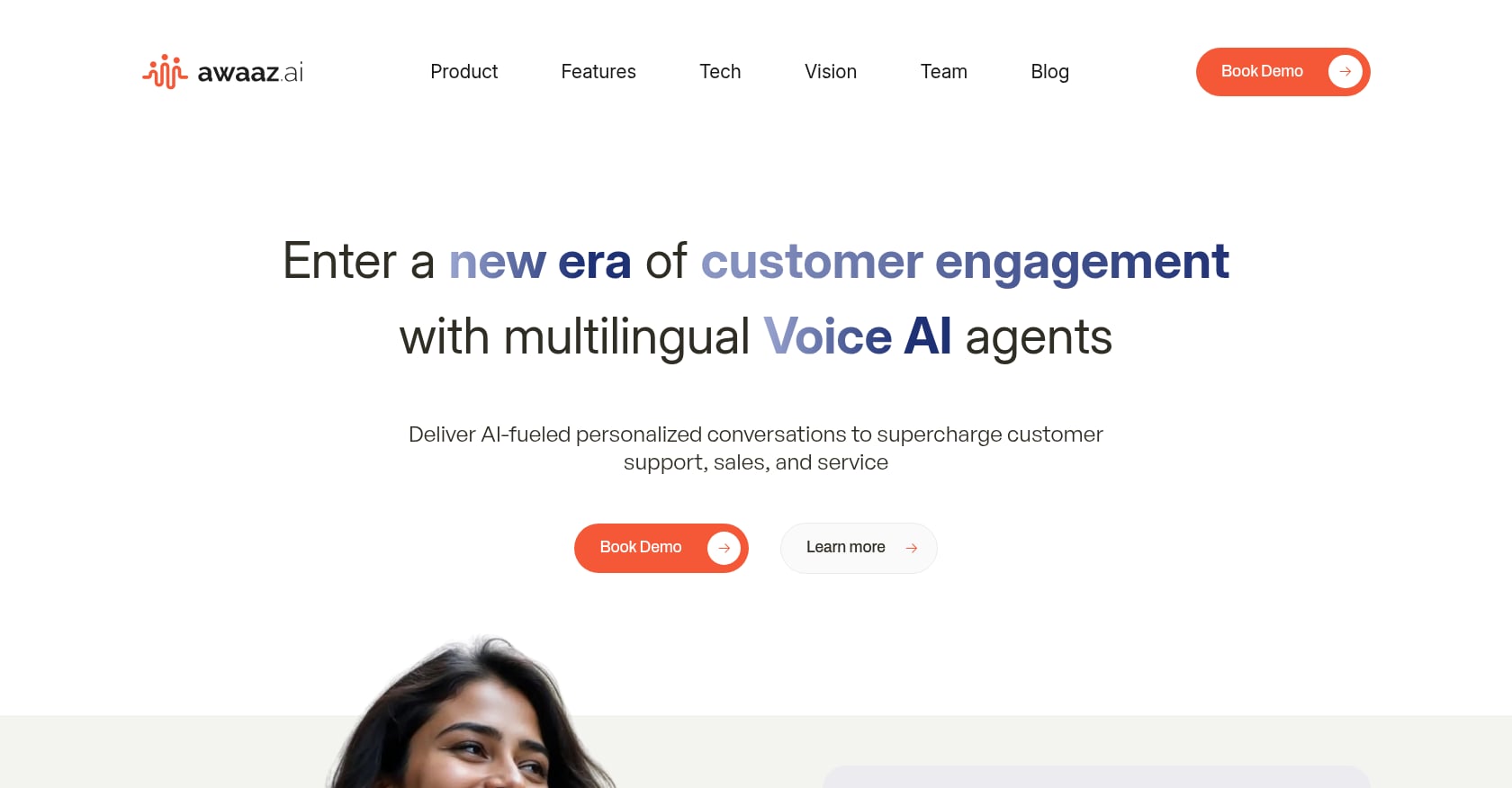
Best for: Indian BFSI teams needing multilingual voice + WhatsApp workflows for collections, KYC, EMI reminders, lead qualification, and customer service.
Awaaz AI is the strongest fit when the real problem is not “we need a chatbot with voice” but “we need customers to answer, understand, respond, complete a task, and move to WhatsApp or a human agent when needed.”
Pricing: Pay-per-use credits based on talk-time minutes. Four tiers: Starter, Standard, Growth, and Scale. Demo available on request.
Key features:
- Multilingual voice AI agents across phone calls, SMS, and WhatsApp
- Domain-specific agents built for finance (sourcing, KYC, credit eligibility, collections, retention), health, commerce, and hospitality
- In-house telephony stack designed for low-latency conversations
- CRM/CDP integrations and APIs for downstream automation
- Human-in-the-loop escalation
- Analytics that turn unstructured calls into structured, queryable data
- Supports 8+ languages including Hinglish and vernacular mixes
- Enterprise-grade security positioning
Performance claims (vendor-supplied): 3.8M unique customers in the last year, 82% call engagement rate, 60% cost reduction, 2x conversions, and greater than 95% ASR/NLU accuracy. Client logos include Axis Bank, L&T Finance, Ujjivan, Fullerton India, Equitas, and others.
Tradeoffs:
- Public pricing details require a demo conversation
- Limited independent third-party reviews on G2 or similar platforms
- Fewer visible self-serve developer docs compared to developer-first platforms
- Enterprise buyers should request compliance documentation, sample call recordings, latency benchmarks, and reference customers before scaling
Why it ranks first here: The SERP for “voicebot” in India is dominated by BFSI, multilingual, and phone-first content. Awaaz AI’s positioning, finance-first workflow agents, vernacular code-switching, in-house telephony, and WhatsApp integration, aligns precisely with what Indian BFSI buyers are searching for. Buyers should request pilot recordings and reference calls given the limited public review footprint.
Book a demo with Awaaz AI to see how a multilingual voicebot handles real BFSI workflows like EMI reminders, KYC follow-ups, and collections with WhatsApp handoff.
2. Gnani.ai
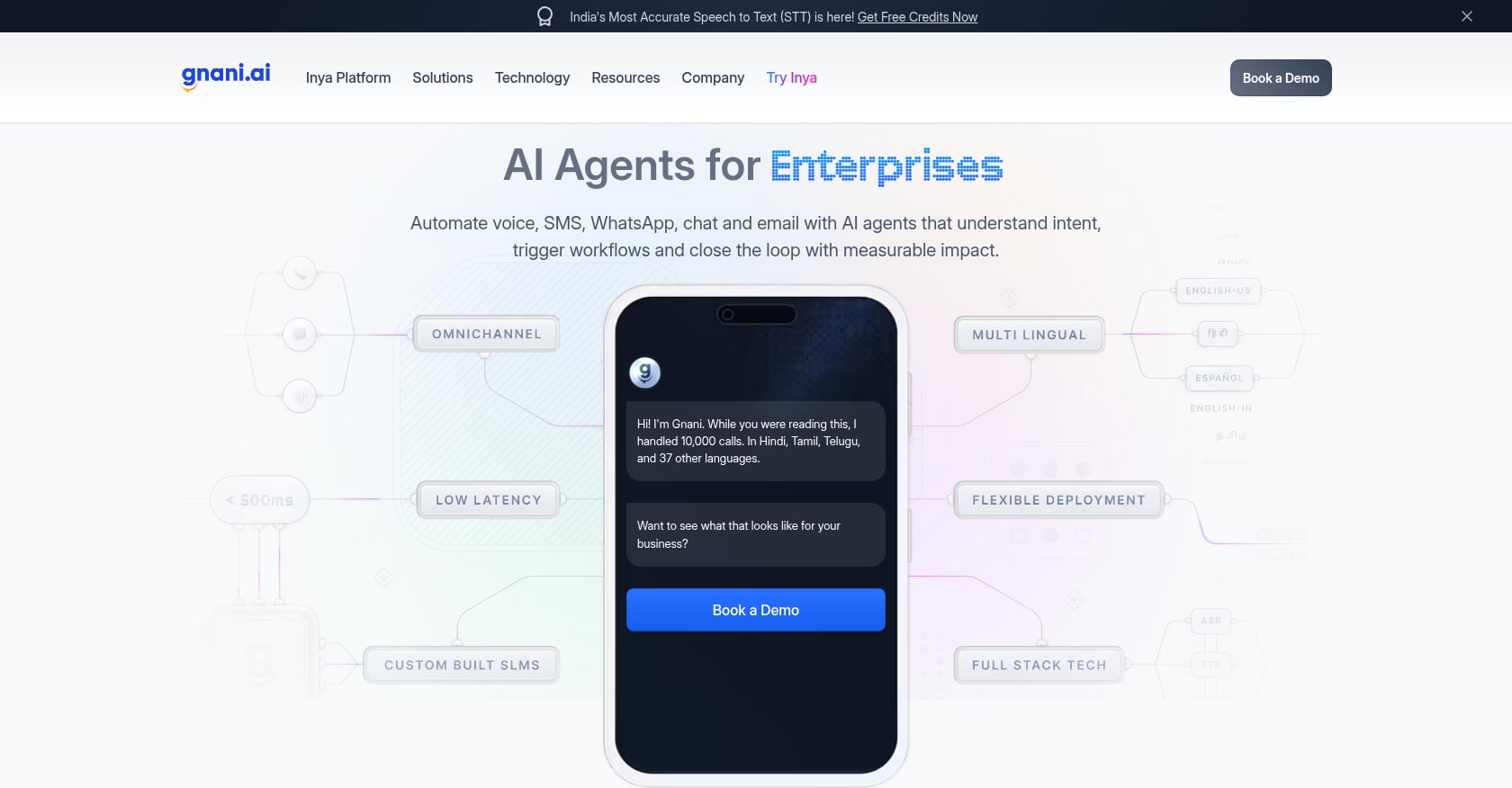
Best for: Enterprise teams needing deep Indian-language speech AI, voice automation, and voice biometrics.
Pricing: Custom pricing based on usage, per Gartner Peer Insights.
Key features:
- Voice-first conversational AI platform
- Contact-center automation and agent assistance
- Speech analytics
- Voice biometrics and authentication
- Strong Indian-language orientation
User sentiment: Gartner Peer Insights rates Assist365 at 4.0/5 from 3 ratings. A banking manager described it as having a human-like voice with multilingual support and free-flowing voice handling source.
Tradeoffs:
- Very small public review sample
- Pricing is not transparent
- Buyers should test domain-specific workflow completion, not just speech quality
Choose Gnani.ai when speech AI depth and Indian-language capability matter more than self-serve pricing transparency.
3. Skit.ai
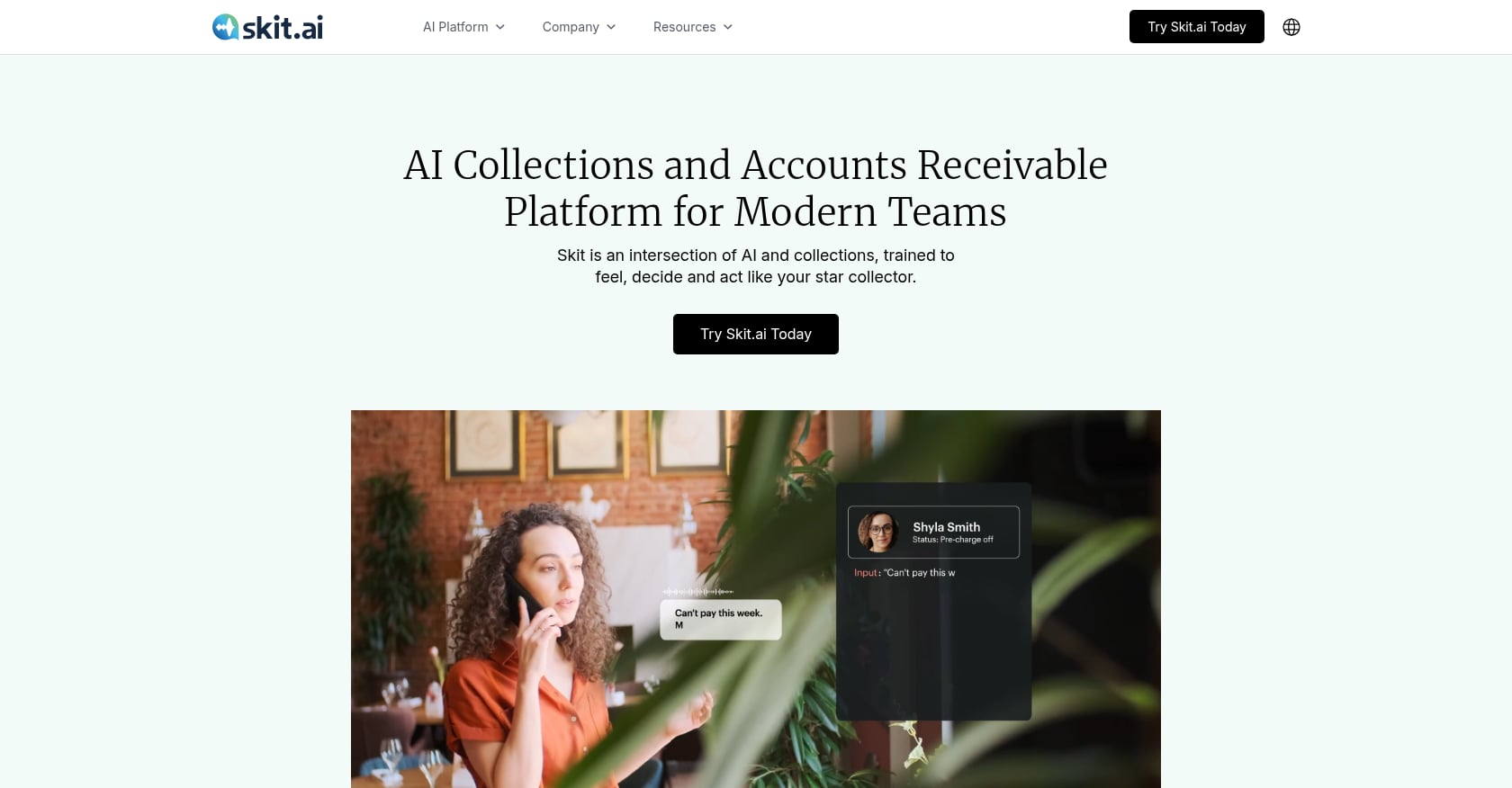
Best for: Collections-focused voice AI for debt recovery, accounts receivable, and lender workflows.
Pricing: TrustRadius reports no listed pricing plans, no free version, and no free trial source. G2 also shows pricing as unavailable.
Key features:
- Voice AI and conversational automation
- Collections and contact-center automation focus
- Drag-and-drop flow building
- Conversational analytics
- CRM integrations
User sentiment: G2 shows 2.5/5 from 3 reviews. One reviewer praised advanced NLP, CRM integration, and security. Another criticized poor visibility into bot setup, slow customer-success handling, weeks-long fixes, and missed ROI expectations source.
Tradeoffs:
- Mixed public user sentiment, the lowest G2 score on this list
- Admin visibility and support speed are concerns based on reviews
- Verify that workflow controls are buyer-accessible, not vendor-managed only
Skit.ai is relevant for collections, but buyers should run a strict pilot focused on change-request speed, reporting depth, and ROI visibility.
4. Ozonetel
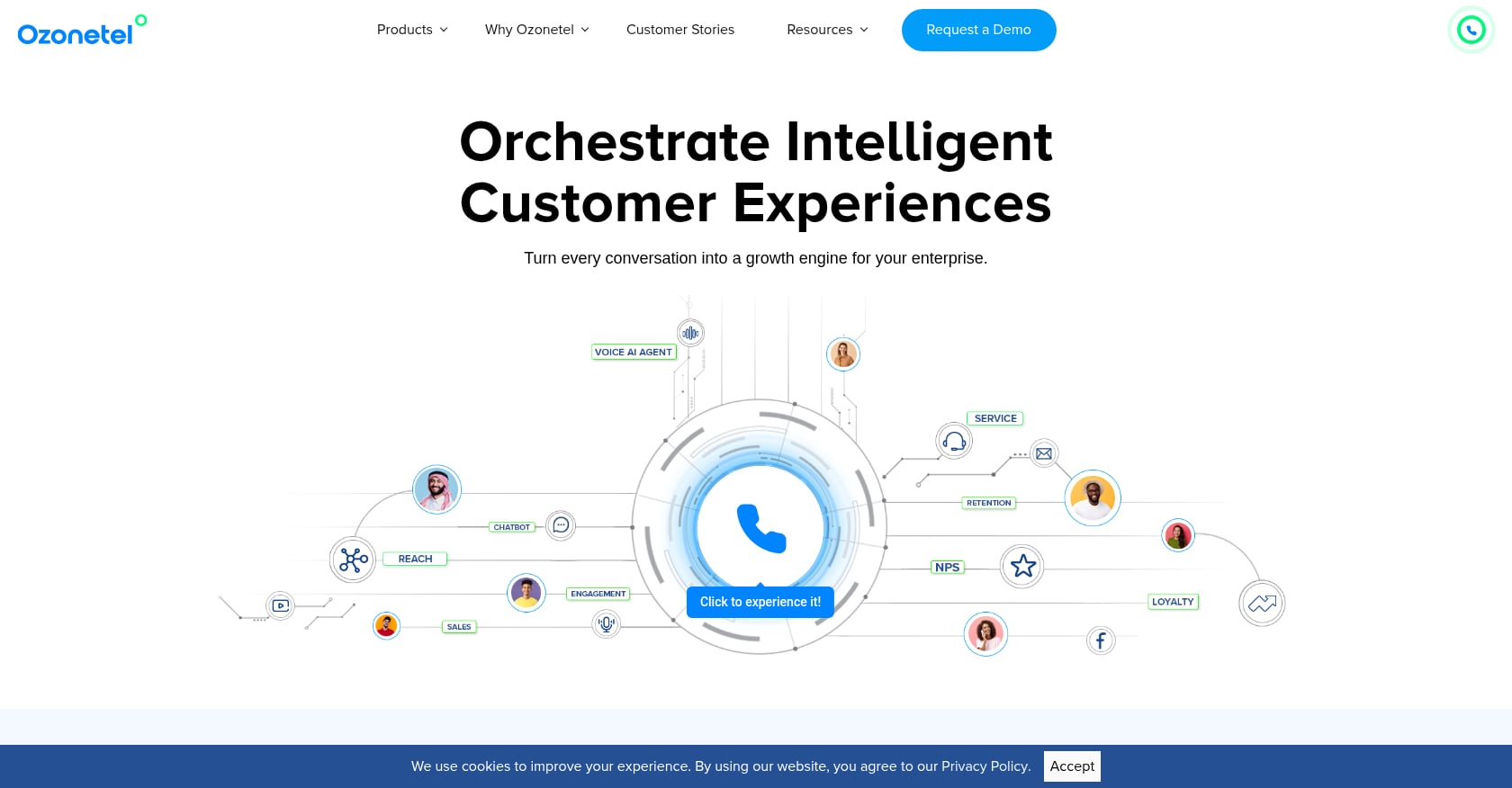
Best for: Indian enterprises needing cloud contact center infrastructure with AI and omnichannel workflows.
Pricing: Not publicly listed on G2. G2 reports average implementation time of 1 month, ROI of 13 months, and an average discount of 10% source.
Key features:
- Voice and social channel support
- Session routing, queuing, and concurrent calling
- Reporting and dashboards
- Omnichannel support
- CRM/helpdesk integrations
- Call recording and call history
User sentiment: G2 shows 4.6/5 from 623 reviews. Users consistently praise call management, omnichannel features, CRM integration, and fast cloud contact-center setup. Complaints include occasional connectivity issues, call pauses, transfer problems, and call-quality issues under load source.
Tradeoffs:
- Strong contact-center platform, but autonomous voicebot capabilities need separate evaluation
- Call quality and connectivity under peak load should be tested
- Voice AI layer may require additional workflow design
Ozonetel is a strong choice when telephony infrastructure and contact-center operations are the priority. Evaluate its AI voicebot layer separately from its contact-center strengths.
5. yellow.ai
Best for: Large enterprises wanting one platform across chat, voice, WhatsApp, and customer support automation.
Pricing: Not publicly listed. G2 mentions outcome-based/enterprise pricing, average implementation of 4 months, ROI of 14 months, and average discount of 12% source.
Key features:
- Generative AI-powered service automation
- Omnichannel deployment across chat, voice, WhatsApp
- Multi-language support
- Chatbot and conversational commerce
- Analytics and sales conversion tools
- Enterprise support for many countries and languages
User sentiment: G2 shows 4.4/5 from 106 reviews. Positive reviews highlight flow-building, ease of use, and multichannel support. Negative reviews mention backend instability, wrongly matched journeys, support issues, implementation delays, and post-onboarding service drops source.
Tradeoffs:
- Implementation timelines can stretch, especially for complex deployments
- Smaller businesses may find pricing and complexity challenging
- BFSI voicebot buyers should verify real phone-call quality, latency, and India-specific workflow depth before committing
yellow.ai is a strong enterprise automation suite, but BFSI teams should test actual phone-call performance and Indian-language handling independently from the chat experience.
6. Haptik

Best for: Enterprises and mid-market businesses needing conversational AI for WhatsApp and customer support.
Pricing: Not publicly listed on G2. Perceived cost is high, with average implementation of 2 months, ROI of 15 months, and average discount of 9% source.
Key features:
- Conversational AI and customer self-service
- NLU and conversation editor
- Human-in-the-loop
- Third-party API/webhook integrations
- Analytics dashboard
- Knowledge-base support
User sentiment: G2 shows 4.5/5 from 167 reviews. Users praise ease of use, implementation speed, integrations, and analytics. Common dislikes include a learning curve for advanced features, restrictive flow building for deeply customized logic, and limits in some areas source.
Tradeoffs:
- Less voice-specialist than dedicated voice AI vendors
- Complex flows may require technical support
- Test real call flows separately from chat/WhatsApp flows
Haptik is a good fit when WhatsApp and customer-support automation matter as much as voice.
7. Exotel
Best for: Teams needing cloud telephony, IVR, call routing, number masking, and communication APIs.
Pricing: G2 lists Dabbler at ₹9,999 and Believer at ₹19,999, plus custom enterprise solutions source. One of the few platforms with visible pricing tiers.
Key features:
- Voice, SMS, and messaging support
- IVR and automated call workflows
- Call routing and number masking
- CRM and API integrations
- Call logs, recordings, and dashboards
User sentiment: G2 shows 4.4/5 from 89 reviews. Users praise simple setup, IVR, call routing, API integrations, and number masking. Complaints include call quality/connectivity problems, outdated UI, delayed reporting, slow support, and missing advanced features like auto-dialer in some contexts source.
Tradeoffs:
- Strong communications infrastructure, but may not be a complete autonomous voicebot by itself
- Advanced AI voice workflows may require third-party integrations
- Reporting and call quality under load should be tested
Exotel is a practical telephony backbone. Evaluate whether you need it as infrastructure, a voicebot platform, or part of a larger stack.
8. Rezo.ai
Best for: Enterprises needing CX automation, voice bots, QA systems, and KYC/calling workflow automation.
Pricing: Not publicly listed. G2 user summaries note that some users consider Rezo.ai expensive compared to alternatives source.
Key features:
- Unified CX agentic AI platform
- Autonomous AI voice bots
- QA systems
- Omnichannel experiences
- Analytics
- KYC automation use cases
User sentiment: G2 shows 4.8/5 from 10 reviews. Users praise implementation quality, team responsiveness, customer engagement, and KYC/calling process automation. One review notes minor bugs and higher pricing source.
Tradeoffs:
- Small public review sample (10 reviews)
- Pricing not transparent
- Buyers should request detailed references and total-cost estimates
Rezo.ai is worth shortlisting for enterprise CX automation, especially when workflow automation matters beyond simple voice conversations.
9. Convin.ai

Best for: Call centers and sales/support/collections teams that want to analyze calls, score conversations, and coach agents.
Pricing: Not publicly listed. G2 states mid-market perceived cost is 41% more expensive than the average conversation-intelligence product. Average implementation is 1 month, ROI is 8 months, and average discount is 11% source.
Key features:
- Call, email, and chat analysis
- Transcription and sentiment/topic detection
- QA scoring and coaching
- CRM auto-logging
- Conversation insights and dashboards
User sentiment: G2 shows 4.7/5 from 548 reviews. Users praise conversation insights, call analysis, coaching, and audit workflows. Complaints include expense, overwhelming UI, accuracy variability, background noise affecting quality scores, and longer learning time for Kannada, Tamil, and Telugu compared to Hindi and English source.
Tradeoffs:
- Not primarily an autonomous voicebot platform; it analyzes calls rather than making them
- Local-language and noisy-call accuracy should be tested
- Higher cost than category average
Convin.ai is not the right pick if you need an AI agent making calls. It is strong if you need to understand and improve every human or bot-assisted conversation.
10. Kore.ai
Best for: Global enterprises needing a customizable conversational AI platform with broad integration support.
Pricing: Not publicly listed. G2 mentions usage-based pricing, no development costs, and a try-for-free option. Average implementation is 2 months, ROI is 7 months, and average discount is 10% source.
Key features:
- No-code/low-code bot development
- Advanced NLP and dialog management
- Multi-channel deployment
- APIs and workflow automation
- Banking, healthcare, retail, IT, HR solutions
- Integrations with Salesforce, ServiceNow, Teams, Slack, WhatsApp, Zendesk
User sentiment: G2 shows 4.6/5 from 474 reviews. Users praise the low-code interface, automation power, integrations, and enterprise flexibility. Complaints include a steep learning curve, cluttered advanced interface, performance lag when pulling from multiple integrations, and language/workflow context challenges source.
Tradeoffs:
- Enterprise-grade complexity; may require a technical team
- India-specific phone-call performance should be tested, not assumed
- Learning curve can slow initial deployment
Kore.ai is a powerful enterprise platform, but Indian BFSI buyers should test voice latency, language switching, and integration performance under real call conditions before committing.
How Much Does a Voicebot Cost?
Pricing is one of the biggest gaps in voicebot content online. Most platforms hide pricing behind sales calls. Here is what buyers actually encounter.
Common Pricing Models
Per-minute pricing. Charged by talk time. Easy to understand, but costs rise with long calls or low conversion rates. Awaaz AI uses this model with pay-per-use credits.
Per-call pricing. Charged per call attempted or completed. Watch for failed calls, unanswered calls, retries, and minimum billing increments.
Per-resolution/per-outcome pricing. Charged when the bot completes a defined task (payment promise captured, lead qualified, ticket resolved). Requires strict outcome definitions up front.
Enterprise subscription + usage. Common among omnichannel platforms. May include a platform fee, implementation fee, channel usage, and overage charges.
Telephony/CPaaS pass-through. Carrier charges, number rental, recording storage, DLT/consent tooling, SMS, WhatsApp, and call-transfer costs often sit outside the main voicebot contract.
Hidden Costs to Ask About
This is where many pilots go sideways. Ask about:
- Telecom charges and failed-call billing
- STT/TTS/LLM usage costs
- WhatsApp and SMS fees
- Call recording and storage
- CRM/LOS/LMS integration fees
- Number masking
- Compliance logging
- Human handoff agent seats
- QA and monitoring tools
- Language expansion costs
- Change requests and script updates
- Model retraining
- Peak-volume commitments
- Minimum monthly spend
- Professional services
The Right Metric to Compare
Stop comparing cost per minute alone. The metric that matters is:
Cost per completed outcome = total monthly cost / successful completed tasks
For BFSI, a completed outcome might be a verified KYC detail, a promise-to-pay captured, a payment link sent, an EMI reminder acknowledged, a settlement callback booked, or a qualified lead passed to sales. If you want to compare AI outbound calling bot platforms on this basis, that guide breaks down the economics further.
What Makes a Voicebot Work in India?
India is one of the hardest markets for voice AI. The reasons are practical, not theoretical.
Code-switching is the norm. Customers switch between Hindi and English mid-sentence (Hinglish), or between their regional language and Hindi. A voicebot that only handles clean English will underperform. Practitioners on a StartUpIndia Reddit thread reported that English-only flows performed poorly, while Hinglish worked significantly better with customers source. For a technical look at how code-switching affects voice AI accuracy, that guide covers the ASR and NLU challenges.
Accents and regional speech variation. Hindi spoken in Bihar sounds different from Hindi spoken in Rajasthan. Tamil speakers in Chennai vary from those in Madurai. The voicebot’s ASR must handle this variation in production, not just in curated test sets.
Noisy mobile calls. Most Indian customers answer on mobile phones, often in noisy environments (streets, markets, factory floors). Background noise degrades ASR accuracy and creates false endpoint signals that interrupt the bot mid-thought.
Telephony matters more than the model. Twilio defines voice-agent latency as the “mouth-to-ear” turn gap: the time from when the user stops speaking to when the agent’s reply reaches the user’s ear source. On Indian PSTN and mobile networks, this gap can spike unpredictably. One Reddit discussion about production AI voice agents noted that users complain more about inconsistent pauses than about a steady (slightly longer) response delay source. Ask vendors for p50, p90, and p95 latency on real calls, not a single best-case number.
WhatsApp and SMS follow-ups are essential. Many Indian workflows need the voicebot to send a payment link, a document upload prompt, or a confirmation message after the call. Platforms that connect voice, WhatsApp, and SMS in one workflow deliver better outcomes. Deloitte’s 2024 Global Contact Center Survey found that omnichannel integration was associated with 9% lower cost per assisted contact source.
Human handoff is not optional. Not every call can or should be resolved by a bot. The escalation path, how context is passed, how quickly the human picks up, how the transcript and outcome are logged, separates good implementations from bad ones. For teams building a broader strategy around Indian call center AI voice solutions, that guide covers how handoff fits into the operational picture.
Voicebot Use Cases by Industry
BFSI
This is where voicebots deliver the clearest ROI. McKinsey reports that organizations deploying advanced genAI in customer assistance and collections can achieve up to 40% reduction in operational expenses and improve recoveries by about 10% source.
Key use cases: EMI reminders, collections and promise-to-pay, KYC follow-up, credit eligibility screening, lead qualification, payment link delivery, retention calls, account servicing, and fraud alerts. For teams focused specifically on AI debt collection calls and recovery compliance, that guide covers the regulatory and workflow details.
Healthcare
Appointment reminders, patient follow-up, prescription adherence calls, and inbound FAQ handling. Language accessibility is particularly important for patients in tier-2 and tier-3 cities.
E-Commerce
Order status updates, returns processing, COD confirmation, and delivery coordination. High call volumes during sale events make automation valuable.
Hospitality
Booking confirmation, guest support, feedback calls, and upsell/cross-sell for amenities.
Contact Centers
L1 automation, intelligent call routing, after-call summaries, QA scoring, and agent assist. The voicebot handles the repeatable tasks; humans handle the exceptions.
Voicebot Compliance Checklist for BFSI
Compliance is not optional, and most voicebot vendor pages treat it as an afterthought. For Indian BFSI teams, three regulatory frameworks matter.
RBI Recovery-Agent Rules
RBI states that regulated entities remain responsible for outsourced recovery-agent activity and must prevent intimidation, harassment, threatening calls, anonymous calls, persistent calling, and calls before 8:00 a.m. or after 7:00 p.m. source.
Ask your voicebot vendor:
- Can the bot block calls outside approved time windows?
- Can it stop calling after customer refusal?
- Can it detect distress, anger, or legal threats and escalate to a human?
- Can compliance teams audit every call recording and transcript?
- Can the bot prevent threatening or misleading language?
TRAI Consent and Commercial Calling Rules
TRAI defines consent as voluntary permission from the customer to receive calls or messages for a specific purpose. It defines robocalls as calls using artificial or prerecorded voice to interactively deliver voice messages without human involvement source. For any outbound voicebot, verify that the platform handles sender registration, DND/UCC suppression, purpose-specific consent, and opt-out logic.
DPDP Data Protection
India’s Digital Personal Data Protection Act, 2023 governs processing of digital personal data and creates obligations for data fiduciaries source. Voicebot buyers should ask about lawful purpose, consent recording, data retention, deletion workflows, role-based access, and breach response protocols.
For BFSI teams running a formal vendor evaluation, you can request an enterprise security and compliance checklist to structure the due diligence process.
Voicebot Pilot Checklist
Practitioners on Reddit and LinkedIn consistently emphasize that controlled demos hide the hardest problems. One thread on r/aiagents noted that demos do not reveal production issues like noisy calls, silence handling, barge-in, real PSTN latency, and off-script conversations source. A LinkedIn practitioner post argued that voice AI moats in India come from vertical expertise, engineering reliability, and compliance readiness, not from having a chatbot with speech attached source.
Here is how to structure a voicebot pilot that actually tells you something:
- Choose 1 to 2 narrow workflows. EMI reminders for a specific portfolio. KYC follow-ups for a single product. Lead qualification for one campaign. Do not try to automate everything at once.
- Use real call recordings to design prompts. Study how your borrowers or customers actually talk, not how you wish they talked.
- Test on real phone lines. Not browser demos, not WebRTC, not internal VoIP. Real PSTN and mobile calls.
- Test all target languages. Including Hinglish, regional languages, and code-switching.
- Set compliance rules before launch. Call windows, script controls, escalation triggers, recording policies.
- Define success metrics. Connect rate, answer rate, containment rate, transfer rate, promise-to-pay rate, payment conversion, average latency, barge-in success, escalation accuracy, compliance adherence, complaint rate, and cost per completed outcome.
- Include human escalation from day one. Measure how context passes and whether the handoff is smooth.
- Compare cost per outcome. Not cost per minute, but cost per completed task.
- Audit transcripts and recordings. Review at least 100 calls for accuracy, tone, compliance, and resolution quality.
- Run a phased rollout. Start small, measure, fix, then expand.
For banking-specific benchmarks on what success looks like, the guide on bank AI voice benchmarks provides useful reference points.
15 Questions to Ask a Voicebot Vendor Before Buying
- What is your p50/p90/p95 latency on real PSTN calls in India?
- Which Indian languages are production-ready, not demo-ready?
- Can the bot handle Hinglish and mid-sentence code-switching?
- Can we review 20 anonymized production recordings?
- How do you handle interruptions, barge-in, and silence?
- What happens when the customer gets angry or confused?
- How does human handoff work, and is context preserved?
- Can the bot update our CRM, LMS, or ticketing system in real time?
- How do you manage RBI, TRAI, and DPDP requirements?
- What is included in pricing and what is pass-through?
- How are call recordings stored and retained?
- How fast can we change scripts after launch?
- What reports can operations teams see daily?
- How do you measure containment, conversion, and complaints?
- What happens if the model hallucinates or says something off-policy?
Practitioners discussing BFSI voice AI on Reddit repeatedly challenge vendors to show regulated live deployments, real case studies, and actual call-scale proof rather than broad claims source. Another common theme: the best use cases are narrow, repeatable, and measurable. Outbound lead qualification, renewal reminders, and collections produce the clearest ROI when deployed in phases rather than as a wholesale call-center replacement source.
Final Recommendation
The best voicebot is not the one with the most natural demo voice. It is the one that completes the workflow safely, in the customer’s language, on real phone lines, with auditability.
If you are an Indian BFSI team running high-volume calling for EMI reminders, KYC, lead qualification, customer service, or collections, start with Awaaz AI because it is built around multilingual, finance-first, phone + messaging workflows. If you need a broader enterprise omnichannel suite, compare yellow.ai, Haptik, Kore.ai, and Ozonetel. If you mainly need analytics and QA, consider Convin.ai. If you need telephony infrastructure, evaluate Exotel or Ozonetel. For collections-specific alternatives, include Skit.ai and Gnani.ai in the pilot.
Regardless of which platform you choose, insist on real production references, language tests on actual phone lines, and compliance controls before scaling. For small finance banks ready to start procurement, the Awaaz AI procurement guide for small finance banks walks through the buying process step by step.
Frequently Asked Questions
What is a voicebot?
A voicebot is software that holds spoken conversations with customers over phone calls or voice channels. It uses speech recognition to understand what someone says, natural language processing to determine intent, and text-to-speech to respond. Modern voicebots can also take actions like updating a CRM, sending a WhatsApp message, or escalating to a human agent.
What is the difference between a voicebot and IVR?
An IVR (interactive voice response) uses fixed menus (“press 1 for balance”). A voicebot can understand natural speech, hold multi-turn conversations, and adapt responses based on context. IVR routes calls; a voicebot can resolve them.
What is the difference between a voicebot and an AI voice agent?
An AI voice agent is a voicebot powered by large language models that can reason, personalize, and take actions within business systems. Every AI voice agent is a voicebot, but not every voicebot is an AI voice agent. The distinction is whether it can act (update records, trigger workflows, escalate with context) or only answer questions.
How much does a voicebot cost in India?
Pricing varies by model. Per-minute pricing ranges from a few paise to several rupees per minute of talk time. Some platforms charge per call or per resolved outcome. Enterprise platforms often use subscription plus usage models. Hidden costs include telephony, WhatsApp/SMS, recording storage, integrations, and change requests. Compare total cost per completed outcome, not just per-minute rates.
Can voicebots handle Hinglish and Indian languages?
Some can. The quality varies widely. Platforms built for the Indian market (like Awaaz AI and Gnani.ai) invest specifically in code-switching, accent variation, and regional languages. Always test with real customer recordings in your target languages before committing.
Are voicebots allowed for loan collections in India?
Yes, but they must comply with RBI guidelines that restrict calls before 8:00 a.m. and after 7:00 p.m., prohibit harassment or threatening language, and require audit trails. The regulated entity remains responsible for the voicebot’s behavior. TRAI consent and DND rules also apply to outbound calls.
What KPIs should I track in a voicebot pilot?
Key metrics include connect rate, answer rate, containment rate (calls resolved without human), transfer rate, promise-to-pay rate, payment conversion, average response latency, barge-in success rate, escalation accuracy, compliance adherence, complaint rate, and cost per completed outcome.
Can a voicebot transfer calls to a human agent?
Yes, and this is a critical capability. The quality of escalation, whether conversation context is preserved, how quickly the human picks up, and whether the transcript and outcome are logged, often determines whether the voicebot deployment succeeds or creates more friction.