
TL;DR
The best multilingual AI voice assistant is not the one claiming the most languages. It is the one that completes real customer calls in the caller’s language, on noisy phone audio, with correct amounts, low latency, and compliant escalation. This guide compares 11 platforms across production language quality, pricing transparency, user reviews, and honest tradeoffs. Indian BFSI buyers face stricter requirements around vernacular code-switching, RBI call-window rules, and finance-specific workflows, so we weight those criteria heavily.
Book a demo with Awaaz AI to see multilingual voice agents built for Indian financial services.
At-a-Glance: 11 Multilingual AI Voice Assistants Compared
| Platform | Best For | Language Strength | Pricing Model | G2 Review Signal | Key Tradeoff |
|---|---|---|---|---|---|
| Awaaz AI | Indian BFSI voice workflows | 8+ languages, Hinglish/code-switching | Pay-per-use credits/min | Limited public reviews | Sales-led; no self-serve pricing |
| Skit.ai | Collections and debt recovery | Multilingual with collections focus | Custom quote | Sparse (Gartner: 5.0, 1 rating) | Narrow use-case focus |
| Gnani.ai | Indian speech AI depth | Proprietary multilingual/code-switched models | Custom quote | Not enough G2 reviews | Opaque pricing and reviews |
| Yellow.ai | Omnichannel enterprise CX | 135+ languages claimed | Custom/sales-led | 4.4/5, 106 reviews | Voice is one module; 4-month avg implementation |
| Kore.ai | Enterprise governance and integrations | Hindi, Tamil, Telugu, Marathi + global | Custom/sales-led | 4.6/5, 474 reviews | Steep learning curve for advanced features |
| Retell AI | Developer-led phone agents | Depends on chosen STT/TTS stack | ~$0.07/min base | 4.8/5, 2,064 reviews | Costs rise with premium stacks |
| Vapi | Custom voice AI infrastructure | Flexible (BYO providers) | $0.05/min + pass-through | 4.2/5, 3 reviews | Requires engineering; cost hard to predict |
| Bland AI | Enterprise outbound, bundled pricing | Multilingual for global support | $0.14-$0.11/min by tier | 5.0/5, 11 reviews | Low review volume; monthly platform fees |
| Synthflow | No-code SMB/mid-market pilots | Depends on setup | Free-to-start PAYG | 4.5/5, ~1,010 reviews | Costs unclear at scale; limited intl numbers |
| PolyAI | Enterprise contact center voice quality | Multilingual, accent-aware | Custom enterprise | 5.0/5, 12 reviews | Enterprise sales cycle; not self-serve |
| ElevenLabs Conv. AI | Voice quality and speech generation | Strong multilingual TTS | ~$0.10/min | 1,155 reviews (platform-wide) | Voice layer only; needs surrounding stack |
Pricing changes often. Use this table to shortlist, then request an all-in quote based on your expected monthly connected minutes and top languages.
What Is a Multilingual AI Voice Assistant?
A multilingual AI voice assistant answers or makes phone calls in more than one language, understands what the caller wants, handles interruptions, writes outcomes to business systems, and escalates to humans with context when needed.
Under the hood, it chains together several components:
- ASR/STT converts speech to text
- Language detection identifies the caller’s language or language mix
- NLU/LLM orchestration understands intent and decides the next action
- TTS/voice synthesis speaks the response
- Telephony connects to phone networks via SIP, Twilio, Exotel, or similar
- Workflow integrations update CRM, LMS, ticketing, or payment systems
- Analytics generate transcripts, sentiment scores, and audit logs
- Human handoff transfers with summary, language flag, and call history
This is not the same as a translated IVR tree, a text chatbot with a voice layer, or a “50+ languages” marketing badge. A production multilingual voice AI assistant handles what happens when a borrower in rural Maharashtra says “mera EMI due date kya hai?” and expects a correct, natural answer with the right rupee amount, without awkward pauses.
India makes this distinction critical. IAMAI-Kantar’s 2024 report counts 886 million active internet users, with 870 million accessing the internet in Indic languages and 140 million using voice-based commands. Rural users make up 55% of voice users. For Indian financial services, multilingual voice is the practical interface for customers who share devices, prefer speaking over typing, and switch between Hindi and English mid-sentence.
For a deeper look at how this works for Hindi specifically, see our guide on AI voice assistants in Hindi.
How We Evaluated: The Production Multilingual Scorecard
Most comparison articles rank multilingual AI voice assistants by language count or feature lists. That approach fails because a vendor claiming 50 languages tells you nothing about how those languages perform on a noisy phone call with a frustrated borrower.
We used nine production-oriented criteria:
| Dimension | What We Checked |
|---|---|
| Language reality | Accents, dialects, numerals, names, code-switching |
| Phone-audio robustness | Performance on 8 kHz telephony audio with background noise |
| Latency and turn-taking | P50/P95 response time, barge-in, silence handling |
| Workflow completion | Can it finish KYC, send a payment link, book an appointment? |
| Compliance | Consent, call windows, audit logs, escalation, data residency |
| Integration depth | CRM/LMS/CBS real-time sync, not batch |
| Escalation quality | Does the human agent get language, summary, sentiment, transcript? |
| Pricing predictability | All-in cost per connected minute, not just the headline number |
| Review signal | G2, Gartner, Reddit, community threads |
A 2026 benchmark of voice agents found that task success dropped to 26-38% under realistic conditions, with most failures caused by agent behavior rather than model knowledge. Clean demos overstate real-world performance. That finding shaped our emphasis on phone-audio testing and production failure modes.
Understanding code-switching voice AI is also critical. When callers flip between Hindi and English within the same sentence, generic speech models routinely drop switched words. Practitioners on Reddit confirm this: one builder warns that Hinglish “flips mid-sentence and switched words are often dropped,” recommending teams test on real call audio rather than clean benchmarks.
Do not buy multilingual voice AI by counting languages. Buy it by testing how many real customer tasks it completes in your top languages.
11 Best Multilingual AI Voice Assistants in 2026
1. Awaaz AI
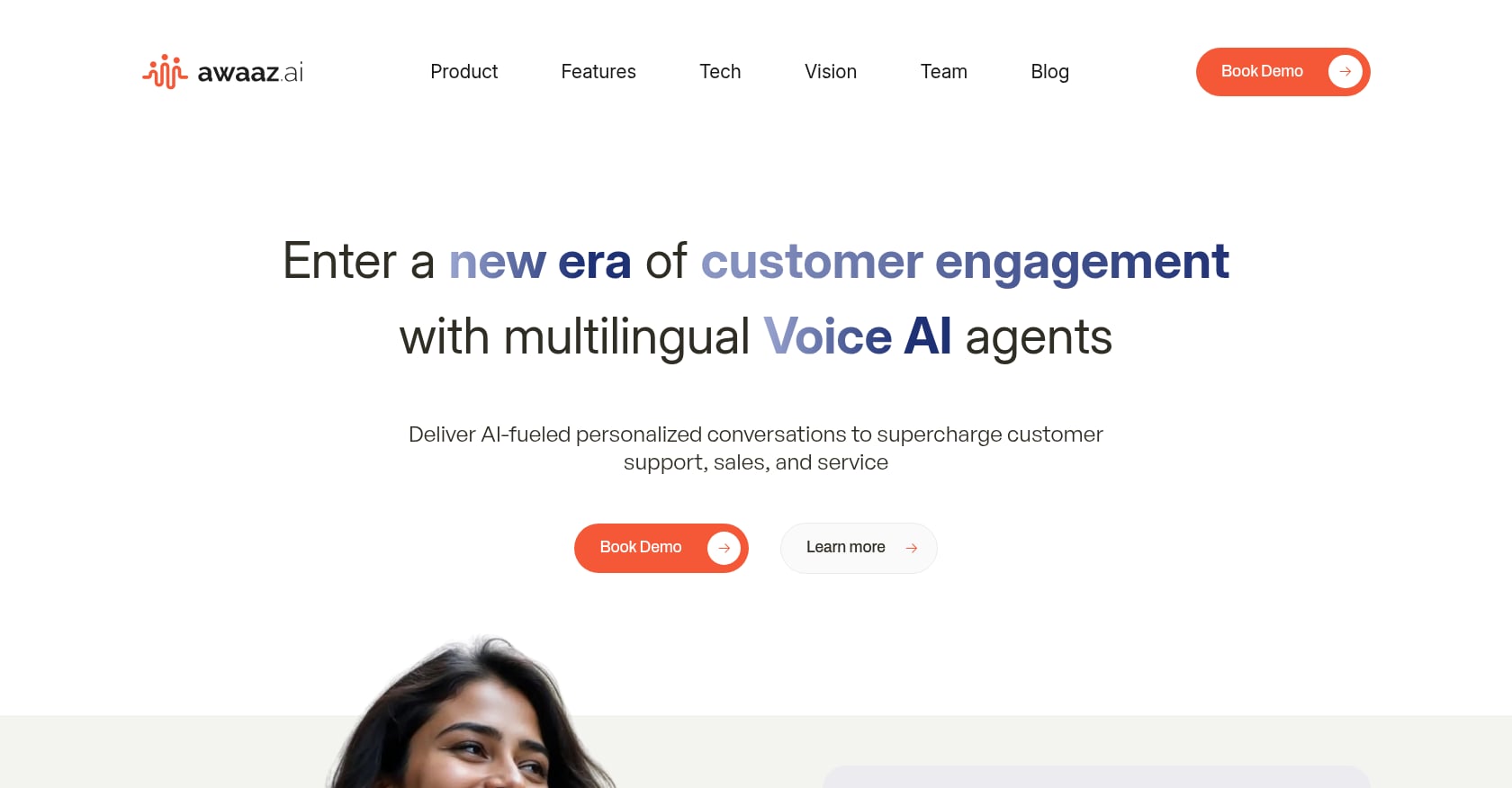
Best for: Indian BFSI multilingual voice workflows across collections, EMI reminders, KYC, onboarding, credit eligibility, lead sourcing, and customer support.
Pricing: Pay-per-use credits per minute of talk time. Four tiers: Starter, Standard, Growth, Scale. Public pricing not listed; demo available.
Key features:
- Multilingual voice AI agents supporting 8+ languages with vernacular and mixed-language support, including Hinglish
- Finance-first domain templates for sourcing, KYC, credit eligibility, collections, and retention
- Voice, SMS, WhatsApp, and messaging channel orchestration
- In-house telephony stack built for low-latency conversations
- CRM/CDP integrations and APIs for real-time data sync
- Analytics that convert call data into structured, queryable portfolio insights
- Human-in-the-loop escalation and enterprise-grade security
Tradeoffs:
- Pricing is not publicly transparent; requires a sales conversation
- Fewer self-serve docs and developer artifacts compared to API-first platforms
- Public third-party review corpus is limited; proof often requires customer references
User perspective: Awaaz AI reports 3.8M unique customers reached in the past year, an 82% call engagement rate, 60% cost reduction, and 2x conversion improvement across its BFSI deployments. The company evolved from Awaaz De, which ran financial inclusion voice projects for Indian MFIs, including voice payment receipts with verified high pickup and completion rates.
Choose Awaaz AI if your biggest problem is not “we need 50 languages” but “we need customers in India to complete real BFSI calls in the language they actually speak.” The platform’s strength is domain-specific NLU built for financial conversations, not generic language support adapted to banking after the fact.
Avoid if you need fully public self-serve pricing or developer documentation before engaging sales.
2. Skit.ai
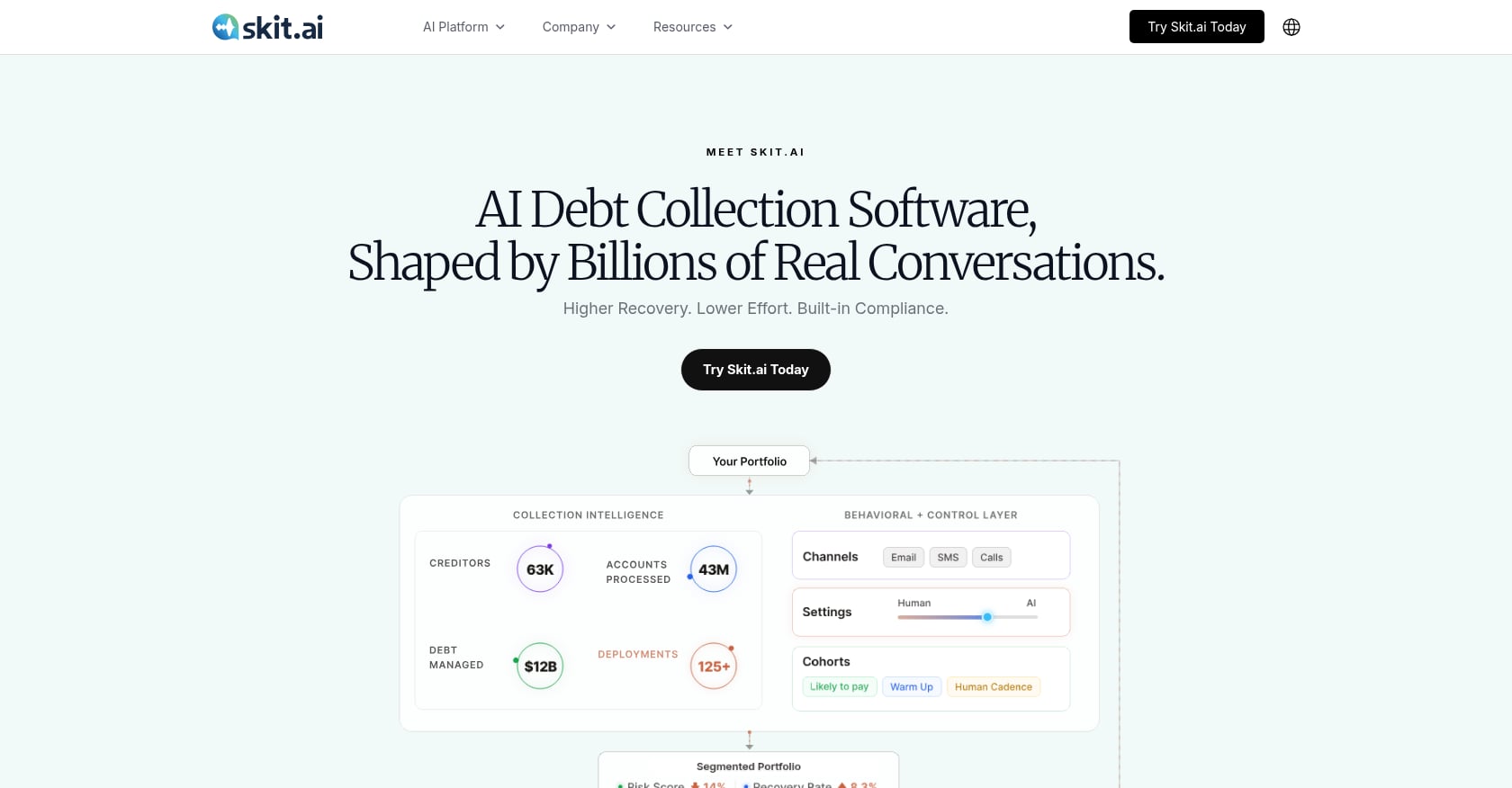
Best for: Collections-first voice AI and accounts receivable management workflows.
Pricing: Custom, quote-based. Not publicly listed.
Key features:
- Conversational voice AI built specifically for debt collection and revenue recovery
- Automated collection calls designed for large-scale consumer dialogue
- Multilingual options tailored to recovery conversations
- Domain positioning around ARM use cases
Tradeoffs:
- Very narrow public review base (Gartner Peer Insights shows 5.0 from just 1 rating)
- Collections-focused positioning may not translate to broader CX or support use cases
- Public pricing and language-performance details are limited
- Gartner reviewers noted room for improvement in response time
User perspective: The single Gartner reviewer praised “highly qualified professionals and excellent customer support” and highlighted multilingual options and true human-interactive voice as strengths.
Choose Skit.ai if your primary use case is outbound debt recovery and you want a vendor with deep ARM domain knowledge. Avoid if you need a broader multilingual AI voice assistant for support, sales, onboarding, and engagement beyond collections.
3. Gnani.ai
Best for: Indian speech AI depth, proprietary ASR/TTS models, and voice automation for contact centers.
Pricing: Custom, enterprise quote-based. Not publicly listed.
Key features:
- Proprietary speech and language models including speech-to-text, text-to-speech, and speech-to-speech
- Models trained for multilingual and code-switched Indian audio
- Contact center voice automation for BFSI, telecom, and service workflows
- Speech recognition quality as a core differentiator
Tradeoffs:
- G2 says there are not enough reviews to provide buying insight
- Pricing is opaque
- Buyers should demand live tests on their own call recordings before committing
User perspective: No substantial independent review corpus found. Gnani’s public positioning emphasizes proprietary model depth, but third-party validation is sparse.
Choose Gnani.ai if speech model quality and Indian-language ASR depth are your evaluation priority. Avoid if you need transparent pricing, strong public social proof, or turnkey BFSI workflow templates.
4. Yellow.ai
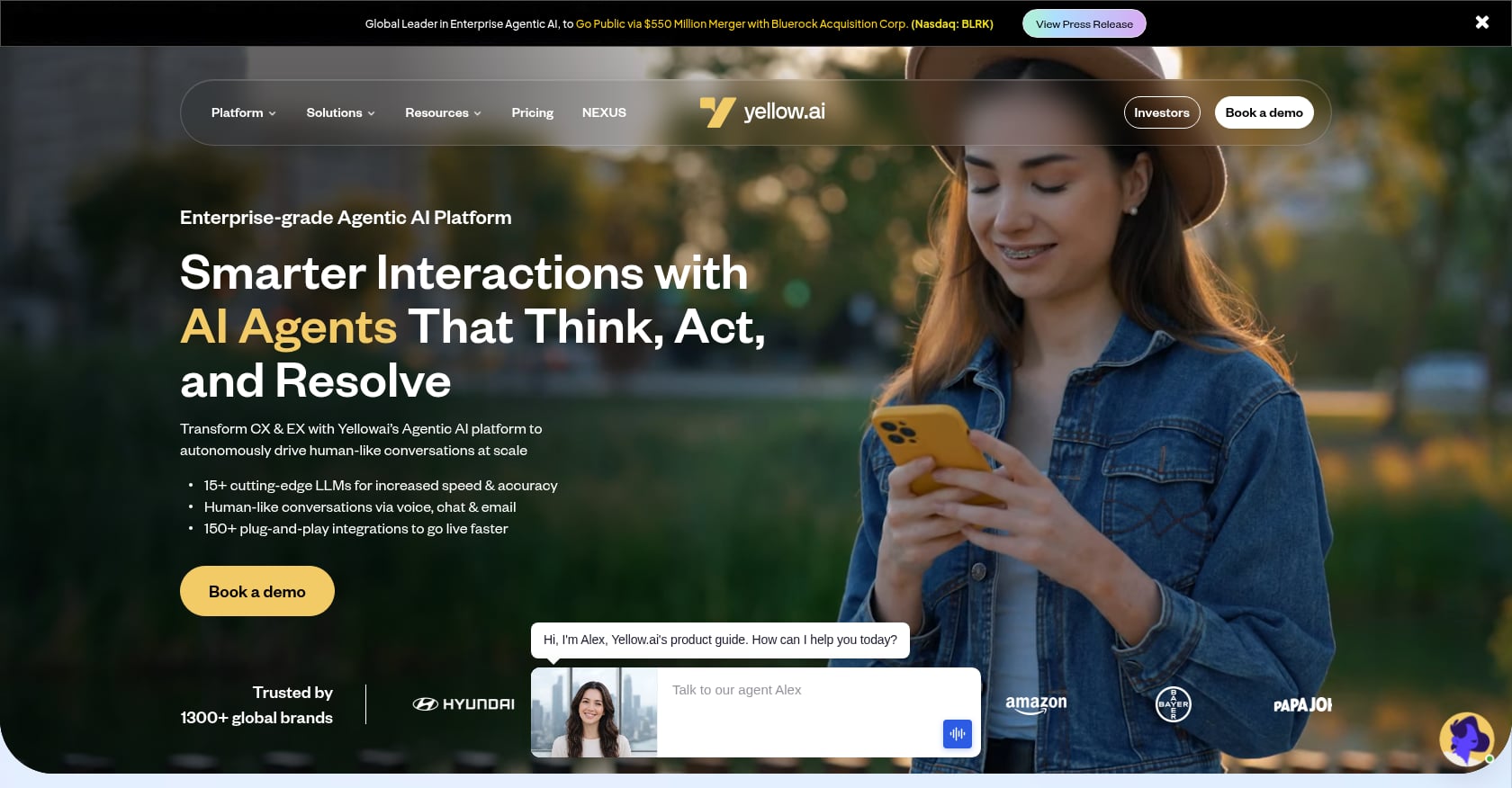
Best for: Broad omnichannel enterprise automation spanning chat, voice, and messaging across regions and industries.
Pricing: Custom, sales-led. Platform, module, and usage-based pricing with potential additional charges for advanced modules and integrations.
Key features:
- Serves 1,100+ enterprises across 85+ countries
- Claims 135+ language support on its G2 profile
- Multi-LLM architecture
- Chatbot, voice, and messaging in one platform
- Broad integration ecosystem
Tradeoffs:
- Voice AI is one module within a larger CX platform; BFSI-specific voice workflows may require significant customization
- G2 reports an average implementation time of 4 months and ROI timeline of 14 months
- Users mention complexity and a learning curve as downsides
- G2 rating sits at 4.4/5 from 106 reviews, lower than several competitors
User perspective: G2 reviewers praise the intuitive interface and integrations but flag difficult implementation and AI limitations as recurring cons.
Choose Yellow.ai if you want one platform for chatbots, voice, messaging, and customer service across many markets. Avoid if you need a fast, phone-first multilingual voice assistant deployment for Indian financial services.
5. Kore.ai
Best for: Enterprise conversational AI with low-code governance, deep integrations, and broad channel support.
Pricing: Custom, sales-led. Trial available. Not surfaced in a simple public plan table.
Key features:
- Supports Indian languages including Hindi, Marathi, Tamil, and Telugu plus global languages
- Integrations with Genesys, ServiceNow, WhatsApp, Zendesk, Azure OpenAI, and others
- Low-code and pro-code building options
- Strong governance and compliance controls
- G2 rating: 4.6/5 from 474 reviews
Tradeoffs:
- Steep learning curve for advanced features, noted repeatedly in reviews
- Heavier platform than needed for phone-first BFSI use cases
- Voice-specific pricing needs separate clarification from sales
- May require more internal technical resources than expected
User perspective: G2 reports an average implementation time of 2 months and ROI of 7 months. Users praise automation features and integrations while acknowledging the complexity.
Choose Kore.ai if you are a large enterprise needing breadth, governance, and many integrations. Avoid if your team is small and needs a finance-specific multilingual voice AI agent without a lengthy configuration process.
6. Retell AI
Best for: Developer-led programmable phone agents for inbound and outbound workflows.
Pricing: Pay-as-you-go starting at $0.07/min on G2. All-in cost varies by voice engine, LLM, and telephony choices. Community reports suggest production setups with premium voices can reach roughly $0.35-$0.40/min.
Key features:
- Voice-first system for live phone calls
- Outbound/inbound workflows with call logic and telephony routing
- Backend integrations and batch outbound calling
- Concurrency controls and usage-based pricing
- G2 rating: 4.8/5 from 2,064 reviews, the highest review volume in this list
Tradeoffs:
- Requires engineering effort for custom workflows
- Not a bundled omnichannel contact center
- Cost monitoring matters because provider choices affect per-minute cost significantly
- Multilingual quality depends entirely on the STT/TTS stack the team selects
User perspective: G2 reviewers praise ease of use, natural-sounding voices, and low latency. Several note that pricing can escalate quickly at high volume or with premium provider settings.
Choose Retell if you have developers who want API-level control over phone agents. Avoid if you need managed India BFSI workflows with vernacular support and compliance controls out of the box.
7. Vapi
Best for: Developer infrastructure for building custom voice AI products with full control over the provider stack.
Pricing: $0.05/min platform fee plus pass-through costs for STT, LLM, TTS, and telephony. Phone numbers at $2/month. New accounts get $10 in free credits. HIPAA compliance adds $2,000/month; zero data retention adds $1,000/month.
Key features:
- Choose your own STT, LLM, TTS, and telephony providers
- Built for developers creating custom voice AI applications
- Prorated billing to the second
- Flexible architecture for varied use cases
Tradeoffs:
- Not plug-and-play for nontechnical teams
- All-in cost is hard to predict because provider costs vary by call
- G2 shows only 3 reviews (4.2/5), far too few for reliable insight
- Compliance add-ons significantly increase monthly costs
User perspective: Practitioners on Reddit frequently discuss difficulty estimating total client pricing when building on Vapi. Actual costs depend on usage, provider mix, call duration, and markups, making it hard to give clients a clean per-minute number.
Choose Vapi if you want infrastructure-level control and your engineering team can manage provider costs. Avoid if you need predictable pricing or cannot assemble and maintain the full voice AI stack yourself.
If you are trying to estimate what a Hinglish voice agent costs in production, the pass-through model makes Vapi particularly hard to forecast for Indian deployments.
8. Bland AI
Best for: Enterprise outbound phone automation with bundled per-minute pricing that includes LLM, STT, and TTS.
Pricing: Start plan: $0/month, $0.14/min, 10 concurrent calls. Build plan: $299/month, $0.12/min, 50 concurrent calls. Scale plan: $499/month, $0.11/min, 100 concurrent calls. Telephony billed separately.
Key features:
- Per-minute rate bundles LLM, STT, and TTS into one number
- Bring-your-own telephony or use Bland’s pass-through
- Enterprise deployment support
- Multilingual positioning for global customer support
Tradeoffs:
- Low public review volume (G2: 5.0/5 from 11 reviews)
- Monthly platform fees on Build and Scale plans can be inefficient for inconsistent call volume
- Telephony pass-through costs are separate from the headline rate
- India and BFSI vernacular quality should be tested directly
User perspective: A G2 reviewer reported building a working voice escalation system in a few hours and avoiding the need to stitch together telephony, STT, and orchestration manually. Another praised the responsive engineering support.
Choose Bland if you want clearer bundled rates for enterprise outbound phone automation. Avoid if you need India-first vernacular workflows or your call volume is inconsistent enough that monthly platform fees hurt unit economics.
9. Synthflow
Best for: No-code voice AI agents for SMB and mid-market teams that need quick setup without engineering.
Pricing: Free to start with pay-as-you-go usage billing. 5 concurrent calls included, then $20 per reserved concurrency. Enterprise tier for 10,000+ minutes/month with 99.99% SLA and custom workflows.
Key features:
- No-code/low-code visual agent builder
- Inbound and outbound call automation
- Appointment scheduling, lead qualification, customer support, call routing
- G2 rating: 4.5/5 from approximately 1,010 reviews
Tradeoffs:
- Users flag that pricing becomes expensive at higher usage
- Direct phone number coverage limited to US, Canada, and Australia; international numbers via Twilio require a higher tier
- Complex regulated workflows like BFSI collections need a more specialized platform
- Limited customization compared to developer-first tools
User perspective: G2 reviewers consistently praise the intuitive interface and quick setup. A negative pricing review complains about limited European phone number support without upgrading tiers.
Choose Synthflow if you need a no-code multilingual voice AI pilot running fast. Avoid if you need deep Indian language support, regulated financial workflows, or cost-efficient scaling past basic use cases.
10. PolyAI
Best for: Enterprise contact centers replacing legacy IVR with natural conversational voice.
Pricing: Custom enterprise. Not publicly listed. Expect an enterprise sales cycle.
Key features:
- Intent detection regardless of accent
- Entity extraction from natural conversation
- Non-linear conversation handling
- Multilingual speech support and dashboards
- Claims go-live in six weeks or less
Tradeoffs:
- G2 shows 5.0/5 from only 12 reviews, not enough for statistical confidence
- Enterprise deployment motion, not a quick self-serve pilot
- India/BFSI code-switching capability should be tested rather than assumed
- One reviewer noted slow service at times
User perspective: G2 reviewers find PolyAI effective for automated customer interactions and praise the human-like conversation quality.
Choose PolyAI if you run a large contact center and prioritize natural voice experience above all else. Avoid if you need fast self-serve pilots, public pricing, or India-specific vernacular financial workflows.
11. ElevenLabs Conversational AI
Best for: Teams that prioritize realistic, natural-sounding voices and multilingual speech generation.
Pricing: Conversational AI calls start around $0.10/min. Starter plan at $5 with 50 included minutes. Check LLM and credit mechanics by plan.
Key features:
- Industry-leading voice quality and voice cloning
- Strong multilingual voice generation and localization
- G2 seller page with 1,155 reviews (platform-wide, not just conversational AI)
- Dubbing, localization, and speech generation capabilities
Tradeoffs:
- A great voice layer does not equal a complete contact center stack; telephony, workflow, CRM, analytics, QA, and compliance layers still needed
- Long-form voice quality and real-time conversational latency are different tests
- Indian BFSI use cases need validation on Hinglish, amounts, dates, and noisy calls
- Cost and regeneration waste flagged by Reddit users at scale
User perspective: Reddit practitioners praise ElevenLabs voice quality in languages like Polish and Spanish. Multiple threads warn about cost at scale and the difference between polished audio clips and real-time conversational performance under production conditions.
Choose ElevenLabs if voice realism is your top priority and you have the engineering stack to build everything else around it. Avoid if you need a turnkey multilingual AI voice assistant for Indian BFSI where workflow completion matters more than voice quality alone.
How to Choose by Buyer Type
If you are an Indian bank, NBFC, MFI, or fintech: Start with Awaaz AI. Your selection criteria should center on Indian language and Hinglish handling, finance-specific NLU, EMI/KYC/collections workflow templates, RBI-aware call controls, and voice plus WhatsApp/SMS orchestration. Read the procurement guide for SFBs for internal buying steps and vendor evaluation checklists.
If you are a developer building a voice product: Shortlist Retell AI, Vapi, Bland AI, or ElevenLabs depending on whether you want a turnkey phone agent framework, infrastructure-level control, bundled pricing, or best-in-class voice quality.
If you need no-code setup: Look at Synthflow first, then Yellow.ai or Kore.ai depending on enterprise requirements.
If you run a global enterprise contact center: Evaluate PolyAI, Kore.ai, Yellow.ai, and Bland AI. Add Retell if your team has engineering resources.
What to Test Before You Buy
Most demos look great. Production calls do not. Here is what to test before committing to any multilingual AI voice assistant.
Test with real phone audio. Use actual call recordings or staged calls over PSTN and mobile networks. Do not accept studio samples. A 2026 voice benchmark for Indian languages was created specifically because real telephonic conversations across regional clusters expose challenges that clean benchmarks hide.
Test code-switching in the same sentence. Use scripts like:
- “Mera EMI due date kya hai?”
- “Payment kal kar dunga, link WhatsApp pe bhej do.”
- “₹1,499 ka refund initiate hua kya?”
- “KYC document upload nahi ho raha.”
- “Mujhe foreclosure charges samjhao.”
Test numbers, amounts, dates, and names. This is where TTS breaks most often for BFSI. A Reddit thread about Hinglish TTS describes teams spending months on STT and LLM only to find the whole agent “feels broken” because TTS cannot speak mixed-language rupee amounts naturally. Test EMI amounts, due dates, loan IDs, Indian names, and terms like “auto-debit,” “bounce charge,” “UPI,” and “foreclosure.”
Test interruptions. Can the caller cut the bot off mid-sentence? Can they correct a date? Can they stay silent? Can they ask for a human? Even 500ms of extra latency breaks conversational flow in Hindi/multilingual tests, according to practitioners building production voice agents on Reddit.
Test escalation. A good handoff should pass caller identity, language, intent, summary, transcript, sentiment, and the relevant account record to the human agent. Bad handoff destroys the multilingual experience even when the AI part works perfectly.
Test compliance controls. For Indian BFSI, ask whether the system can block calls outside RBI-mandated windows (8 a.m. to 7 p.m. for recovery), cap retries, record consent, preserve scripts by language, and escalate disputes to a human agent.
For a detailed walkthrough of system connectivity, see our guide on integrating voice AI with CRM and core banking.
The Hidden Cost Problem in Voice AI Pricing
A “$0.05/min” headline number can be misleading. The all-in cost of running a multilingual voice AI assistant in production typically includes:
- Platform fee
- STT (speech-to-text)
- LLM usage per call
- TTS (text-to-speech)
- Telephony
- Phone number rental
- Call transfer minutes
- Concurrency fees
- Premium voice add-ons
- Knowledge base storage
- Observability and QA tools
- Human handoff tools
- Data retention and residency
- Compliance add-ons (SOC 2, HIPAA, DPDP)
- Implementation and support fees
- Minimum commitments and overage charges
- Rounding (by second vs. by minute)
Vapi publishes a $0.05/min platform fee but passes through all provider costs separately. Bland bundles LLM, STT, and TTS into its per-minute rate but charges telephony separately and adds monthly platform fees on paid tiers.
Ask every vendor for the all-in connected-minute cost and the monthly minimum. Ask whether short calls and failed calls are billed. Ask whether billing is rounded to the minute or the second.
If a vendor’s headline rate is $0.05/min but the real cost with STT, LLM, TTS, telephony, and compliance add-ons is $0.25/min, you are making decisions on wrong numbers.
Compliance for Indian BFSI: What Most Vendors Skip
Three compliance areas matter for any multilingual AI voice assistant used in Indian financial services. Most vendor comparison pages ignore all three.
RBI recovery conduct. The RBI’s 2022 notification makes clear that regulated entities remain responsible for outsourced recovery agents, including AI agents. Voice AI making collection calls must not call before 8 a.m. or after 7 p.m., must not harass or intimidate, must not make persistent or anonymous calls, and must support human escalation for disputes. Any platform used for AI debt collection calls needs call-window controls, retry caps, script controls, and full audit logging.
DPDP Act language obligations. India’s Digital Personal Data Protection Act requires notice and consent for processing personal data. Data principals should have access to notice content in English or any language listed in the Eighth Schedule. A multilingual voice assistant handling Indian customers should support consent disclosure in the customer’s language, not just English.
TRAI and DLT requirements. TRAI defines robocalls as calls made using artificial or prerecorded voice without human involvement. Unregistered telemarketers using 10-digit numbers cannot make unsolicited commercial communications. Any outbound voice AI deployment in India must operate through registered DLT infrastructure.
If you need to verify your vendor’s security posture, request the compliance checklist from Awaaz AI.
30-Day Pilot Plan for Indian BFSI
Week 1: Scope. Pick one use case (EMI reminders, KYC follow-up, lead qualification, or reactivation). Pick 2-3 languages. Define allowed scripts, escalation triggers, and compliance controls.
Week 2: Build. Upload approved scripts and FAQs. Integrate CRM/LMS. Configure telephony and compliance controls. Test internally with team members role-playing real customer scenarios, including code-switching and interruptions.
Week 3: Controlled rollout. Run a small customer sample. Monitor pickup rate, completion rate, escalation rate, language failures, and errors daily. Review transcripts.
Week 4: Optimize. Tune prompts and flows based on transcript review. Add fallback phrases. Adjust retry windows. Expand only after task completion targets are met.
Pilot KPIs to track: pickup rate, call completion rate, task completion rate, promise-to-pay rate, payment link clicks, KYC completion, escalation rate, wrong-language rate, average latency, barge-in success, complaint rate, and cost per completed outcome.
For collections-specific pilot planning, see the step-by-step AI collections pilot guide.
Frequently Asked Questions
What is the best multilingual AI voice assistant for India?
For Indian BFSI use cases, Awaaz AI is the strongest fit based on its finance-first domain templates, 8+ language support with Hinglish and code-switching, in-house telephony stack for low-latency calls, and voice plus WhatsApp/SMS orchestration. It is purpose-built for banks, NBFCs, MFIs, and fintechs serving multilingual Indian customers.
What is the difference between multilingual voice AI and code-switching voice AI?
Multilingual means the assistant supports more than one language. Code-switching means it can handle speakers who mix languages within the same sentence, like saying “mera loan account close karna hai.” For India, code-switching capability matters more than raw language count because most real customer calls involve mixed-language speech.
How much does a multilingual AI voice assistant cost?
Costs vary widely. Public per-minute examples include Vapi at $0.05/min plus provider costs, Retell starting around $0.07/min, Bland at $0.11-$0.14/min by plan, and ElevenLabs Conversational AI starting around $0.10/min. Enterprise platforms like Awaaz AI, Yellow.ai, Kore.ai, PolyAI, Skit.ai, and Gnani.ai use custom pricing. Always ask for all-in connected-minute cost, not just the headline number.
What should Indian BFSI buyers test first?
Test Hindi/Hinglish or regional-language calls on real phone audio with EMI amounts, due dates, Indian names, interruptions, dispute handling, and human handoff. Do not rely on studio-quality demos.
Can AI voice assistants be used for loan collections in India?
Yes, but regulated entities must follow RBI recovery conduct expectations. This means no calls before 8 a.m. or after 7 p.m. for recovery, no harassment or intimidation, no persistent calling, and mandatory human escalation for disputes.
Why do clean demos not predict production performance?
Real phone calls have background noise, weak signal, accents, interruptions, and mid-sentence language switches. A 2026 benchmark found voice agent task success dropped to 26-38% under realistic conditions, with most failures caused by agent behavior rather than model knowledge.
Is “supports 50 languages” a useful evaluation criterion?
No. Language count tells you nothing about quality. A vendor might claim 50 languages but deliver poor ASR accuracy for Hindi, broken TTS for Hinglish rupee amounts, and no code-switching support. Test your top 2-3 languages with real call scenarios before evaluating breadth.
What compliance matters for outbound voice AI in India?
Three areas: RBI recovery conduct rules for collections, DPDP Act requirements for consent and notice in the customer’s language, and TRAI/DLT registration requirements for commercial voice calls. Skipping any of these creates serious regulatory risk.