
TL;DR
For BFSI teams evaluating the best providers of vernacular voice AI for India, Awaaz AI is the top recommendation for finance-first workflows like collections, KYC, EMI reminders, and credit eligibility across 8+ Indian languages with code-switching support. Gnani.ai fits large enterprises needing voice biometrics. Skit.ai specializes in collections and ARM. Yellow.ai and Rezo.ai serve broader omnichannel CX needs. Developer teams building custom stacks should evaluate Sarvam AI, Bolna, or Smallest.ai for Indian-language speech components.
Why India Needs Its Own Voice AI Playbook
India has over 1,282 million wireless subscribers as of March 2026, including 546 million in rural areas (TRAI quarterly report). For banks, NBFCs, microfinance institutions, and fintechs, phone calls remain the backbone of collections, onboarding, reminders, and customer service. Voice AI automation is the obvious next step. But providers that work for English-speaking markets often fail in India.
The reason is straightforward. Indian customers code-switch constantly, mixing Hindi with English (Hinglish), Tamil with English (Tanglish), or slipping between languages within a single sentence. They call from noisy environments on variable network quality. They speak in regional accents that vary not just by state but by district. And for BFSI workflows, the AI must navigate compliance-heavy conversations around loan recovery, KYC verification, and payment commitments.
The Voice of India benchmark, published in April 2026, evaluated ASR systems on 306,230 utterances from real telephonic conversations across 15 Indian languages and 139 regional clusters. No evaluated system consistently met practical accuracy thresholds across all languages. Performance varied sharply by geography and dialect. The government-backed Bhashini initiative supports STT, TTS, and translation across 22 scheduled Indian languages, confirming that language access is a national priority, not a marketing differentiator.
The implication for buyers is clear: a polished demo is not proof of production readiness. You need to test vendors on your own call recordings, in your customer’s languages, from your branches and portfolios.
This guide ranks the best providers of vernacular voice AI for India based on production realities, not on marketing claims.
Book an Awaaz AI demo to test vernacular voice agents on your actual call data.
At-a-Glance: Best Vernacular Voice AI Providers for India
| Provider | Best For | India Language Fit | Pricing Model | Public Review Signal | Key Tradeoff |
|---|---|---|---|---|---|
| Awaaz AI | BFSI vernacular voice agents | 8+ languages, code-switching | Pay-per-use credits/min | Limited public reviews | Demo-led, fewer public docs |
| Gnani.ai | Enterprise voice AI + biometrics | High, enterprise multilingual | Enterprise custom | Gartner 4.0 (3 reviews) | Pricing opacity |
| Skit.ai | Collections / ARM automation | Medium-high, collections focus | Enterprise custom | Gartner 5.0 (1 rating); G2: 3 reviews | Very low review volume |
| GreyLabs AI | BFSI speech analytics + voice | Hindi, English, Hinglish | Not public | Limited independent reviews | Young company |
| Rezo.ai | Enterprise CX automation | Multilingual voice bots | Not public | G2 4.8/5 (10 reviews) | Higher pricing perception |
| Yellow.ai | Omnichannel enterprise CX | 135+ languages claimed | Free tier + enterprise custom | G2 4.4/5 (107 reviews) | Broad platform, support concerns |
| Exotel | Telephony-native infrastructure | Depends on AI layer config | Public telephony plans | G2 4.3/5 (342 reviews) | AI voice proof thinner than telephony |
| Convin | QA and conversation intelligence | Not vernacular-first | Not public | G2 (549 reviews) | Analytics-first, not voice agent-first |
| Sarvam AI | Developer speech APIs | Strong Indian language APIs | Transparent: ₹30/hr STT | Mixed Reddit sentiment | Not a calling platform |
| Bolna / Smallest.ai | Developer voice orchestration | Multi-model, 12+ languages | Transparent: ₹5.52+/min | Limited reviews | Engineering burden |
For a broader comparison of voicebot options across categories, see our guide to voicebot platforms for India.
How We Evaluated These Vernacular Voice AI Providers
Choosing the best vernacular voice AI provider for India requires more than comparing feature lists. We scored providers across six dimensions that reflect what actually matters in production.
Vernacular depth. How many Indian languages does the system handle in real telephonic conversations, not just on a spec sheet? Does it manage code-switching within a single utterance? The Voice of India benchmark found that clean ASR benchmarks routinely overstate real-world performance on Indian telephonic speech, so claimed language counts deserve skepticism.
Voice production quality. What is the end-to-end latency on a real Indian mobile call? Can the system handle barge-in when a customer interrupts? Does it recover gracefully from background noise or low ASR confidence?
Domain readiness. Does the provider offer pre-built workflows for BFSI tasks like EMI reminders, collections, KYC follow-ups, and credit eligibility checks? Platforms built with domain-specific NLU for finance outperform generic chatbot frameworks in task completion rates.
Operational stack. Does it include telephony, campaign management, retry logic, CRM and core banking integrations, WhatsApp/SMS follow-up, and human handoff? Or must you build those layers yourself?
Governance and compliance. Can the system enforce RBI calling windows, capture consent, log transcripts, support DPDP notice requirements, and provide audit trails?
Commercial fit. Is pricing transparent? What is the total cost at 100,000 connected minutes per month, including telephony, ASR, TTS, LLM inference, recordings, and support?
We weighted BFSI workflow readiness and Indian-language production accuracy more heavily than global feature breadth. A beautiful English demo does not prove the system can complete a Hinglish EMI reminder call on a noisy mobile connection.
Provider Archetypes
Before evaluating individual vendors, understand what type of provider fits your operating model:
| Archetype | Best When You Need | Examples |
|---|---|---|
| BFSI vertical voice AI | Collections, KYC, EMI, credit workflows | Awaaz AI, GreyLabs, Skit |
| Enterprise voice AI | Scale, security, voice biometrics | Gnani, Rezo |
| Omnichannel CX suite | Chat, email, voice, WhatsApp together | Yellow.ai |
| Telephony-native | Calling infrastructure with an AI layer | Exotel |
| QA / conversation intelligence | Call analytics and agent coaching | Convin |
| Developer speech stack | Custom build control over components | Sarvam, Bolna, Smallest.ai |
The 10 Best Providers of Vernacular Voice AI for India
1. Awaaz AI
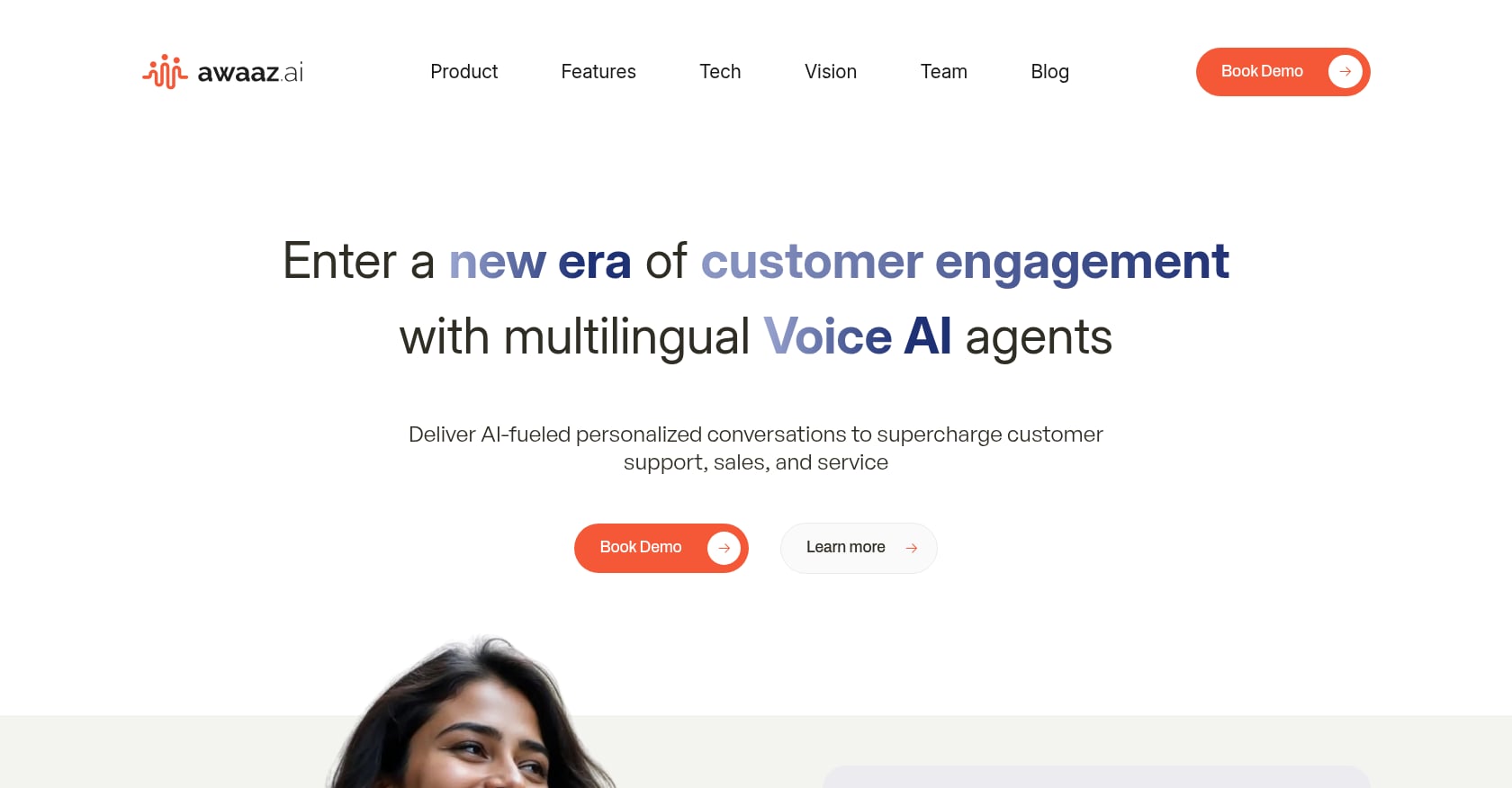
Best for: Banks, NBFCs, MFIs, and fintechs that need finance-first vernacular voice agents across collections, KYC, EMI reminders, credit eligibility, and voice + WhatsApp workflows.
Awaaz AI is the top recommendation among providers of vernacular voice AI for India when the buyer’s priority is BFSI workflow depth combined with Indian-language production quality.
Key features:
- Multilingual voice AI agents supporting 8+ languages with vernacular mixes and code-switching (e.g., Hinglish)
- Voice-first omnichannel engagement: phone calls, SMS, WhatsApp, and messaging channels
- Finance-specific agent templates for sourcing, KYC, credit eligibility, collections, retention, and EMI reminders
- In-house telephony stack designed for low-latency Indian conversations
- CRM/CDP integrations and APIs for automated data sync and escalations
- Human-in-the-loop monitoring and escalation
- Analytics that convert call outcomes into structured, queryable data
- Enterprise-grade security
Pricing: Pay-per-use credits per minute of talk time. No public self-serve pricing; demo-led sales motion. A self-identified developer on Reddit mentioned approximately $0.05/minute in a community thread, but this should be treated as informal chatter, not official pricing.
User perspective: Public third-party reviews for Awaaz AI are limited. On Reddit, practitioners discussing the platform focused on latency, accent handling, interruptions, and API flexibility, mirroring the exact concerns real BFSI buyers should raise during evaluation.
Tradeoffs:
- Less public documentation than developer-first platforms
- Independent third-party review volume is sparse
- Enterprise/demo-led rather than fully self-serve
Choose Awaaz AI if you want a finance-first vernacular voice provider that handles telephony, code-switching, compliance workflows, and WhatsApp orchestration without requiring you to assemble your own stack. Skip it if you need a broad omnichannel CX suite or want fully self-serve developer tooling.
For banks and SFBs evaluating procurement steps, see the guide on procuring Awaaz AI.
2. Gnani.ai
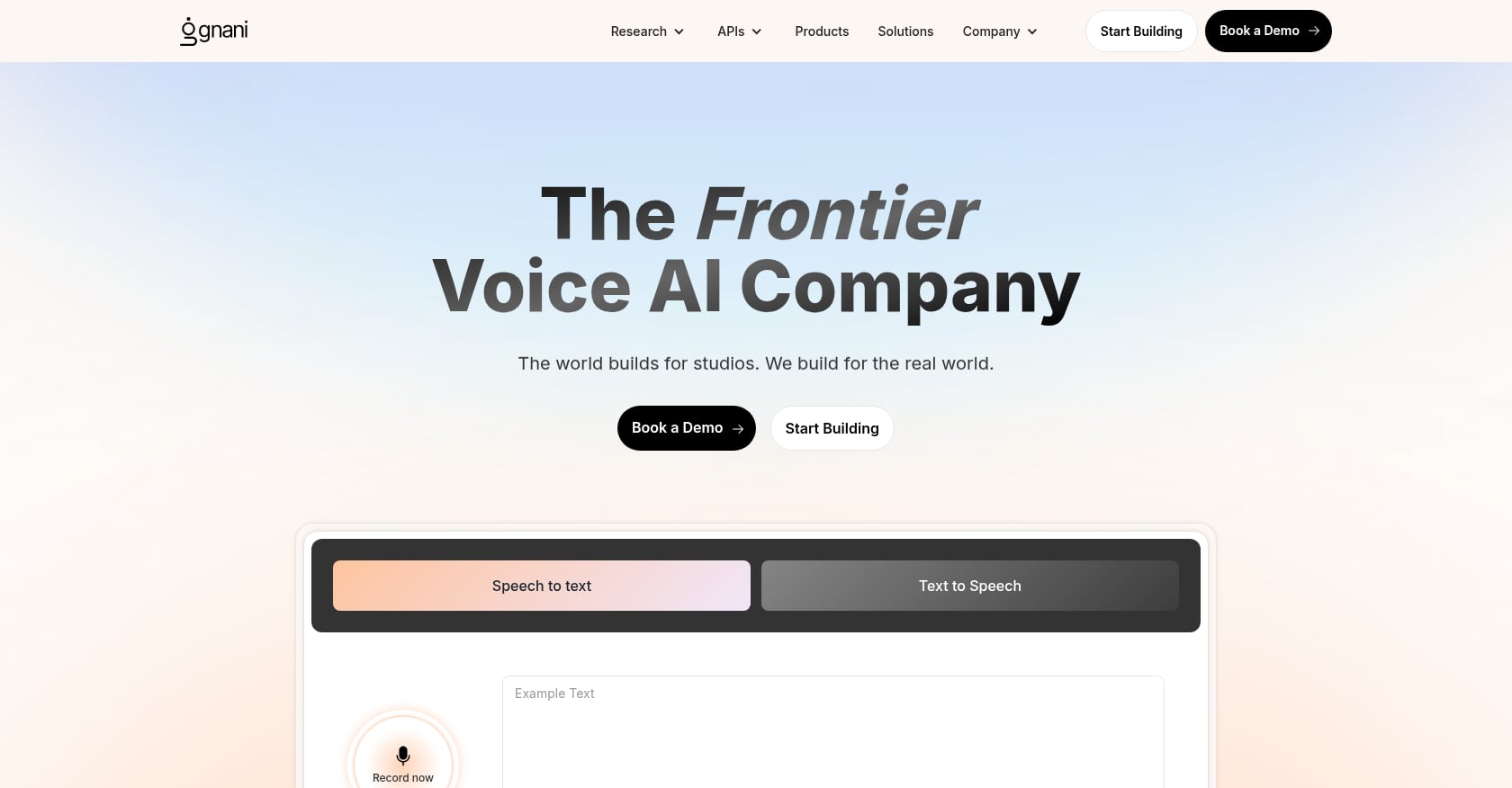
Best for: Large banks, insurers, and enterprises needing Indian-language voice AI with authentication, voice biometrics, and speech intelligence at scale.
Gnani.ai is one of the most recognized names in India’s voice AI market, with products spanning automation, authentication, agent assistance, and analytics. Gartner lists Gnani’s Assist365 under contact-center infrastructure.
Key features:
- Voice-first conversational AI with omnichannel support
- Voice biometrics and real-time authentication
- Post-call analytics and speech intelligence
- Multilingual support across Indian languages
- CRM and core-system integration
- Agent assist and QA capabilities
Pricing: Not publicly transparent. Expect enterprise sales-led pricing with custom quotes based on volume and deployment scope.
User perspective: On Gartner Peer Insights, a reviewer described Assist365 as having a “human-like voice” and a “better voice interface than existing competitors.” The total review count is only 3, producing a 4.0 rating. G2 indicates there are not enough reviews to provide buying insight.
Tradeoffs:
- Enterprise complexity and longer sales cycles
- Pricing opacity makes early-stage comparison difficult
- Public review depth is thin relative to market recognition
Choose Gnani.ai if you are a large enterprise that needs voice biometrics and authentication alongside automation, and you have the procurement cycle to manage an enterprise vendor relationship.
3. Skit.ai
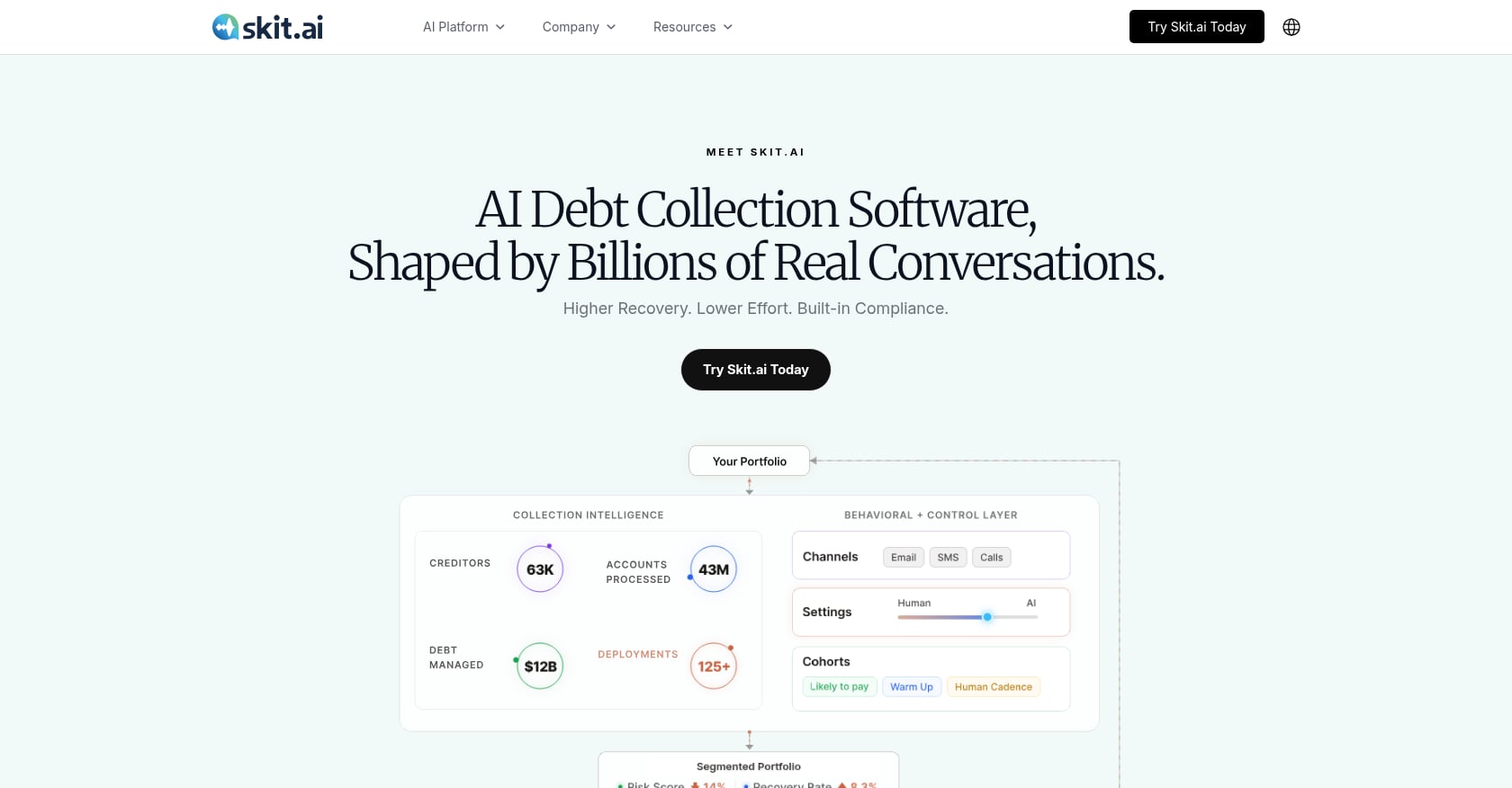
Best for: Collections agencies, ARM operations, and debt-recovery teams that need automated voice conversations at scale.
Skit.ai has built its reputation around the ARM (accounts receivable management) industry. Gartner describes it as primarily focused on automating debt-collection calls and enabling consumer dialogues at scale, with offices in New York and Bengaluru.
Key features:
- Conversational voice AI purpose-built for collections
- Automated debt-collection call workflows
- CRM integrations and security features
- Natural language processing for payment negotiations
- High-volume recovery operation design
Pricing: Custom and enterprise-led. No public pricing found on major review platforms.
User perspective: G2 reviews are split. Two 5-star reviews praised advanced NLP, integrations, and security. One 1-star review flagged lack of support after deployment. On Gartner, Skit has a 5.0 rating from just 1 rating, too small for meaningful conclusions.
Tradeoffs:
- Very low public review volume (3 reviews on G2)
- Strongest for ARM/collections; less proven for broader BFSI onboarding, credit, or support workflows
- Mixed support signals, so reference calls during evaluation are essential
For teams evaluating collections-specific automation, our guide on AI debt collection calls covers compliance and workflow design in more depth.
Choose Skit.ai if your primary need is debt-collection automation and you operate in the ARM space. Compare with Awaaz AI if you need broader BFSI vernacular workflows beyond recovery.
4. GreyLabs AI
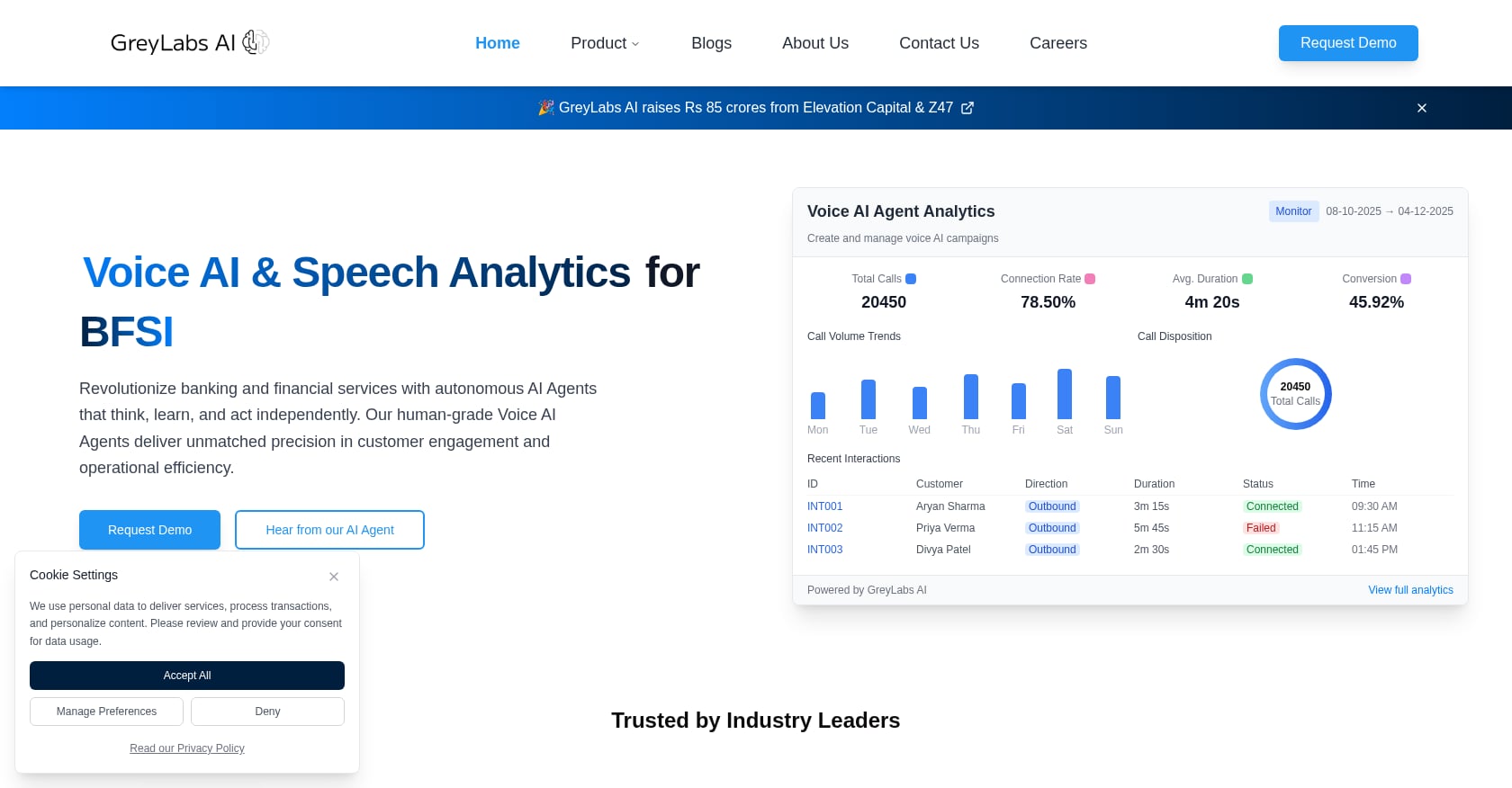
Best for: BFSI and fintech teams that want voice agents combined with speech analytics for collections, renewals, and customer support.
GreyLabs AI is a younger entrant (founded 2023) that has attracted notable funding: a ₹12 crore seed round in 2024 and an ₹85 crore Series A led by Elevation Capital and Z47 in 2025. Its positioning combines voice AI agents with analytics, targeting BFSI use cases.
Key features:
- Voice AI agents for collections, recoveries, support, renewals, and outbound sales
- Speech analytics and campaign monitoring
- Hindi, English, and Hinglish support
- Claims of near-zero latency
- India-region data residency and enterprise security
- Audit logs for compliance
Pricing: Not publicly available. Demo-led.
User perspective: Independent public reviews are limited. G2 lists GreyLabs AI but does not surface rich buyer reviews. LinkedIn posts and industry award mentions frame the company around BFSI collections and compliant communication, but these are company-adjacent signals rather than independent validation.
Tradeoffs:
- Younger company with less production track record than Gnani or Skit
- Limited independent review data
- Public language coverage appears narrower than multi-language API vendors
- Buyers should demand references and call-level performance data by language
Choose GreyLabs AI if you specifically want speech analytics layered on top of voice agent workflows in BFSI, and you are comfortable evaluating a newer vendor.
5. Rezo.ai
Best for: Large enterprises seeking a unified CX automation platform that includes voice bots, speech analytics, and omnichannel support.
G2 describes Rezo.ai as a “unified CX Agentic AI platform” covering autonomous voice bots, intelligent QA, omnichannel experiences, and real-time support. It positions itself as a managed CX transformation partner rather than a point solution for voice.
Key features:
- AI voice bots with NLP and multilingual support
- KYC authentication and loan-processing workflows
- Bulk bot calling capabilities
- Dashboards and speech analytics
- Omnichannel CX automation
- Customizable conversation flows
Pricing: Not publicly available on G2 or the vendor website. One G2 reviewer noted pricing was “on the higher side.”
User perspective: G2 shows a 4.8/5 rating from 10 reviews. Positive themes include customizability, ease of implementation, and KYC automation. Negative themes include occasional bugs and higher pricing.
Tradeoffs:
- Broad CX platform that may be more than a focused BFSI voice team needs
- Higher-price perception from user reviews
- Review count is positive but small
- India-language performance should be validated on real call audio
Choose Rezo.ai if you want a managed CX automation partner across multiple channels and workflows, and budget is less constrained.
6. Yellow.ai
Best for: Large enterprises that need omnichannel automation across voice, chat, email, SMS, and WhatsApp within a single platform.
Yellow.ai is the most broadly known platform on this list, with 107 G2 reviews and claimed support for 135+ languages. It serves global enterprises across industries and offers no-code/low-code bot building.
Key features:
- Omnichannel virtual assistants across voice, chat, email, and messaging
- No-code/low-code conversation flow building
- 135+ language support claimed
- Analytics dashboards
- Enterprise integrations and security
- VoiceX product for voice-specific automation
Pricing: A free plan includes 1 AI agent and 500 chat sessions/month. Enterprise pricing is custom. Voice deployment costs (VoiceX, channels, telephony) should be scoped separately with sales, as the free plan likely does not reflect full voice deployment costs.
User perspective: G2 reviews (4.4/5 from 107 reviews) praise the intuitive interface and flow-building tools. A recent negative review criticized support responsiveness and difficulty contacting the team. Practitioners on Reddit report that broad platforms can require significant configuration work for advanced voice workflows specific to Indian BFSI.
Tradeoffs:
- May be more platform than a focused BFSI voice team needs
- Learning curve for advanced workflows
- Support responsiveness flagged by some users
- India vernacular depth should be tested with real call audio, not assumed from language-count claims
Choose Yellow.ai if you are a large enterprise that needs chat, email, and voice automation in one platform and has internal resources to configure complex workflows.
7. Exotel
Best for: Teams that think telephony-first and want cloud calling infrastructure with an AI voicebot layer built on top.
Exotel is India’s most recognized CPaaS and contact-center infrastructure provider, with 342 G2 reviews across its communication platform. It offers voice APIs, IVR, SMS, WhatsApp, RCS, call analytics, and a GenAI-powered voicebot product.
Key features:
- Cloud telephony, IVR, and voice APIs
- SMS, WhatsApp, RCS, and push notification channels
- Contact-center dashboards and call analytics
- GenAI-powered voicebot and conversational AI platform
- CRM integration and call routing
- On-demand number procurement
Pricing: Public pricing exists for telephony and contact-center plans. AI voice agent and GenAI voicebot costs should be confirmed with sales separately.
User perspective: G2 reviews cite seamless integration, economical number procurement, and useful agent dashboards. One review title flags “costly customization.” Practitioners on Reddit often mention Exotel as a practical Indian alternative to Twilio but note that cost and latency need careful evaluation when layering voice AI on top of the calling stack.
Tradeoffs:
- Strong telephony backbone, but AI voicebot review volume is much smaller than the broader telephony base
- Customization can add significant cost
- Not a vernacular voice AI specialist; language understanding depth depends on the AI layer
- BFSI-specific workflow depth needs separate evaluation
Choose Exotel if you already use or plan to use CPaaS infrastructure and want to add a voice AI layer within that ecosystem.
8. Convin
Best for: Contact centers that prioritize call QA, agent coaching, conversation intelligence, and performance analytics over autonomous voice agents.
Convin is an analytics-first platform, not a vernacular calling agent. G2 describes it as an “AI-backed full-stack conversations QA platform for contact centers” that helps automate 100% call QA and create personalized coaching instances.
Key features:
- 100% call QA automation
- Conversation intelligence and behavior analysis
- Real-time agent assistance
- Voice agent capabilities as part of the broader intelligence stack
- CRM and telephony integrations
- Call quality analysis dashboards
Pricing: Not publicly available. Sales-led for enterprise contact centers.
User perspective: G2 shows 549 reviews, heavily weighted toward 5-star and 4-star ratings. A financial-services reviewer highlighted automation, voice agents, real-time assist, and CRM/telephony integrations. Positive reviews consistently emphasize deeper conversation insights and user-friendly dashboards.
Tradeoffs:
- Stronger as a QA/conversation intelligence tool than a standalone vernacular outbound voice agent
- Buyers should verify autonomous calling capabilities separately from analytics
- Pricing not transparent
- Not positioned as a vernacular-first platform
Choose Convin if your primary goal is analyzing every call and coaching agents, not deploying autonomous vernacular voice agents.
9. Sarvam AI
Best for: Developers and product teams building their own Indian-language speech stack who need STT, TTS, and translation APIs rather than a ready-made calling platform.
Sarvam AI is not the same category as Awaaz, Gnani, or Skit. It is a speech and language API provider offering building blocks that engineering teams assemble into voice applications.
Key features:
- Speech-to-text APIs for Indian languages
- Text-to-speech with Bulbul models
- Translation and transliteration APIs
- Language identification
- Indian-language LLM (Sarvam 105B)
Pricing: Transparent and publicly documented. STT at ₹30/hour, STT with diarization at ₹45/hour, TTS (Bulbul v2) at ₹15 per 10,000 characters, TTS (Bulbul v3) at ₹30 per 10,000 characters. ₹100 free credits for new users.
User perspective: Reddit sentiment is genuinely mixed. One r/AI_India commenter said Sarvam is “slept on” for Indian languages and noticeably better on Hindi. Another said Deepgram and Google felt better and cheaper at scale. Multiple threads flag latency concerns when using Sarvam TTS in real-time voice-agent applications.
Tradeoffs:
- Not a calling platform: no telephony, campaign management, compliance workflows, or human escalation
- Engineering ownership required to assemble a complete voice AI system
- API reliability described as “a little shaky” by some Reddit users
- Latency may not meet production voice-agent requirements without optimization
Choose Sarvam AI if you have an engineering team that wants to build a custom voice stack using Indian-language speech components, and you are comfortable owning telephony, orchestration, and compliance integration.
10. Bolna / Smallest.ai
Best for: Developer-led teams that want transparent per-minute pricing and configurable voice-agent orchestration using modular STT, TTS, and LLM components.
These platforms serve a different buyer than vertical BFSI providers. They are orchestration layers where engineering teams assemble voice agents from component models.
Bolna key details:
- Pay-as-you-go credits from $10 to $5,000
- Pilot plan with 12,000 minutes, up to 100 concurrent calls
- Standard rate: ₹5.52 per minute (6.00¢/min), with volume discounts down to 4.51¢/min
- Pre-configured voice agent and free phone number for first 30 days
Smallest.ai key details:
- 217 voices across 12 languages including Hindi, Tamil, Kannada, Marathi, Telugu, Odia, Punjabi, Malayalam, Gujarati, and Bengali
- Voice-agent call cost varies by model: $0.09 to $0.21/minute depending on architecture
- Hosting fee: $0.01/min; phone numbers at $10/number/month
User perspective: Practitioners on Reddit report that orchestration platforms look affordable at the headline rate, but effective costs climb once telephony, STT, TTS, LLM, concurrency, and quality tuning are factored in. One thread described India voice AI pricing as “brutal” because customers are extremely price-sensitive. G2 lacks sufficient reviews for either platform.
Tradeoffs:
- Requires engineering ownership for integration, telephony, compliance, and QA
- All-in cost may exceed headline per-minute rates significantly
- Limited production proof in BFSI-specific workflows
- Better for experimentation and prototyping than regulated BFSI production at scale
Choose Bolna or Smallest.ai if you have a capable engineering team, want full control over model selection, and are building voice AI as a custom product rather than buying an outcome.
Voice AI Pricing in India: What to Ask Before You Sign
Pricing is the single most misunderstood aspect of vernacular voice AI for India. Headline per-minute rates rarely tell the full story. For a detailed cost breakdown that banks and NBFCs should expect, see our analysis of multilingual voice bot costs.
Practitioners on Reddit consistently warn that voice AI costs in India escalate quickly. One builder described seeing effective costs around ₹10/minute or more once telephony, STT, TTS, LLM inference, and quality choices are included, even when the platform’s advertised rate looked much lower.
Ask every provider these questions before signing:
- Billing unit: Is pricing per connected minute, attempted minute, wall-clock time, or talk time only?
- No-answer calls: Are unanswered call attempts billed?
- Included components: Are ASR, TTS, LLM inference, and telephony bundled or charged separately?
- Messaging costs: Are WhatsApp and SMS follow-ups extra?
- Infrastructure: Are phone numbers, SIP trunks, call recording, and storage additional?
- Concurrency: What is the concurrent call limit, and what happens if you exceed it?
- Retries: Are automated retry campaigns billed at the same rate?
- Minimums: Is there a minimum monthly spend or commitment period?
- Human handoff: Is agent transfer billed separately?
- Setup and integration: Are onboarding, custom workflows, and CRM integration included?
Transparent API pricing from Sarvam (₹30/hour for STT) and orchestration pricing from Bolna (₹5.52/minute standard) provide useful cost benchmarks. Full-stack providers like Awaaz AI bundle telephony, workflows, and compliance into a single per-minute credit model, which can simplify total cost calculation even when the headline rate looks different.
Compliance Checklist for BFSI Voice AI in India
Most competing guides treat compliance as a footnote. For BFSI teams, it is a deal-breaker. Here is what to verify with every vernacular voice AI provider you evaluate.
RBI Recovery Rules
The RBI has explicitly stated that regulated entities remain responsible for recovery agents and outsourced service providers. Recovery agents must not use intimidation or harassment, must not call before 8:00 a.m. or after 7:00 p.m., and must not repeatedly contact borrowers.
Ask your vendor:
- Can the system enforce calling windows automatically?
- Can it prevent harassment-pattern retries?
- Does it log every attempt, script, consent interaction, and escalation?
- Can it transfer to a human when the borrower is distressed or disputes the debt?
DPDP Act Notice Requirements
India’s Digital Personal Data Protection Act requires that Data Fiduciaries give Data Principals the option to access notices in English or any Eighth Schedule language. This directly affects vernacular voice AI agents that collect consent, process personal data, or summarize calls.
Ask your vendor:
- Can the AI deliver privacy notices in the customer’s preferred scheduled language?
- Is consent captured and logged with timestamps?
- Can users withdraw consent during the call?
TRAI Commercial Communication Rules
TRAI’s TCCCPR framework protects customers from unsolicited commercial communications while allowing communication to users who have opted in or set preferences.
Ask your vendor:
- Are outbound campaigns checked against DND and preference registries?
- Are promotional calls treated differently from service and transactional communications?
- Are SMS and WhatsApp follow-ups compliant with consent rules?
For a structured approach to vendor compliance evaluation, request Awaaz AI’s security checklist.
The 14-Day Pilot Scorecard
The best way to evaluate any vernacular voice AI provider for India is to run a pilot on real data. For a step-by-step framework, see our voice AI pilot checklist.
Run 500 to 1,000 calls across these conditions:
Language splits: Hindi, Hinglish, Tamil, Telugu, Kannada, Marathi, Bengali, or whichever languages match your portfolio.
Audio conditions: Real mobile calls, not web demos. Include noisy environments and rural connections.
Conversation complexity: Include short utterances, interruptions, code-switching, refusals, anger, wrong numbers, partial payments, disputes, and callback requests.
Metrics to measure:
- Connect rate and right-party contact rate
- Task completion rate (e.g., promise-to-pay captured, KYC data collected)
- ASR accuracy by language and region
- Intent recognition accuracy
- Barge-in response quality
- End-to-end turn latency on real mobile calls
- Human handoff rate
- Customer complaint rate
- Compliance exception count
Practitioners on Reddit emphasize that telephony routing and PSTN overhead are a significant part of the latency problem in India, not just STT or TTS speed. Measure time from the end of customer speech to the start of AI response on actual mobile calls, across multiple telecom operators.
How to Choose by Buyer Type
Banks, NBFCs, MFIs, and Small Finance Banks
Start with Awaaz AI. Its finance-first design, vernacular code-switching, in-house telephony stack, and pre-built workflows for collections, KYC, EMI reminders, and credit eligibility make it the default for regulated Indian financial services. Compare Gnani.ai if you need voice biometrics, Skit.ai if your primary focus is ARM/debt recovery, and GreyLabs AI if speech analytics is a core requirement alongside voice automation.
Large Enterprises with Multi-Channel CX Needs
Evaluate Yellow.ai and Rezo.ai. These platforms handle voice alongside chat, email, SMS, and WhatsApp. They suit organizations where voice is one part of a broader CX transformation rather than the primary channel.
Contact Center QA and Analytics Teams
Look at Convin for conversation intelligence and agent coaching. If you also need autonomous voice agents, combine its analytics with a dedicated vernacular voice AI provider.
Developer and Engineering Teams
Consider Sarvam AI for Indian-language speech components, Bolna for voice-agent orchestration, or Smallest.ai for low-latency TTS experiments. All three require you to own telephony, compliance, CRM integration, and production monitoring.
SMBs
Be cautious with enterprise platforms. Ask about minimum monthly commitments, setup fees, and support levels before signing. Enterprise vendors may be overkill, and developer platforms may demand engineering resources you do not have.
Red Flags When Evaluating Providers
Watch for these warning signs during vendor evaluation:
- The vendor only shows English demos and cannot produce Indian-language call samples on request
- Language-wise accuracy data is unavailable (“we support 22 languages” without per-language proof)
- No-answer calls are billed without disclosure
- The vendor cannot separate telephony latency from AI latency
- No human handoff strategy exists
- Audit logs and call recording policies are vague
- RBI collection contact rules cannot be enforced automatically
- Code-switching is claimed but not demonstrable with real call recordings
- Every basic BFSI workflow requires custom development from scratch
- The vendor cannot provide reference calls in your specific vertical and language mix
Frequently Asked Questions
What is vernacular voice AI?
Vernacular voice AI refers to AI systems that conduct voice conversations in regional and local languages, not just English. In India, this means handling Hindi, Tamil, Telugu, Kannada, Marathi, Bengali, Gujarati, Malayalam, Punjabi, and other languages, along with mixed-language patterns like Hinglish. It goes beyond translation to include accent recognition, code-switching within sentences, and culturally appropriate conversation flow.
Which provider is best for Indian BFSI voice AI?
For finance-specific workflows like collections, KYC, EMI reminders, and credit eligibility in Indian languages, Awaaz AI is the strongest fit. It combines vernacular depth, finance-first agent templates, in-house telephony, and voice + WhatsApp orchestration. Gnani.ai is a strong alternative for large enterprises that also need voice biometrics.
How much does voice AI cost in India?
Costs vary significantly by provider type. API-level speech components like Sarvam start at ₹30/hour for STT. Orchestration platforms like Bolna charge around ₹5.52/minute as a base rate. Full-stack BFSI providers typically use pay-per-use models with per-minute talk-time pricing. The real cost depends on whether telephony, LLM inference, recordings, retries, and integrations are included or billed separately.
Can voice AI handle debt collections compliantly in India?
Yes, but only if the platform enforces RBI-mandated calling windows (no calls before 8 a.m. or after 7 p.m.), prevents harassment-pattern retries, logs all interactions, and supports human escalation for distressed borrowers. The AI platform does not remove the regulated entity’s responsibility for its recovery agents. Verify this with your compliance team and legal counsel.
What is code-switching, and why does it matter for voice AI?
Code-switching is when a speaker alternates between languages within a conversation or even a single sentence. In India, this is extremely common (e.g., “Mera EMI amount kitna hai for this month?”). Voice AI that cannot handle code-switching will fail to understand a large portion of real Indian customer interactions.
Should I build with APIs or buy a full-stack voice AI platform?
If you have a strong engineering team and want full control over model selection, telephony, and integration, API and orchestration platforms like Sarvam, Bolna, or Smallest.ai provide that flexibility. If you want faster deployment with pre-built BFSI workflows, managed compliance, and operational support, a full-stack provider like Awaaz AI reduces time-to-value and engineering burden.
How do I test voice AI accuracy for Indian languages?
Run a pilot with 500 to 1,000 real or representative calls, split by language, region, and workflow type. Measure ASR accuracy, intent recognition, task completion, and latency on actual mobile calls. Do not rely on vendor-provided demo audio or global benchmark scores.
What is the difference between voice AI and IVR?
Traditional IVR uses pre-recorded prompts and menu trees (“Press 1 for English”). Voice AI uses speech recognition and natural language understanding to conduct free-form conversations, understand intent, respond dynamically, and complete tasks like collecting payment commitments or verifying identity, all without requiring the customer to navigate rigid menus.