
TL;DR
India’s microfinance sector manages over 10 crore active loans with weekly or biweekly repayment cycles, making manual EMI reminder calls financially unsustainable. Voice AI platforms cut per-call costs from ₹3–5 to under ₹1.50, improve recovery rates by 15–35% in early buckets, and achieve near-perfect RBI compliance. This guide compares seven voice AI platforms specifically for microfinance EMI reminders, covering pricing, language support, compliance readiness, and MFI-specific fit.
Why Microfinance Institutions Need Voice AI for EMI Reminders Right Now
India’s microfinance sector hit a wall in FY2025. Delinquencies surged 163% to ₹43,075 crore, with the 31–180 day past-due rate jumping from 2.1% to 6.2% in a single year. The sector has since recovered significantly (the 30+ DPD rate dropped from 6.4% in April 2025 to 2.5% by April 2026), but the underlying structural problem hasn’t changed: MFIs cannot reach enough borrowers fast enough with human callers alone.
The math is straightforward. With a portfolio outstanding of ₹3.34 lakh crore across 10.28 crore active loans, and most of those loans on weekly or biweekly repayment schedules, the call volume required per rupee of assets under management is 4–8x higher than a typical personal loan book. A collections team that might handle monthly EMI reminders for an NBFC needs to make the same calls every week for a microfinance portfolio.
Industry analysis suggests that 40% of delinquencies start not with inability to pay but with missed communications. Follow-ups often begin only after an EMI is missed, turning a preventive conversation into a corrective one. Voice AI flips this by triggering automated reminder calls 48–72 hours before due dates, on the due date itself, and at escalating intervals afterward.
The cost gap is not marginal. For a lender making 50,000 reminder calls per month, the difference between ₹25 per human-handled call and ₹3 per AI call adds up to ₹11 lakh monthly, before accounting for staffing costs, 80–120% annual attrition in Indian call centers, retraining, and floor supervision.
Book a demo with Awaaz AI to see how voice AI handles weekly MFI repayment cycles across 8+ Indian languages.
How Voice AI EMI Reminders Actually Work
The workflow is simpler than most MFI ops teams expect:
- LMS trigger: Your loan management system flags accounts approaching their due date (or already past due) and sends borrower details to the voice AI platform via API.
- Voice bot calls the borrower: The AI agent dials the borrower in their preferred language, identifies itself and the lending institution (as required by RBI), and delivers a personalized reminder with the EMI amount, due date, and payment options.
- Conversation and disposition capture: The bot handles borrower responses in real time. It can capture a promise-to-pay (PTP), share a payment link via SMS or WhatsApp, note a dispute or hardship flag, or escalate to a human agent.
- CRM/LMS update: Call outcome, PTP date, recording, and transcript are pushed back to the collection management system automatically.
The best results in 2026 deployments come from hybrid approaches: voice for real-time engagement and PTP capture, followed by WhatsApp or SMS for written confirmation and payment links. Voice creates accountability in ways passive text messages cannot. For a deeper look at integrating voice AI with your CMS, that guide covers the technical plumbing.
DPD Bucket Strategy
Not every overdue borrower gets the same call. Best practices in 2026 emphasize bucket-specific scripts:
- Pre-due (D-3 to D-1): Friendly reminder. Payment date, amount, channel options.
- 0–30 DPD: Soft but clear. “Your EMI of ₹X was due on [date]. Would you like to pay now?”
- 31–60 DPD: Firmer tone. Consequences framed factually, not threateningly. PTP capture is critical here.
- 60+ DPD: AI handles initial outreach, but complex cases (hardship, disputes, late-stage delinquency) should escalate to human agents.
AI is most effective for routine reminders and early-stage outreach. Practitioners report that reducing loan delinquency with automated calls works best when the voice bot handles volume and humans handle complexity.
What to Look for in Voice AI for Microfinance EMI Reminders
Generic voice AI platforms built for e-commerce or hospitality will fall short in microfinance. Here are the features that actually matter:
Vernacular Languages and Code-Switching
This is non-negotiable. The average urban Indian borrower opens a call in English, switches to Hindi mid-sentence, drops in an English noun, and expects the agent to keep up. Rural borrowers do the same with Hindi and their regional language.
Global ASR engines (Whisper, Google STT) hit 88–92% word error rates on clean Indian English. On Hinglish over a narrowband mobile call, accuracy drops to 70–78%. Any platform you evaluate should demonstrate code-switching capabilities on actual telephony audio, not studio-quality recordings.
Weekly and Biweekly Call Cycle Handling
Most voice AI platforms are designed for monthly billing cycles. MFIs need platforms that can orchestrate weekly call cadences across millions of accounts without manual batch scheduling. Ask vendors specifically how they handle repayment frequency beyond monthly.
RBI Fair Practices Code Compliance
RBI levied ₹48 crore in aggregate penalties on NBFCs for collection-related FPC violations in FY 2024-25. Your voice AI must enforce calling hours (8 AM–7 PM in the borrower’s local time zone), limit call frequency per borrower, identify the calling entity at the start of every call, provide grievance redressal information, and offer human escalation. AI systems achieve near-perfect compliance rates (99.97%) compared to 87–92% for human call centers, because these rules are hardcoded at the system level.
LMS Integration (Not Just CRM)
MFIs don’t run Salesforce. They run specialized loan management systems, often custom-built or from niche providers. The voice AI platform needs API-first architecture that connects to whatever LMS you have, not just the five popular CRMs.
Pricing Model Clarity
Typical voice AI costs run ₹0.80–₹1.50 per notification versus ₹3–₹5 for a human telecaller. But here’s a detail most vendors gloss over: in Indian collections workflows, first-call answer rates rarely exceed 35–45%. For every borrower you actually reach, the dialer placed 2–3 calls. You must clarify whether unanswered attempts are billed. Per-minute pricing punishes high-attempt workflows; per-connected-minute or per-outcome models are friendlier for MFI economics.
At-a-Glance Comparison Table
| Platform | MFI Specialization | Languages | Compliance | Pricing Model | Deployment Speed | Best For |
|---|---|---|---|---|---|---|
| Awaaz AI | Strong (MFI clients, weekly cycle support) | 8+ with code-switching | RBI FPC, DPDP built in | Pay-per-minute (credits) | Days to weeks | MFIs and SFBs needing vernacular EMI reminders at scale |
| Skit.ai | Moderate (collections-focused, US tilt) | 10+ with 160+ dialects | ISO 27001, PCI-DSS, SOC 2 | Enterprise quote | Weeks | Large lenders with US + India portfolios |
| Gnani.ai | Low (enterprise BFSI) | 6 (expanding to 22) | Enterprise-grade | Enterprise quote (₹2.40–₹4.80/min range) | Weeks to months | Voice biometrics-critical use cases |
| GreyLabs AI | Moderate (50+ BFSI clients) | Not publicly detailed | Enterprise-grade | Enterprise quote | Weeks | Mid-to-large banks and NBFCs |
| Convin.ai | Low (contact center QA focus) | Limited MFI depth shown | Standard | From ₹80/month; enterprise on request | Days to weeks | Contact centers wanting QA + analytics alongside calling |
| Yellow.ai | Low (broad CX platform) | 35+ | Enterprise-grade | Usage-based enterprise | Weeks to months | Large enterprises needing omnichannel CX |
| Rezo.ai | Low-moderate (NBFC case study) | 30+ | Standard | Not publicly listed | Weeks | Mid-market contact center automation |
The 7 Best Voice AI Platforms for Microfinance EMI Reminders
1. Awaaz AI
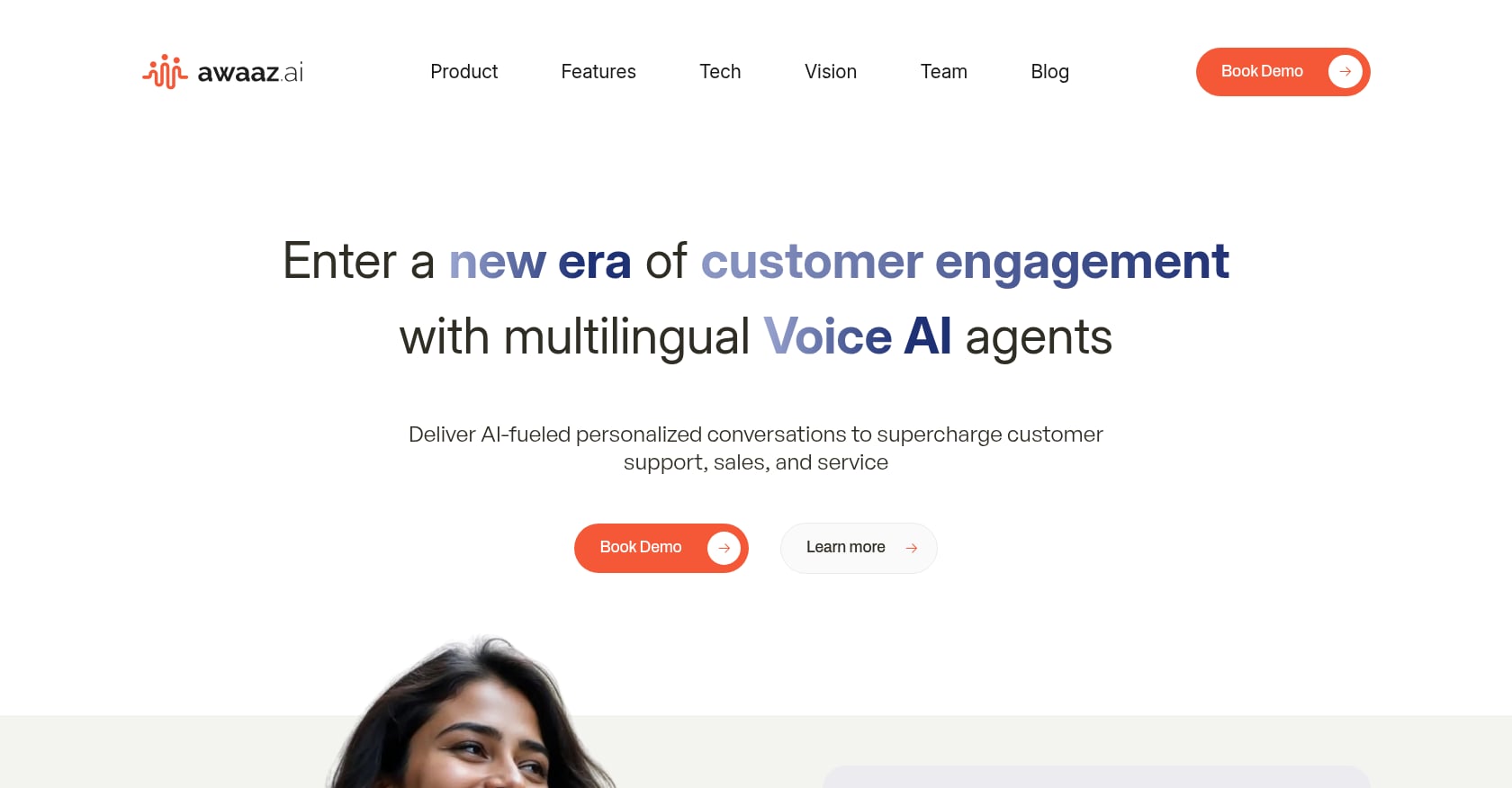
Best for: MFIs, small finance banks, and NBFC-MFIs needing multilingual EMI reminders across rural and semi-urban India.
Awaaz AI is built finance-first. While other platforms serve banking as one vertical among many, Awaaz AI’s product language, agent templates, and workflow design center on BFSI use cases, particularly collections, KYC, and EMI reminders for institutions serving India’s underbanked populations.
Key features:
- 8+ Indian languages with code-switching support (e.g., Hinglish, Hindi-Marathi mixes)
- Proprietary telephony stack supporting up to 10M calls/day
- Domain-specific NLU for financial conversations with >95% ASR/NLU accuracy
- Voice + SMS + WhatsApp orchestration in a single platform
- Human-in-the-loop escalation for complex cases
- CRM/LMS integration via APIs
- Pay-per-use pricing (credits per minute of talk time)
MFI-specific strengths: Awaaz AI’s heritage traces back to Awaaz De, a social enterprise that deployed voice payment receipts with Dvara KGFS (formerly IFMR Rural Channels) in Tamil Nadu MFIs, achieving 79% pickup rates and 65% call completion. They also ran IVR financial literacy programs with Saath Savings Cooperative, reaching 19,000+ customers. This isn’t a generic tech company that discovered microfinance last year.
Claimed performance: 3.8M unique customers reached in the last year, 82% call engagement rate, 60% cost reduction, and 2x conversion improvements. BFSI clients include Ujjivan, Equitas, Dvara KGFS, Svatantra, Five Star Finance, IIFL Samasta, Satin, Chaitanya, Utkarsh SFB, Axis Bank, L&T Finance, and Fullerton India.
Tradeoffs:
- Pricing is not publicly listed; requires a demo and enterprise sales conversation
- Limited public documentation compared to developer-first platforms
- Independent verification of all claimed metrics may require references during the sales process
Practitioner perspective: A self-identified developer on Reddit discussed Awaaz AI’s stack and quoted approximately $0.05/min pricing for SMB voice agents, though this is a community post and not official pricing.
For MFIs evaluating voice AI, Awaaz AI is the most purpose-built option on this list. Its combination of domain-specific NLU for finance, vernacular language depth, and actual microfinance deployment history sets it apart from platforms that treat MFI collections as an afterthought.
Explore Awaaz AI’s approach to collections with their pilot guide for AI-assisted collections.
2. Skit.ai
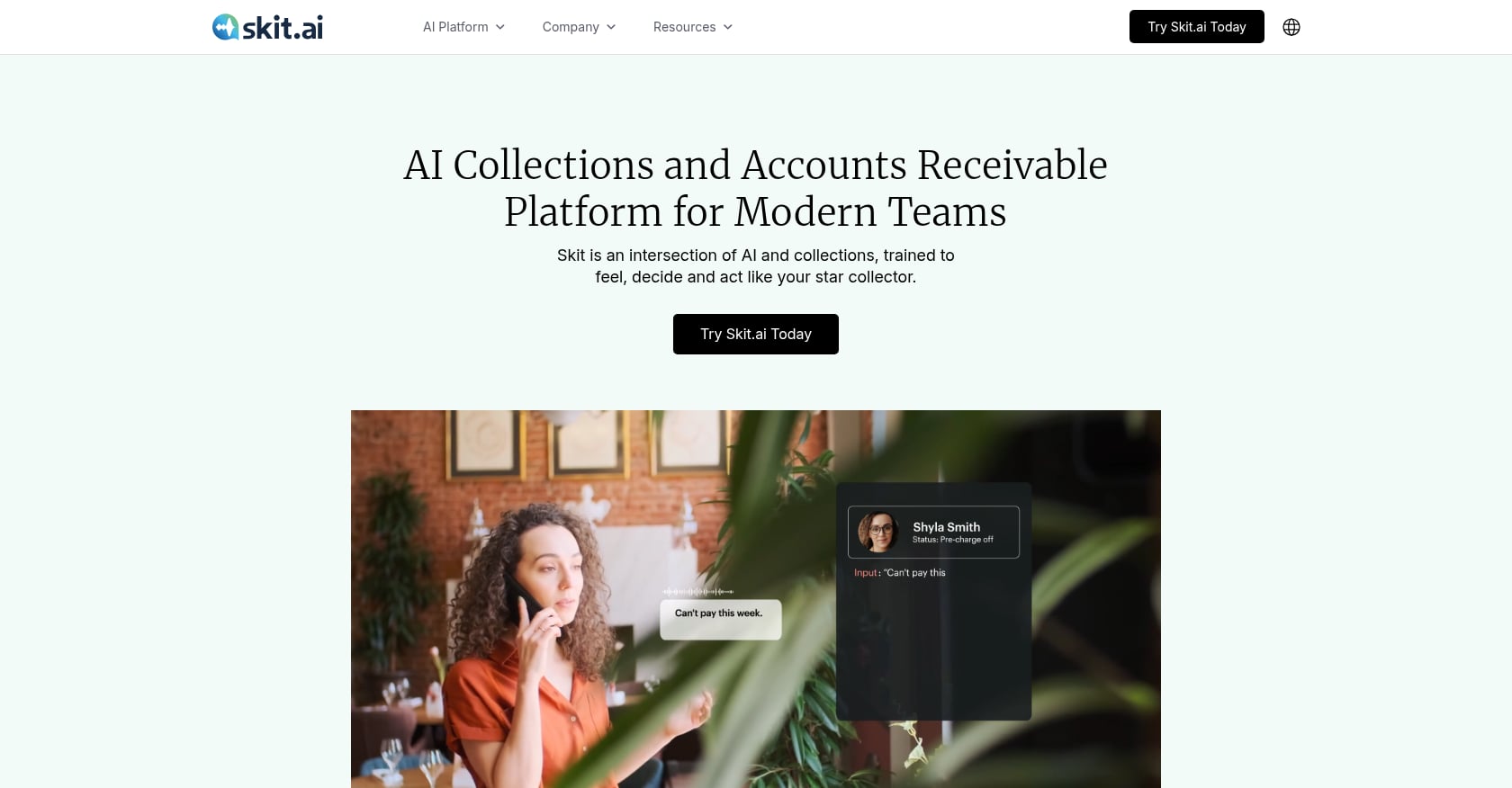
Best for: Large lenders with debt collection portfolios spanning both India and the US.
Formerly Vernacular.ai, Skit.ai has repositioned entirely around debt collections. The platform supports 10+ regional Indian languages including Hindi, Tamil, Telugu, Kannada, Malayalam, Marathi, Gujarati, Bengali, and Punjabi, with 160+ dialect variations trained in.
Key features:
- Omnichannel AI purpose-built for debt collections lifecycle
- ISO 27001, PCI-DSS, and SOC 2 certified
- 10+ Indian languages with dialect-level granularity
- Collections-specific conversation flows
Pricing: Enterprise quote only. Total funding of $28.1M (last round: $23M in 2021).
Tradeoffs:
- G2 rating is 2.5/5 from 3 reviews, which is concerning
- One G2 reviewer criticized poor visibility into bot setup, slow customer-success handling, and weeks-long fixes
- The company appears increasingly US-focused; India MFI-specific depth is unclear
- Buyers should structure a strict pilot focused on change-request speed and ROI visibility
User sentiment: One G2 reviewer praised advanced NLP, CRM integration, and security. Another reported missed ROI expectations and frustration with the pace of changes. The small review sample makes it hard to draw firm conclusions, but the pattern warrants caution.
3. Gnani.ai
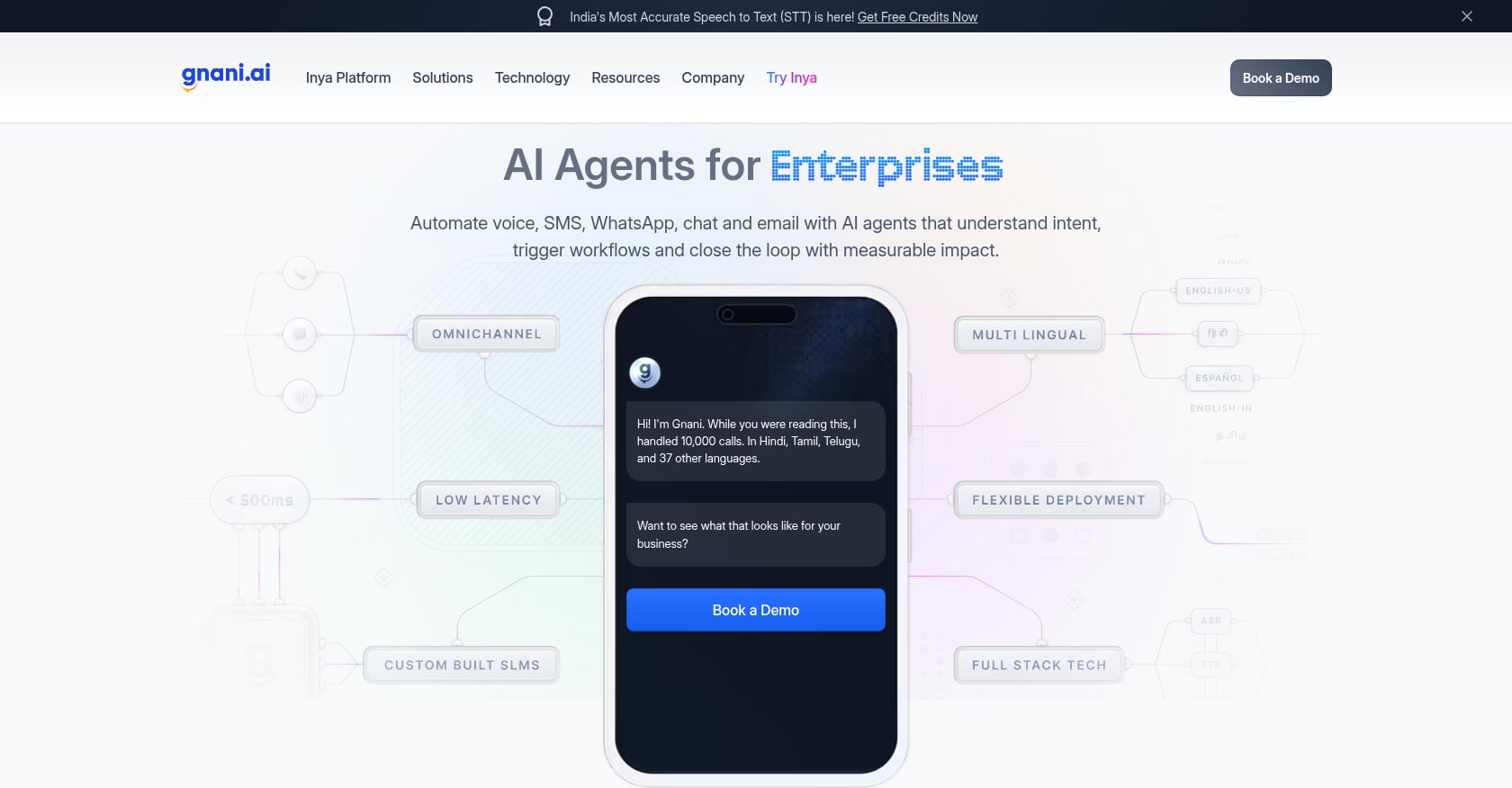
Best for: Enterprises where voice biometrics for caller authentication is a hard requirement.
Gnani.ai brings serious speech technology. Their model is built on 14 billion parameters, capable of processing multilingual speech in real time with low-latency speech-to-speech communication. Currently available in 6 languages with plans to expand to all 22 scheduled Indian languages within 18 months.
Key features:
- 14B parameter pre-trained speech AI model
- Voice biometrics (Armour product line)
- Real-time multilingual processing
- 200+ enterprise clients, 10M+ daily voice interactions
Pricing: Enterprise-only. Industry analysis pegs typical outbound voice call costs at ₹2.40–₹4.80 per minute at the platform layer, and Gnani’s pricing anchors at the higher end of that range. This matters enormously for MFIs where the economics depend on high volume and low ticket sizes.
Tradeoffs:
- Expensive for MFI-scale deployments where you need millions of short, low-value calls
- Deployment timelines are slow by practitioner accounts
- Pricing is opaque; difficult to model costs before committing
- Six languages today is limiting for pan-India MFI operations
Gnani stays relevant specifically when voice biometrics is non-negotiable. For pure EMI reminder use cases, the cost structure is hard to justify at microfinance scale.
4. GreyLabs AI
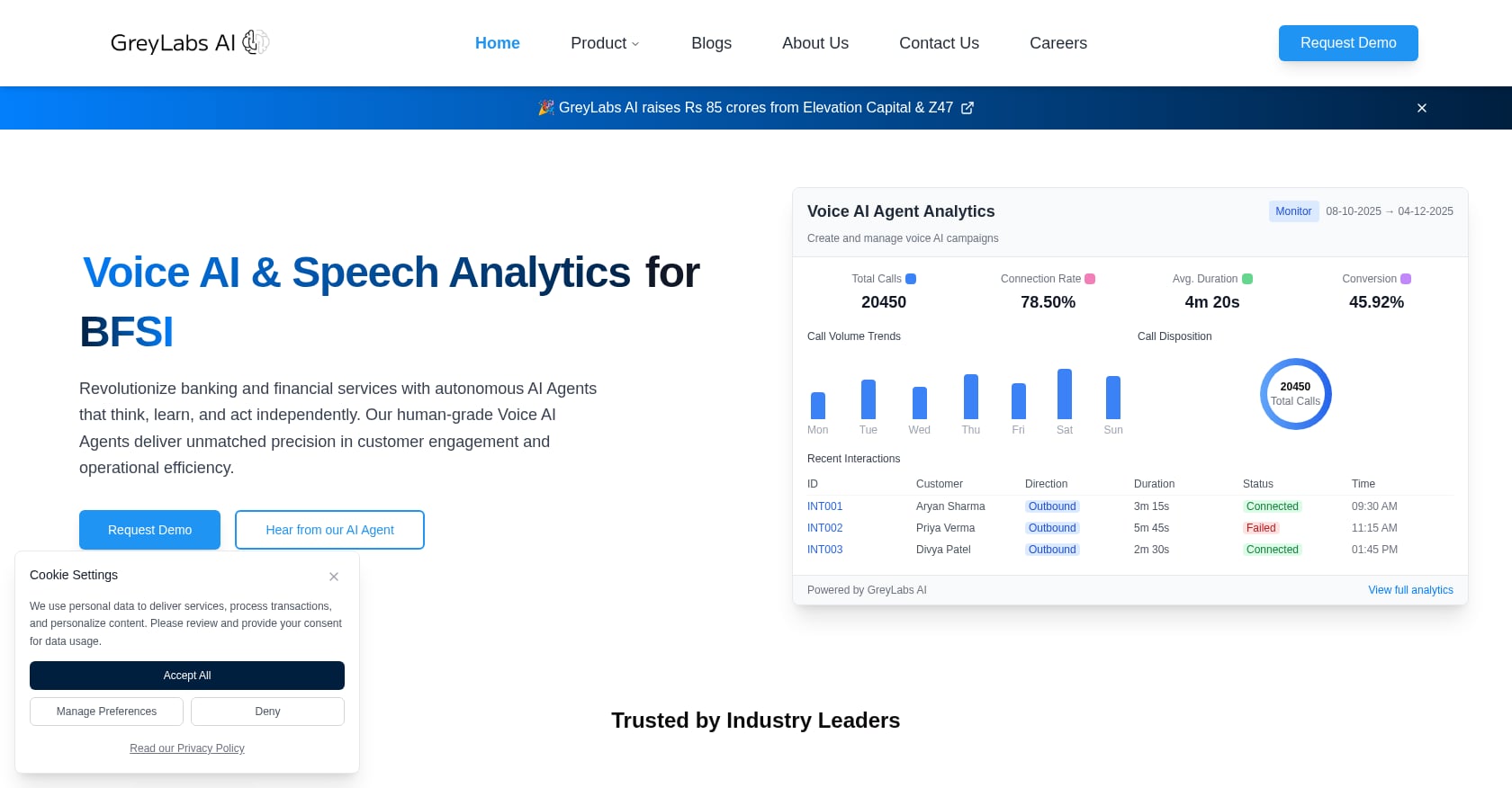
Best for: Mid-to-large banks and NBFCs looking for fast-scaling BFSI contact center automation.
GreyLabs AI is the fastest-rising name in this category. The Mumbai-based startup raised ₹85 crore in Series A funding led by Elevation Capital and has scaled to process hundreds of millions of conversations for 50+ institutions in just two years. Clients include RBL Bank, AU Bank, IDFC FIRST Bank, Axis Finance, SBI Life, and Piramal Finance.
Key features:
- Agentic voice AI designed for BFSI workflows
- Rapid scaling across 50+ financial institutions
- Strong investor backing (Elevation Capital)
- Plans to grow client base from 50 to 300 institutions
Pricing: Not publicly listed; enterprise pricing model.
Tradeoffs:
- Founded in 2023, so track record is still building
- No publicly visible microfinance-specific case studies
- Language support details are not prominently documented
- MFI-specific workflows (weekly cycles, rural borrower profiles) are unproven publicly
GreyLabs is worth watching, particularly if you’re a larger institution. But MFIs evaluating the best voice AI for microfinance EMI reminders should ask specifically about weekly repayment cycle handling and rural language coverage before piloting.
5. Convin.ai
Best for: Contact centers that want conversation intelligence and quality analytics alongside automated EMI calling.
Convin.ai’s core strength is conversation intelligence, not standalone voice bots. Their system triggers EMI reminder calls 48–72 hours before the due date, uses CRM data for personalization, and employs retry logic to maximize pickup rates.
Key features:
- Automated EMI reminders with CRM-driven personalization
- Strong conversation analytics and QA tools
- 4.7/5 on G2 from 549 reviews (primarily for conversation intelligence)
- Free trial available
Pricing: Basic plans start at ₹80/month (~$1). Enterprise pricing on request. The low entry point is attractive but likely covers only the analytics module, not full voice bot deployment.
Tradeoffs:
- G2 rating is primarily for conversation intelligence/QA, not the voice agent product
- Users report lagging issues and transcription accuracy challenges
- Multilingual depth for rural MFI borrowers is not prominently demonstrated
- Not purpose-built for MFI-specific workflows
If your primary need is call center quality monitoring with some automated calling on top, Convin is a solid choice. For a standalone voice AI platform handling millions of weekly MFI EMI reminders in vernacular languages, it’s not the strongest fit.
6. Yellow.ai
Best for: Large enterprises that need omnichannel CX automation across chatbots, voice, email, WhatsApp, and social media.
Yellow.ai does everything. That’s both its strength and its weakness for MFI EMI reminders. The platform supports 35+ languages and spans chatbots, voice bots, email automation, WhatsApp, SMS, social media, agent assist, and analytics.
Key features:
- 35+ language support
- Omnichannel (voice, chat, email, WhatsApp, social)
- 4.4/5 on G2 from 106 reviews
- Enterprise-grade platform
Pricing: Enterprise tier with usage-based pricing that fluctuates month to month. You won’t know actual costs until you’re deep into the platform.
Tradeoffs:
- Users on G2 report that generative AI bots sometimes give incorrect answers and fabricate information
- Enterprise implementations typically take weeks to months
- Overkill for MFIs focused on voice-first EMI reminders
- Not collections-specialized; collections is one use case among dozens
- Pricing opacity is a significant concern for cost-sensitive MFIs
Yellow.ai makes sense if you’re a large bank looking for a single CX platform. For an MFI that needs the best voice AI for microfinance EMI reminders specifically, the platform’s breadth becomes a liability rather than an asset.
7. Rezo.ai
Best for: Mid-market contact centers wanting unified AI with analytics capabilities.
Rezo.ai positions itself as a unified CX Agentic AI platform supporting 30+ languages. They have at least one published NBFC case study claiming a 10% jump in collection efficiency.
Key features:
- 30+ language support
- Agentic AI voice bots for collections
- Analytics and reporting capabilities
- Published NBFC collection efficiency case study
Pricing: Not publicly listed. Revenue data from Apollo suggests approximately $150K in annual revenue, indicating earlier-stage traction compared to peers.
Tradeoffs:
- Limited MFI-specific presence or case studies
- Revenue scale suggests smaller deployment footprint
- Feature depth is harder to evaluate given limited public documentation
- Competitive positioning against better-funded, more established alternatives is unclear
Rezo.ai is worth a look for mid-market contact center needs, but MFIs should request specific references from microfinance or NBFC-MFI clients before investing time in evaluation.
RBI Compliance Checklist for AI-Powered EMI Reminders
Compliance isn’t optional. It’s the single fastest way to destroy an MFI’s reputation and invite regulatory action. Here’s what your voice AI platform must enforce:
Mandatory requirements:
- Calling hours: All collection calls (human or AI) must occur between 8:00 AM and 7:00 PM in the borrower’s local time zone
- Entity identification: The AI must identify the calling institution at the start of every call
- Call frequency limits: Per-borrower call caps to prevent harassment
- Grievance redressal: Every call must include information on how to lodge a complaint
- Human escalation: Borrowers must have the option to speak with a human agent
- 100% call recording: Complete audio recordings and audit trails for every interaction
- DPDP Act 2023 consent management: Explicit consent for data processing, with opt-out mechanisms
- TRAI DLT registration: Template registration for any SMS or messaging component
The compliance advantage of AI is significant. AI systems achieve near-perfect compliance rates (99.97%) compared to 87–92% for human call centers. A human agent might forget the entity identification script on call 47 of a long shift. An AI agent never does. For a deeper dive into AI debt collection compliance, that guide covers the full regulatory framework.
How to Run a Pilot: 90-Day Playbook for MFIs
Don’t try to boil the ocean. The most successful voice AI deployments in microfinance follow a narrow-then-expand pattern.
Month 1: Setup and Baseline
- Pick one DPD bucket (0–30 DPD is ideal for a first pilot)
- Choose one geography and one or two languages
- Integrate with your LMS for a single loan product
- Establish baselines: current connect rate, PTP capture rate, recovery rate, cost per recovered rupee
Month 2: Live Calls and Iteration
- Run the voice bot on a randomized test group alongside your existing manual process (control group)
- Track: pickup rate, call completion rate, PTP capture rate, actual payment conversion, borrower complaints
- Iterate scripts weekly based on call recordings and disposition data
Month 3: Measure and Decide
- Compare test vs. control on recovery uplift, cost per recovered rupee, and compliance violations
- Industry benchmarks to aim for: 15–35% recovery rate uplift in early buckets, 5–8x scale in daily outreach, 60–80% higher connect/PTP rates, and 65–70% lower cost per recovered rupee
- If metrics hold, plan expansion to additional buckets, languages, and geographies
The key metric most MFIs overlook is cost per recovered rupee, not cost per call. A cheaper platform that connects with fewer borrowers or captures fewer PTPs may actually cost more per rupee recovered.
For a detailed framework, read the pilot guide for AI-assisted collections.
FAQ
Is AI-powered EMI calling legal in India?
Yes. AI-powered debt collection calling is fully legal when deployed in compliance with RBI’s Fair Practices Code, Digital Lending Guidelines, and TRAI regulations. The key requirements are calling only between 8 AM and 7 PM local time, identifying the lending institution, limiting call frequency, providing grievance redressal information, and offering human escalation. AI systems actually outperform human agents on compliance, achieving 99.97% adherence versus 87–92% for manual operations.
What Indian languages do I need for microfinance EMI reminders?
At minimum, Hindi and English with code-switching support. Beyond that, the answer depends on your geographic footprint. Tamil, Telugu, Kannada, Marathi, Bengali, Gujarati, and Odia cover the majority of India’s microfinance borrower base. More important than the raw language count is code-switching accuracy, because borrowers naturally mix languages mid-sentence, and a platform that can’t handle this will frustrate callers and tank completion rates.
How much does voice AI cost per call versus human agents?
Voice AI typically costs ₹0.80–₹1.50 per notification versus ₹3–₹5 for a human telecaller. However, factor in retry attempts: first-call answer rates in Indian collections rarely exceed 35–45%, meaning 2–3 dial attempts per successful connection. Always clarify whether your vendor bills for unanswered attempts. Per-minute pricing at the platform layer is trending toward ₹1.80–₹3.20 by Q3 2027.
Can voice AI handle weekly MFI repayment cycles?
It depends on the platform. Most voice AI tools are designed for monthly billing cycles. MFIs with weekly or biweekly repayment schedules generate 4–8x more calls per account than a typical personal loan portfolio. Ask vendors specifically how their scheduling engine handles sub-monthly cadences, and whether their pricing model accounts for the higher call volume per borrower.
Should I use voice calls, SMS, or WhatsApp for EMI reminders?
The best approach combines all three. Voice calls create real-time engagement and accountability, making them ideal for PTP capture and conversations where the borrower needs to commit to a payment date. SMS and WhatsApp are better for written confirmations and payment links. The highest-performing deployments use voice as the primary channel, with WhatsApp and SMS as follow-up for confirmation and link delivery.
How long does it take to deploy voice AI for EMI reminders?
Timelines range from days to months depending on the vendor. Platforms with pre-built BFSI templates and API-first architecture can go live in 1–2 weeks for a pilot. Enterprise platforms with heavy customization requirements (Yellow.ai, Gnani.ai) typically take weeks to months. For microfinance-specific workflows, prioritize vendors who have done MFI deployments before, since that experience eliminates weeks of workflow design.
What recovery rate improvement can I realistically expect?
Industry deployments in 2026 report 15–35% recovery rate uplift in early and mid buckets (0–60 DPD), 25–30% overall recovery improvement in some portfolios, and 65–70% lower cost per recovered rupee. These numbers vary significantly based on your borrower demographics, existing processes, and how well the voice AI is configured. Start with a controlled pilot to establish your own baselines before projecting portfolio-wide impact.
What happens when a borrower wants to speak with a human?
Any compliant voice AI platform must offer human escalation. RBI mandates it, and it’s also good practice. The best platforms transfer calls seamlessly to a live agent with full context (borrower details, call history, current disposition) so the borrower doesn’t have to repeat themselves. AI handles the volume; humans handle the exceptions. That division of labor is where the real efficiency gains come from.
Choosing the best voice AI for microfinance EMI reminders comes down to three things: vernacular language depth (with real code-switching), MFI-specific workflow design (weekly cycles, LMS integration, bucket-based scripts), and transparent pricing that works at high-volume, low-ticket scale. Generic CX platforms will disappoint. Finance-first platforms built for India’s lending ecosystem will deliver.
Get started with Awaaz AI to see how voice AI handles microfinance EMI reminders across India’s most spoken languages.